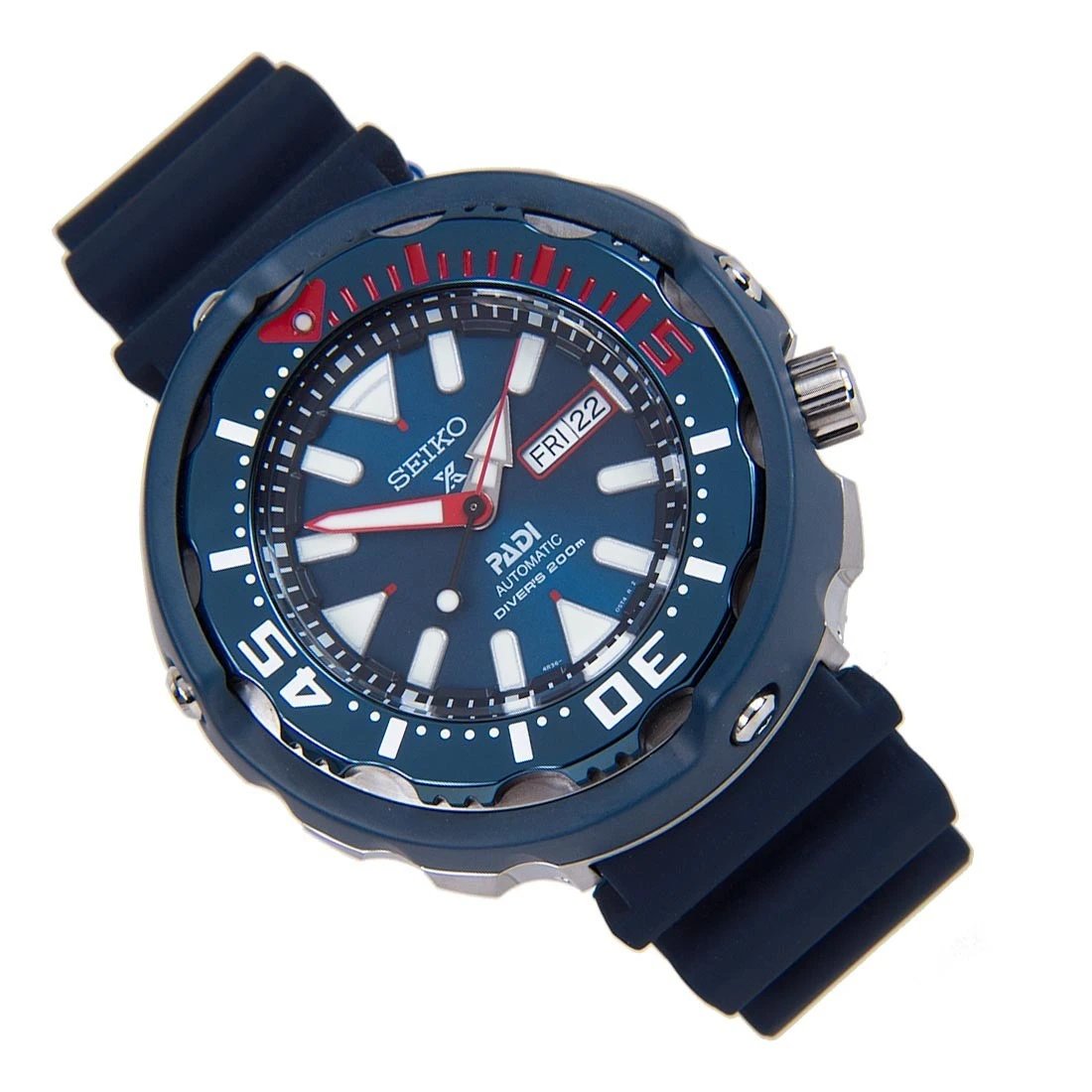
Seiko PADI Monster Tuna Review: A Bold Dive Tool for the Modern Collector
There are watches that blend into the background, and then there are watches that announce themselves with every glance. The Seiko PADI Monster Tuna belongs firmly in the latter camp. It's a timepiece that doesn't just tell time — it makes a statement. For the young collector who wants a dive watch with real horological roots, a splash of color, and a price tag that won't cause palpitations, the Monster Tuna is a compelling option.
Heritage and Evolution
Seiko's dive watch legacy dates back to 1965 with the 62MAS, but the Tuna silhouette emerged in 1975 with the 6159-7010, featuring a quartz movement and a protective shroud. That shroud was designed to protect the movement from impacts and pressure changes, and it became an iconic look. The Monster, introduced in 2001, brought a more aggressive, angular case design with bold hands and markers. The PADI Monster Tuna fuses these two DNA strands into a single, striking package.
The PADI collaboration adds a layer of authenticity — PADI is the world's leading scuba diving training organization, and their endorsement is a badge of honor for any dive watch. The blue dial and red bezel accents are straight from the PADI color palette, making this a piece that resonates with divers and non-divers alike.
Movement: The Reliable Workhorse
Inside the 42.7mm stainless steel case beats the Caliber 4R36, a movement that has become the backbone of Seiko's mid-range automatic line. Introduced in 2011, it's a 24-jewel, 21,600 vph (3 Hz) movement with hacking and hand-winding capabilities. It offers a 41-hour power reserve, which is decent for a movement in this class. While it lacks the finishing and precision of higher-end calibers like the 6R35, the 4R36 is known for its robustness and ease of service. It's a movement that can take a beating and keep ticking, which is exactly what you want in a dive watch.
In practice, the 4R36 performs admirably. My test unit ran consistently at around +7 seconds per day, well within Seiko's official tolerance of -20 to +40 seconds. That's not COSC territory, but for a tool watch, it's more than adequate. The date function is practical, and the quick-set date works smoothly.
Design and Build
The Monster Tuna is a study in purposeful design. The case is a blend of brushed and polished surfaces, with the signature shroud covering the bezel. The shroud is made of stainless steel and adds a layer of protection, but it also gives the watch its distinctive appearance. The bezel is unidirectional with a 60-minute scale, and the action is crisp and satisfying — no wobble, just solid clicks. The blue and red inlay is eye-catching and matches the PADI branding on the dial.
The dial itself is a deep blue with a sunburst finish that plays with light. Applied index markers are filled with Seiko's Lumibrite, which glows brightly after a few minutes in the sun. The hands are chunky and easy to read, with the minute hand reaching the minute track for precise time reading. The date window at 3 o'clock is framed nicely, though some might wish for a cyclops. The PADI logo sits above 6 o'clock, adding a touch of color without overwhelming the design.
The crystal is Hardlex, Seiko's proprietary hardened mineral glass. It's scratch-resistant but not as hard as sapphire. If you're rough on your watches, you might want to consider a sapphire upgrade, but for most daily wear, Hardlex holds up fine. The caseback is solid steel with a simple engraving, keeping the watch's water resistance intact.
The bracelet is a three-link design with a fold-over clasp and a safety lock. It's solidly built, but the clasp feels a bit tinny compared to the rest of the watch. The bracelet has a standard taper and is comfortable on the wrist. If you prefer, you can swap it for a NATO or rubber strap — the 20mm lug width is standard.
Wearing the Monster Tuna
On the wrist, the Monster Tuna is a presence. The 42.7mm case diameter is manageable, but the shroud makes it look larger. The lug-to-lug is 48.5mm, which is surprisingly compact, so it doesn't overhang on average wrists. The thickness of 13.4mm is reasonable for a dive watch, and the curved caseback helps it sit flat against the wrist.
Weight-wise, it's substantial but not heavy. You'll notice it, but it won't fatigue you. The bracelet is well-balanced, and the clasp, while basic, holds securely. I wore it for a full day of activities, including swimming, and it never felt uncomfortable. The 200m water resistance means you can take it anywhere — from the office to the ocean.
The lume is outstanding. Lumibrite absorbs light quickly and glows for hours. In low light, the hands and markers are legible at a glance. This is a watch that's built to be read in the dark.
Accuracy and Reliability
As mentioned, the 4R36 is a solid performer. Over a week of varied wear, my sample stayed within +10 seconds per day. It's not a chronometer, but it's consistent. If you're a stickler for accuracy, you could regulate it, but most owners will be perfectly happy with the performance.
The power reserve of 41 hours is enough to last through a weekend if you take it off on Friday evening. It's not a 72-hour monster, but it's practical.
Versatility and Occasions
The Monster Tuna is not a dress watch. It's a tool watch, and it looks the part. It shines in casual settings, at the beach, on a hiking trail, or at a casual dinner. It's not going to work with a tuxedo, but that's not its job. The PADI colors add a sporty vibe that pairs well with jeans and a t-shirt. If you're a diver, it's a legitimate piece of equipment. If you're not, it's a stylish conversation starter.
For daily wear, it's robust enough to handle whatever you throw at it. The Hardlex crystal will pick up scratches over time, but that adds character. Many owners embrace the patina.
Value and Investment
At an MSRP of $525, the Monster Tuna offers excellent value. You're getting a proven automatic movement, 200m water resistance, and a design that's instantly recognizable. The secondary market is stable, with pre-owned examples selling for $400-$500. It's not a limited edition, so don't expect appreciation, but it holds its value well. This is a watch to buy because you love it, not because it'll make you money.
Service intervals are typically every 5 years, and a basic overhaul will cost around $200 if you go to an independent watchmaker. Seiko movements are easy to work on, so you have options.
Pros and Cons
Pros: The PADI styling is distinctive and fun. The 4R36 movement is reliable and easy to service. The lume is fantastic. The watch is comfortable despite its size. The price is reasonable for what you get.
Cons: The Hardlex crystal is not as scratch-resistant as sapphire. The bracelet clasp feels cheap. The watch wears large and might overwhelm smaller wrists. The movement accuracy is not chronometer-grade.
Final Verdict
The Seiko PADI Monster Tuna is a fantastic dive watch that delivers on all fronts. It's rugged, stylish, and affordable. It has a rich heritage, a reliable movement, and a design that stands out in a sea of black divers. If you're looking for a daily beater that can handle the elements and look good doing it, this is a top pick. Just be prepared for the size and the inevitable scratches that add character.
Whether you're a seasoned diver or a landlocked enthusiast, the Monster Tuna is a watch that deserves a spot in your collection. It's a tool, a statement, and a joy to wear.