Seiko Presage: The Blue Moon and the Case for the Honest Dress Watch
There is a particular kind of watch enthusiast who arrives at the Seiko Presage after a long and slightly embarrassed detour. They have owned the diver. They have owned the chronograph. They have read enough about movement finishing to be mildly insufferable about it. And then, somewhere in their late twenties, they need a watch to wear to a wedding, a client meeting, a dinner that requires a jacket — and they discover that everything in the obvious price bracket is either a fashion object with a quartz heart or a mechanical watch designed to look expensive rather than to be good.
The Presage sits in that gap. It is not marketed as a luxury object and does not pretend to be one. It is a mechanical dress watch made by a company that has been manufacturing its own movements since 1913, finished to a standard that is frankly unreasonable for the money, and priced so that owning one does not require a justification speech.
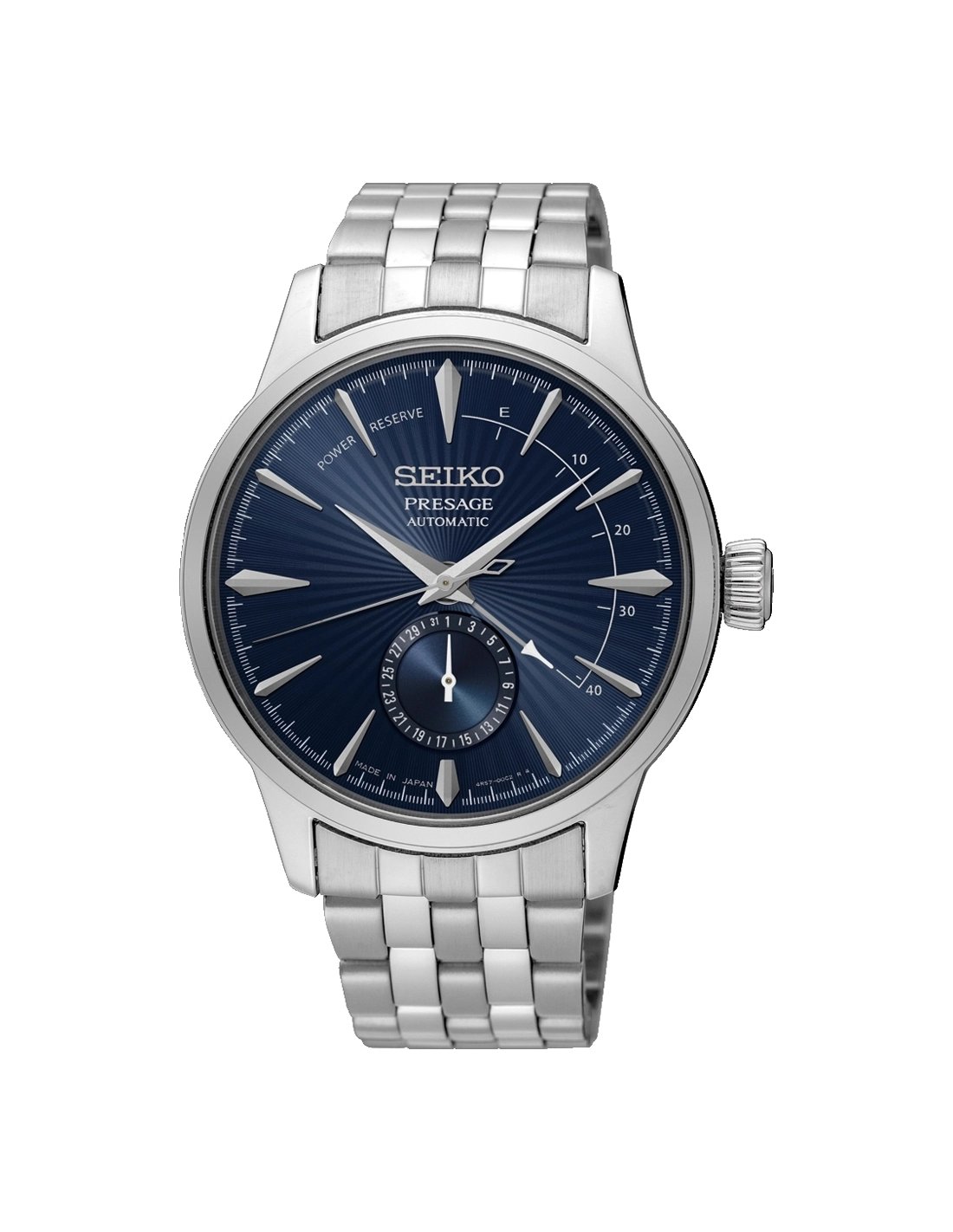
This review takes the SRPB41J1 — the "Blue Moon" Cocktail Time — as its anchor. It is the reference that built the modern Presage audience, and it remains the clearest statement of what the collection is for.
A Brief History of the Presage Name
Seiko's history is unusually long and unusually self-contained. Kintarō Hattori opened a watch and clock shop in Tokyo in 1881; the company produced Japan's first wristwatch, the Laurel, in 1913, and has never depended on an outside movement supplier since. That vertical integration is the quiet engine behind everything the Presage does. When Seiko decides to put a stamped, gradient-lacquered dial on a watch that sells for four hundred dollars, it is not absorbing the cost against a Swiss movement purchase — it is making the dial and the movement in the same house.
The Presage name itself was formalised as a global collection in 2016. Before that, Seiko's better dress watches lived under a tangle of domestic reference prefixes — SARB, SARY, SARX — that meant nothing to buyers outside Japan. The consolidation pulled those watches into a single identifiable family and gave them a coherent identity built around two ideas: Japanese dial craft, and mechanical simplicity.
The Cocktail Time sub-family predates the rebrand. The original SARB065 launched in 2010 as a Japan-only model, designed in collaboration with Shinobu Ishigami, the bartender behind Bar Ishigami in Ginza. The brief was a dial that evoked a cocktail glass under bar lighting — a gradient that darkens at the edges and glows at the centre. It became a cult object through grey-market imports and forum photography, and when Presage went global, the Cocktail Time came with it.
The Dial: Why Anyone Cares
Everything about the SRPB41 is a support system for the dial, and the dial justifies it. The Blue Moon is a deep, saturated blue that shifts across its surface — near-black at the chapter ring, lifting to something closer to cobalt where the light hits the centre. Beneath the colour sits a stamped radial texture, fine lines radiating from the hand stack outward, that catches light in a way flat lacquer simply cannot. It is the same trick Grand Seiko uses on its more sculptural dials, executed with less subtlety and a fraction of the budget.
The furniture is restrained: applied baton indices, polished dauphine hands, a framed date aperture at three o'clock. There is no lume, correctly — a dress watch with glowing hands is a contradiction. The printing is crisp, the date disc is colour-matched reasonably well, and the overall composition has the kind of balance that only comes from someone making a decision rather than adding an element.
It is worth saying plainly: at this price, no other manufacturer is doing this. Swiss brands at four hundred dollars give you a sunburst stamping and a printed logo. Seiko gives you a dial with depth.
Case and Crystal
The case is stainless steel, 40.5mm across and 11.8mm thick, with a mix of brushed surfaces and polished flanks that reads as more expensive than it is. The bezel is slim, the dial aperture correspondingly large, and the effect is a watch that presents as a dress piece rather than a sports watch wearing a jacket. The crown is small and unsigned-by-necessity, sitting slightly recessed — unobtrusive, though not the easiest to grip.
The crystal is Hardlex, Seiko's hardened mineral glass. This is the most consequential cost decision in the watch, and it is worth being honest about it. Hardlex is more scratch-resistant than standard mineral glass but will not resist the way sapphire does. Wear this daily for three years and you will find hairlines. They are usually only visible at an angle in direct light, and the crystal can be polished or replaced cheaply — but if sapphire is a hard requirement, this watch will not satisfy you, and no amount of dial quality changes that.
Water resistance is rated at 50 metres, which in practice means splash-resistant. Wash your hands in it; do not swim in it. The caseback is closed, which suits the watch's purpose — there is nothing decorative waiting to be seen.
The Movement: Calibre 4R35
The 4R35 is Seiko's mid-tier workhorse, derived from the 6R15 family that has powered everything from JDM dress watches to entry-level Prospex divers. It is an automatic with 23 jewels, beating at 21,600 vibrations per hour — three hertz, six beats per second — with a power reserve of around 41 hours. It hacks, it hand-winds, and it is built entirely in-house.
Technically, the interesting parts are the ones Seiko rarely advertises. The Magic Lever winding system uses a pair of pawls to capture rotor energy in both directions, which is both efficient and elegantly simple — fewer parts, less to wear. The mainspring is Spron alloy, Seiko's own cobalt-nickel formulation chosen for fatigue resistance. Diashock protects the balance pivots. None of this is exotic; all of it is proven, and the sheer volume of 4R-family movements in service worldwide means parts and expertise are everywhere.
Finishing is industrial: brushed plates, a plain rotor, no anglage or perlage worth discussing. That is the correct trade at this price. Seiko has spent the money where you can see it — on the dial — rather than where you cannot. A buyer who wants to admire a movement should save for a different watch. A buyer who wants a movement that will run for twenty years with minimal fuss is in exactly the right place.
On the Wrist
The SRPB41 wears beautifully, and largely because Seiko resisted the temptation to make it large. At 40.5mm with a slim bezel it reads as a full-dial watch, but the case is only 11.8mm thick and the lugs curve down and away rather than projecting outward. It sits flat and close, tucks under a shirt cuff without a fight, and disappears in the way a dress watch should. On a 6.5-inch wrist it is close to ideal; on a 7.5-inch wrist it is still perfectly proportionate, which is a narrower window than most modern cases manage.
The one component that lets the side down is the strap. Seiko's supplied leather is stiff, slightly synthetic in feel, and visually thinner than the case deserves. It is not a defect so much as a placeholder — the watch is transformed by a decent grained calf or shell cordovan, and most owners make that change early. Budget for it when you buy; it is the single best money you will spend on this watch.
Accuracy and Daily Ownership
Seiko rates the 4R35 at −35 to +45 seconds per day. That specification is honest and slightly alarming; the real-world picture is kinder. Most examples settle somewhere within ±15 seconds per day once they have been worn regularly for a few weeks, and many do meaningfully better. The variance between individual movements is real, so buying from a dealer who will let you return an outlier is sensible.
In practice, ownership means setting the watch every few days, or simply accepting that it will drift by a minute across a week. Because the movement hacks, precise setting is straightforward. Because it hand-winds, you can bring it back to life after a weekend in a drawer without shaking your wrist like a fool. This is the level of mechanical engagement that suits a first serious watch: enough to be interesting, not so much that it becomes a chore.
The Wider Presage Family
The Cocktail Time is the entry point, but the Presage catalogue is deliberately broad, and it is worth understanding what sits above the SRPB41 before committing.
The Sharp Edged series moves the collection toward everyday wear: a distinctively faceted case, sapphire crystal, 100 metres of water resistance, and the 6R35 movement with its 70-hour power reserve and 24 jewels. Same 21,600 vph beat rate, considerably more capability, and a price roughly double the Cocktail Time.
The Craftsmanship series is where Presage becomes genuinely serious. Enamel dials made with Japanese artisans, urushi lacquer, Arita porcelain, Shippo enamel — applied by hand, in small numbers, on movements including the 6R27 with its power-reserve indicator. These are the watches that make the argument that Japanese dial craft belongs in the same conversation as anything made in Switzerland.
Between those poles sit dozens of Cocktail Time variants — different dial colours, gradients, textures, and limited editions — plus the Style60s and other retro-inflected lines. The practical advice is simple: buy the dial you cannot stop looking at. The movement underneath will be broadly the same.
Service and Long-Term Ownership
The 4R35 is one of the easiest movements in the world to live with. Seiko's own service network is inexpensive and reliable, and virtually any competent independent watchmaker can service the calibre without drama. A realistic interval is five years of regular wear, with a service cost in the region of a couple of hundred dollars — often less if the movement is simply exchanged rather than rebuilt. That is a fraction of what a Swiss automatic in the same price band will cost to maintain, and it materially changes the ownership arithmetic.
Value, Resale, and the Honest Calculation
New, the SRPB41 sits in the region of five hundred dollars. Pre-owned, clean examples trade closer to a quarter of that, which tells you everything you need to know about the depreciation curve: it is steep on day one and then essentially flat. Seiko does not have the scarcity mechanics to sustain resale value, and the grey market keeps new prices honest.
This is not a flaw. It means the watch is an unusually low-risk purchase. Buy it pre-owned and you will likely sell it for what you paid. Buy it new and you have bought a decade of daily pleasure for the price of a mediocre weekend away. The Presage is best understood as a consumer good in the most respectable sense — something well made, fairly priced, and intended to be used.
Against its obvious rivals — the Tissot Le Locle, the Orient Star Classic, the Hamilton Jazzmaster — the Seiko wins on dial, loses slightly on crystal, and holds its own on movement. Against the homages and budget alternatives below it, the gap in finishing is wide enough to justify the step up.
Verdict
The Seiko Presage SRPB41 is the watch I recommend to anyone who asks what to buy first. Not because it is perfect — the Hardlex crystal and the disposable-feeling strap are real compromises — but because it teaches the correct lesson. It demonstrates that a dial can be an object of craft, that an in-house movement need not be a luxury, and that a watch can be genuinely refined without being precious about itself.
Wear it to a wedding. Wear it to a meeting where you want to be taken seriously without being noticed. Change the strap, accept the scratches, and enjoy the fact that the most interesting thing on your wrist cost less than a decent suit. That is a rare and quietly subversive pleasure, and the Presage delivers it better than anything else at the price.