Sixty Years From the Suwa Workshop
There is a temptation, when a brand announces an anniversary diver, to reach for the language of nostalgia. Seiko resists it better than most. The 1965 62MAS was never a glamorous object — it was a working instrument designed for saturation divers and coastal engineers, with a rotating bezel you could read with gloved hands and a dial that prioritised contrast over decoration. The Prospex 60th Anniversary Diver inherits that disposition almost entirely intact.
What the anniversary edition represents, then, is not a reissue but a consolidation. Seiko has spent the last several years refining its 62MAS modern re-interpretation family, and this watch is the point at which the case design, the dial architecture and the movement finally line up without compromise. The headline change is the Caliber 6R55, which replaces the 6R35 and pushes the power reserve from 70 to 72 hours. It is a small number on paper and a meaningful one in practice.
Case Architecture: Restraint as a Design Language
The case is stainless steel, and its geometry is the most interesting thing about it. The 62MAS silhouette is defined by a caseband that tapers inward toward the caseback, with lugs that curve downward rather than projecting horizontally. The effect is that the watch sits into the wrist rather than on top of it — a distinction that sounds academic until you have worn a top-heavy diver for a full day.
The bezel is unidirectional, as a dive bezel should be, with a coin-edge grip that is aggressive enough to turn with wet fingers and refined enough not to shred a shirt cuff. Detents are clean and there is very little rotational backplay, which is one of the areas where Seiko has quietly improved over the last generation of Prospex divers. The bezel insert is aluminium on this reference rather than ceramic — a deliberate choice that keeps the watch closer to its 1965 ancestor and produces a warmer, less glassy reflection in daylight.
The crystal is sapphire with anti-reflective coating applied to the inner surface, which is Seiko's standard approach and a sensible one: the coating cannot be scratched off, and the dial remains readable in flat light without the blue haze that outer coatings can produce. Water resistance is rated to 200 metres, which is the correct figure for a watch in this family and more than sufficient for any recreational diving most owners will ever attempt.
Dial and Lume: Legibility as Doctrine
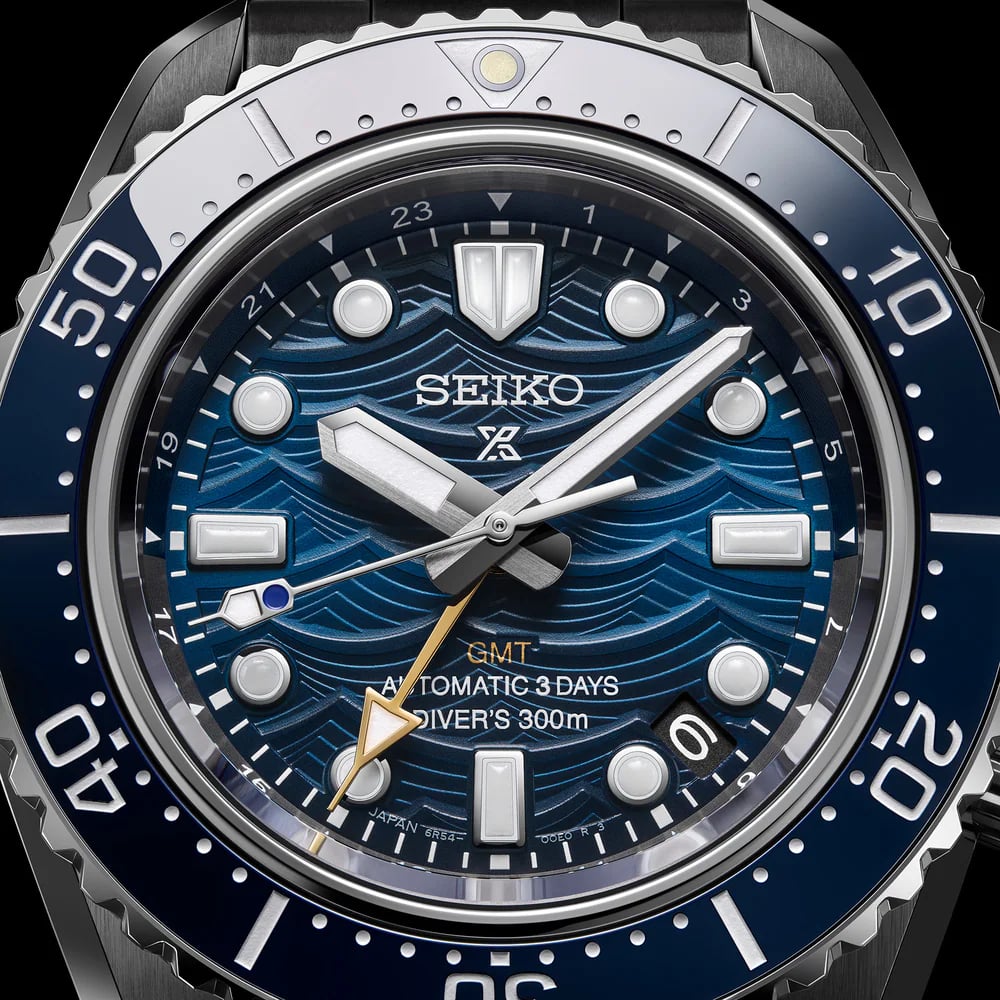
The dial is a blue-grey that shifts between slate and steel depending on the light — muted enough to read as a tool watch, complex enough to hold attention across a desk. Applied indices are faceted and filled with Lumibrite, and the hands are the classic broad sword-and-arrow arrangement that the 62MAS lineage has used for decades. There is a date window at three o'clock, framed cleanly and matched in tone to the dial, which is the only concession to convenience on an otherwise single-minded face.
Lumibrite performance is excellent, as it tends to be on Seiko's professional divers. Charge the watch under a lamp for a minute and the indices and hands will remain legible through a full night, with the bezel pip holding its own alongside them. It is not the brightest lume on the market in absolute terms, but it is consistent, and consistency is what matters when you are actually using a dive watch rather than photographing one.
The caseback is solid and screw-down, engraved with the anniversary inscription and the individual limited-edition number. Seiko has resisted the urge to fit a display back here, which is the right call: the 6R55 is a robust, industrially finished movement, and there is nothing behind the caseback that benefits from being looked at.
The Caliber 6R55
The 6R55 is an automatic movement running at 21,600 vibrations per hour — three hertz — with 24 jewels and a 72-hour power reserve. It is an evolution of the 6R35, and the architecture will be familiar to anyone who has owned a modern Prospex: a conventional lever escapement, Seiko's Magic Lever bidirectional winding system, and a single mainspring barrel sized to deliver the extended reserve.
Finishing is functional. Bridges are brushed, the rotor is signed, and there is no anglage or perlage to speak of. This is not a criticism so much as a description of the design brief: the 6R family exists to be reliable, serviceable and affordable, and it succeeds at all three. The Magic Lever system in particular is one of the most efficient automatic winding mechanisms in production, which means the watch reaches full wind quickly from modest wrist movement — a real advantage for anyone who splits time between a desk and a dive boat.
The 72-hour reserve is the practical headline. It means the watch can come off on a Friday evening and still be running on Monday morning, which eliminates the ritual of resetting and rewinding that plagues shorter-reserve automatics. It also means the movement spends more of its life at lower amplitude, which is the trade-off: a long reserve is achieved with a longer, thinner mainspring, and the torque curve is less flat than on a shorter-reserve caliber.
On the Wrist
The 62MAS case shape is one of the most successful in Seiko's modern catalogue, and the anniversary model benefits from every iteration that preceded it. The lugs curve away from the caseband steeply enough that the watch hugs the wrist, and the flat caseback prevents the rocking motion that domed backs can introduce during extended wear. On a medium wrist the watch reads as compact and purposeful; on a larger wrist it reads as restrained rather than small.
The bracelet is a three-link stainless steel design with alternating brushed and polished surfaces — brushed on the outer links, a narrow polished chamfer on the centre link. It articulates well, particularly at the clasp end, which keeps the head centred on the wrist throughout the day. The folding clasp uses a push-button release with a dive extension, and while the stamped inner clasp is not the most refined piece of hardware in the segment, it is entirely functional and easy to adjust.
Weight distribution is the standout quality. The watch feels dense without feeling heavy, because the mass sits low against the wrist rather than projecting upward from it. That is the difference between a diver you wear occasionally and one you wear constantly, and it is the reason this watch works as a daily wearer in a way that thicker, more top-heavy dive watches do not.
Accuracy in the Real World
Seiko rates the 6R family at approximately −15 to +25 seconds per day, and buyers should take that seriously rather than treating it as a formality. Out of the box, most examples of the 6R55 will land somewhere inside that band, and after a few weeks of consistent wear the rate typically settles — often into the region of +5 to +12 seconds per day, with clear positional variation between dial-up and crown-down resting positions.
The 72-hour reserve introduces a wrinkle worth understanding. As the mainspring unwinds, amplitude falls, and a watch that is running +6 seconds per day at full wind may drift toward +10 or more in the final stretch of its reserve. This is normal behaviour for a long-reserve movement at this price point, and it is easily corrected by keeping the watch on a winder or simply wearing it consistently. Regulation is straightforward for any competent watchmaker, and there is no chronometer certification inflating the price.
The Anniversary Context
The 60th Anniversary Diver is a limited edition of 6,000 pieces, which is a large enough run that availability will not be a genuine problem for most buyers, but small enough that the watch will disappear from dealers within a season. Seiko has released it alongside a higher-grade 62MAS re-creation powered by the 8L35, positioned at a substantially higher price and aimed at collectors who want the movement architecture as much as the case design.
For most buyers, the 6R55 model is the more sensible proposition. The 8L35 is a better-finished movement with a superior rate, but it does not change the essential character of the watch, and the difference in price is substantial. The anniversary edition delivers the same case, the same dial philosophy and a movement with a longer power reserve than the 8L35 offers.
How It Compares
Against the Tudor Black Bay 58, the Seiko gives up finishing refinement and brand cachet but holds its own on case design and beats the Tudor on power reserve. Against the Oris Divers Sixty-Five, it offers a more sophisticated bracelet and a more purposeful bezel action. Against the Omega Seamaster Diver 300M, it is a step down in movement technology and a significant step down in price — and for many buyers that trade is the right one.
The more interesting comparison is internal. The standard 62MAS modern re-interpretation is already an excellent watch, and the anniversary edition's advantages come down to the movement, the limited-edition caseback and the dial treatment. If those specifics matter to you, the premium is justified. If they do not, the standard reference is the better value.
Value and Ownership
At an MSRP in the region of $1,350, the anniversary diver sits at the upper end of what Seiko charges for a 6R-powered Prospex, and the premium over the standard model is modest. On the secondary market these watches trade in a band that roughly tracks retail, with limited-edition status providing a floor rather than a ceiling. This is not a watch to buy as an investment; it is a watch to buy because you intend to wear it for a decade.
Servicing is straightforward. Seiko does not publish a fixed interval for the 6R family, and most owners service on condition — typically somewhere between five and eight years. Independent watchmakers can handle a 6R55 overhaul more cheaply than a Seiko service centre, and parts availability is good.
Verdict
The Prospex 60th Anniversary Diver is the most complete expression of the modern 62MAS idea Seiko has produced. It pairs a genuinely useful 72-hour movement with a case that disappears on the wrist, a dial that reads in any light and a bezel that behaves the way a dive bezel should. It is not the most accurate watch at its price, and it is not the most finely finished.
What it is, instead, is a tool watch with sixty years of design discipline behind it — one that asks nothing of you beyond winding it occasionally and wearing it often. For a diver, that is the highest compliment available.