The Short Version
Serica does not do hype cycles. There's no waiting list, no limited-edition countdown, no Instagram drop designed to make you feel late. The Paris brand sells watches, explains them plainly, and ships them. The Diving Chronometer Date, reference 5330, is the most grown-up thing the brand has made: a compact steel diver with a Swiss automatic movement certified by COSC, a date window at the practical position, and a price that stays on the right side of two thousand dollars.
That's the pitch. The reality is more interesting, because the 5330 is not simply a 5303 with a certificate rubber-banded to the box. It's the model where Serica stopped being a very good field-watch company and started being a watch company.
Serica, In Context
Serica was founded in 2019 by Jérôme Burgert and Gabriel Vachette, working out of Paris with Swiss movements and a direct-to-consumer model. The 4512 field watch was the opening statement — a compact, thin, beautifully proportioned thing that looked like it had been designed by someone who had studied mid-century military watches and then decided not to copy one.
The 5303 dive watch, which followed, is where the brand found its audience. It was a skin diver in the true sense: a watch built for water but proportioned for a shirt cuff, with a domed sapphire, a matte dial, and none of the aggressive bezel knurling that turns so many modern divers into wrist furniture. Collectors noticed because the design held together. There were no orphaned details, no borrowed lugs, no dial text shouting at you about depth ratings.
The 5330 takes that foundation and adds two things the market kept asking for: chronometer certification and a date. It's the least romantic upgrade imaginable and, for a daily wearer, the most useful one.
On The Wrist
The first thing you notice is that Serica understands proportion. The 5330's case is compact and softly faceted, with lugs that curve away from the wrist quickly rather than extending straight out and leaving a gap under the caseband. That curvature is what makes the difference between a dive watch that sits and a dive watch that teeters. On a medium wrist it settles into place immediately, and the low-slung bezel means it slides under a jacket cuff without the usual tug-of-war.
Weight is another quiet win. Steel is steel, but a compact case on a rubber strap distributes mass close to the wrist, so the watch never announces itself with a swing when you gesture. This is a watch you put on in the morning and stop thinking about — which, for a tool watch, is the highest compliment available.
The rubber strap deserves its own paragraph. Plenty of brands treat rubber as a cost-saving afterthought, a slab of material with a buckle riveted to it. Serica's is soft, pliable from the first wear, and shaped so the keeper sits flush rather than sliding around. The pin buckle is the right call here — a deployant on a dive strap adds bulk exactly where you don't want it. If you want to dress the 5330 up, Serica's Bonklip bracelet is the obvious move; it transforms the watch into something closer to a 1960s skin diver and gives you a second personality for the price of an accessory.
Dial, Bezel And Legibility
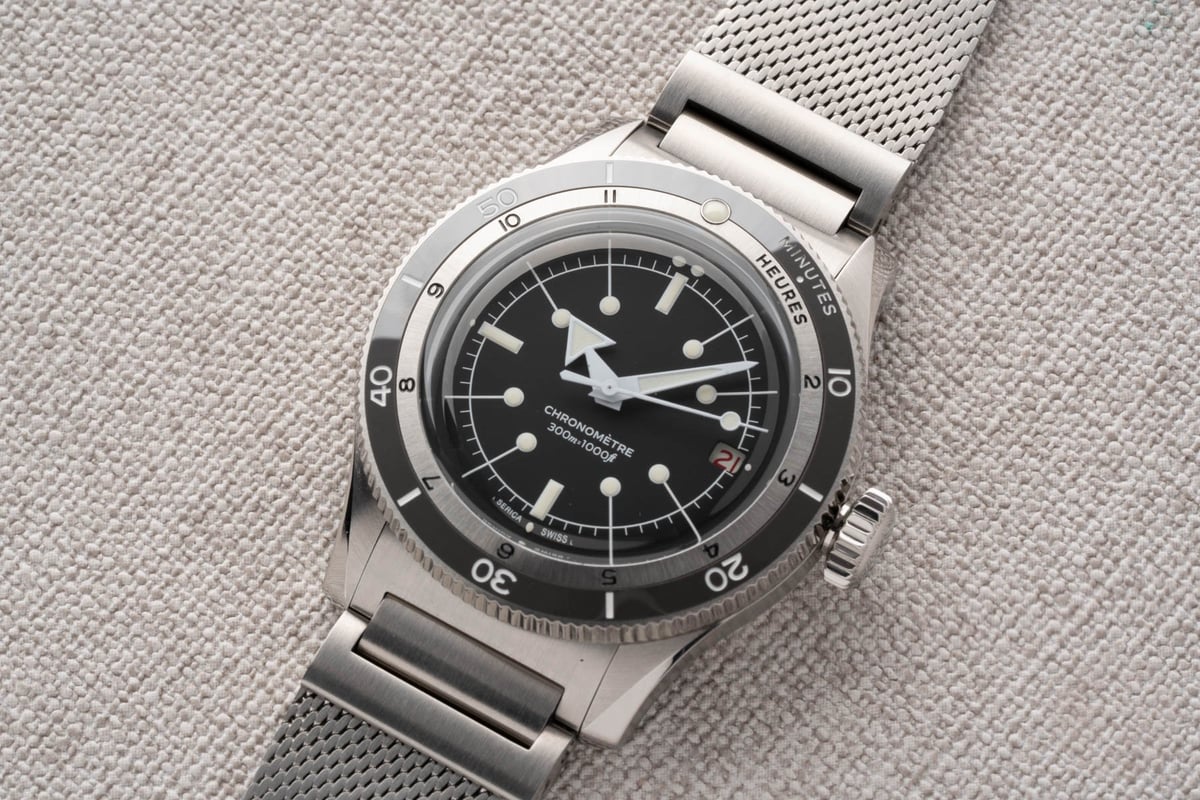
Serica's dial design is restrained to the point of stubbornness. Matte surface, applied markers, a thin chapter of printing and nothing else. There's no paragraph of text, no depth rating in six typefaces, no red accent line pretending to be a racing pedigree. What you get is legibility, which is the entire job.
The bezel is the part that separates a real dive watch from a diver-shaped watch. It's firm without being a two-handed operation, the grip is machined rather than decorative, and the alignment is clean — a detail that shouldn't need mentioning at this price and yet routinely does. The lume is Super-LumiNova, applied generously to the markers and hands, and it does what lume is supposed to do: charge quickly and stay readable through the small hours without glowing like a nightlight.
The sapphire crystal is domed, which gives the dial a warm, slightly vintage distortion at the edges and — more practically — means the bezel doesn't have to be tall to protect it. It's the kind of decision that reads as aesthetic but is actually structural.
The Date Question
Purists will complain, because purists always complain, but the date is the reason this reference exists. The window sits in a position that doesn't chop a marker in half, the disc matches the dial, and the aperture is small enough that it doesn't become the first thing your eye lands on. It's a functional addition that doesn't cost the dial its symmetry.
The honest argument against it is that a dive watch is a tool with one job, and a date is a second job. The honest argument for it is that most people reading this will wear the 5330 to work, to dinner and to the airport, and will use the date far more often than they use the bezel. Serica made the daily-wear call, and it made it well.
Movement: Soprod Newton, Certified
Under the solid caseback sits a Soprod Newton, a Swiss automatic running at 28,800 vibrations per hour with roughly 42 hours of power reserve. In the 5330 it's supplied COSC-certified, which means each movement is tested across positions and temperatures to a standard of -4 to +6 seconds per day. That certification is the entire reason the word "Chronometer" appears on the dial, and it's a meaningful upgrade over an uncertified ébauche — not because COSC magically makes a movement accurate, but because it forces a baseline of regulation and gives you a paper trail.
What you don't get is decoration. The Soprod is an industrial Swiss calibre — reliable, serviceable, well understood by watchmakers — and Serica has chosen to close the case rather than fit a display back and charge you for finishing you'd look at twice. That's a defensible trade at this price. It also keeps the case profile lower.
In daily wear, the practical story is boring in the best way. Wind it, set it, wear it. Expect single-digit deviation. Leave it in a drawer for a week and you'll be resetting it anyway, which means the accuracy conversation matters less than the reliability conversation — and the Soprod base has a long track record on that front.
Who It's Actually For
Serica's customer is not the person buying their first nice watch. It's the person who already owns the obvious things — the Submariner, the Speedmaster, the Black Bay — and has started caring more about how a watch was designed than how it was marketed. That collector has watched the independent space fill up with Kickstarter brands selling renders and pre-orders, and has developed a finely tuned allergy to it.
The 5330 is the antidote to that allergy. It's a watch from a small brand that behaves like a serious one: consistent design language, stated specifications, a real service path, no artificial scarcity. Wearing one signals you did the reading. In a room full of dive watches, it's the one that starts a conversation rather than ending one — and it starts it with the person who actually knows what they're looking at.
It's also a genuinely good travel watch. The date, the legibility, the bezel you can use as a crude second time zone, the ability to survive a pool or a swim without a second thought — this is the watch you take when you're only taking one. That's not a glamorous role, but it's the role most watches actually play.
Value And The Secondary Market
At a retail price in the high four figures' low end — comfortably under two thousand dollars — the 5330 sits in a strange, enviable spot. Above it are the Swiss heritage divers with dealer networks and decades of brand equity. Below it is a wall of spec-sheet warriors with ceramic bezels and 300-metre claims and no design authorship whatsoever. Serica occupies the narrow band where the movement is Swiss, the certification is real, the design is original, and the price hasn't been inflated to pay for a boutique in a mall.
Secondary market reality is more sobering. Serica's direct model and steady production mean there's no scarcity premium, and liquidity is thin — you'll wait longer to sell one than you would a Tudor, and you'll take a haircut on the way out. Pre-owned examples trade below retail, as they should. But the brand's reputation for design integrity has kept residuals from doing what generic microbrand divers do, which is fall off a cliff the moment the next Kickstarter darling launches. This is a stable watch, not an appreciating one.
Which is the correct way to think about it. Buy the 5330 because it's the watch you'll wear four days out of five. Not because it's a store of value. Nothing at this price is.
Service And Ownership
Serica handles service through its own network, and the Soprod base means that once you're out of warranty, a competent independent watchmaker can take it on without needing a parts pipeline from Switzerland. That matters more than people admit: watches at this price live or die on whether they can be maintained in ten years, and a familiar Swiss ébauche is a genuine advantage over an in-house calibre nobody has seen before.
The solid caseback also helps, in a small way — fewer entry points, less to go wrong, and no gasket gymnastics every time a watchmaker opens a display back.
What Else To Consider
The Tudor Black Bay 54 is the obvious benchmark for a compact vintage-leaning diver and costs roughly twice as much, which tells you most of what you need to know about how Serica is priced. The Oris Divers Sixty-Five is the established Swiss alternative with a dealer network and a similar brief. The Longines HydroConquest gives you ceramic and a bracelet if that's what you're after. The Christopher Ward C60 Trident Pro 300 remains the spec-per-dollar champion, and the Baltic Aquascaphe is the closest thing to a design sibling from another small European brand.
None of them is a better watch in the abstract. They're different answers to the same question, and Serica's answer — restraint, certification, proportion, no theatre — is the most quietly confident of the group.
The Verdict
The Serica Diving Chronometer Date is the rare upgrade that improves the watch rather than the brochure. Certification and a date are unglamorous additions, but they're the ones that make a watch wearable every day for a decade, and Serica has added them without bloating the case, cluttering the dial, or padding the price.
It won't impress anyone at a dinner party who reads logos for a living. It will impress the person sitting next to them who knows what a Soprod is and why COSC matters. That's a smaller audience, and a better one. Buy it as your one watch, wear it hard, and let the bezel collect the scratches that prove you actually used it.