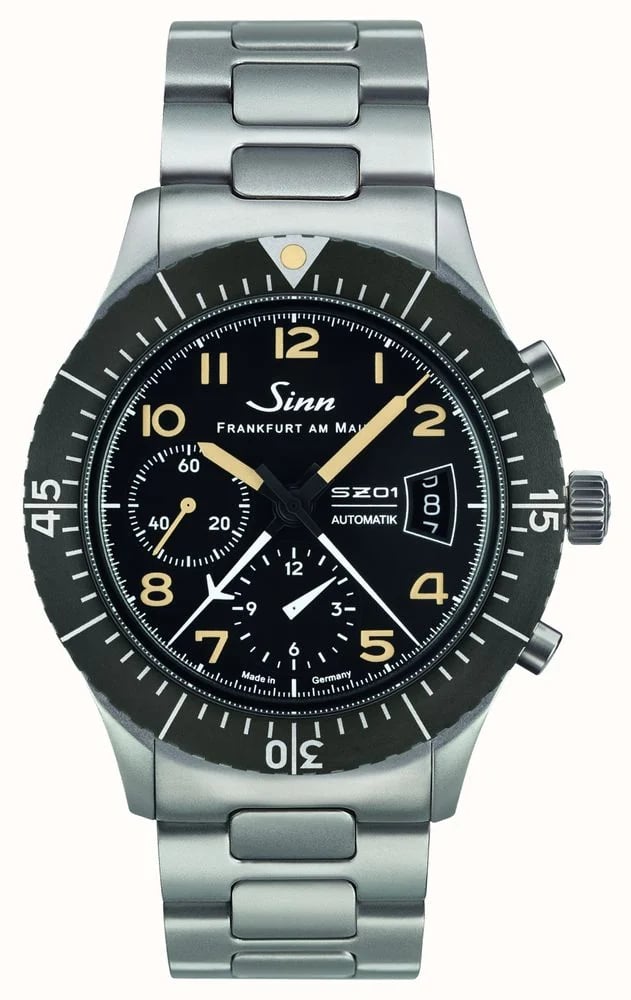
There is a particular kind of watch that rewards the second look — the one that does not shout, does not sparkle, and does not try to be a piece of jewellery. The Sinn 156 is that watch. It is a German pilot's chronograph built around a matte black dial, a hand-wound Valjoux movement, and a single organising principle: you should be able to read it at a glance, in bad light, without thinking.
The Short Version
I spent a week with the 156 as my only watch. It handled desk work, commutes, a dinner out, and a weekend of errands without once feeling like the wrong choice. It is not a precious object, and that is its greatest strength. If you want a chronograph that behaves like an instrument rather than an ornament, keep reading.
Brand and Lineage
Sinn was founded in Frankfurt in 1961 by Helmut Sinn, a pilot and flight instructor who built instruments for people who could not afford for them to fail. That origin story matters here, because the 156 is not a fashion exercise dressed up as a tool watch. It descends directly from the German military pilot-chronograph tradition — the same lineage that produced the legible, high-contrast chronographs issued to aircrew.
That inheritance shows up in everything from the dial layout to the case philosophy. There is no decoration that does not serve a purpose, no flourish that compromises clarity. The 156 is what happens when a brand with aviation in its DNA decides that the job description comes first.
The Dial and Legibility
Legibility is the headline. The matte black dial swallows reflection, the hands stand out cleanly against it, and the chronograph registers are laid out so that elapsed time reads instantly. Nothing is competing for attention. There is no sunburst, no guilloché, no applied logo catching the light at the wrong moment.
In practice this is the most satisfying part of living with the watch. Under office lighting, in a car at dusk, in the flat grey of an overcast morning, the 156 reads the same way every time. You do not have to angle your wrist to find a legible patch of dial. For a daily wearer, that consistency is worth more than any amount of finishing.
The tritium lume is a vintage consideration rather than a modern one. Original luminous material of this age will have aged, and its glow is a shadow of what it once was. That is part of the charm — and part of the reason collectors prize original, untouched dials — but it is not the reason to buy the watch. Buy it for daylight legibility and the pleasure of a clean, functional face.
The Movement
Inside sits a hand-wound Valjoux chronograph, the 7760, a cam-lever design that is robust, well understood, and serviceable by anyone who knows vintage chronographs. It is not a column wheel, and it is not decorated to display standards, but neither of those things matters in a tool watch. What matters is that it works, that it can be maintained, and that parts and expertise exist to keep it running for decades.
Winding it each morning becomes a small ritual — a few turns, a check of the power reserve, and you are set for the day. Some owners find that comforting; others find it a chore. I landed firmly in the first camp. There is something honest about a watch that asks you to participate in keeping it alive.
Accuracy is vintage-mechanical accuracy. A healthy example will typically settle into a consistent daily rate rather than a perfectly precise one, and consistency is the metric that matters. If you are evaluating a prospective purchase, have it timed on a machine and look for a steady beat rather than a single impressive number.
On the Wrist
This is where the 156 quietly wins. It wears close and unobtrusive, and on a leather strap it balances beautifully. The acrylic crystal keeps the visual weight down, the matte dial avoids glare, and the whole package slips under a cuff without fuss. It is not a watch that announces itself across a room, and it is not trying to be.
Comfort, as with any vintage piece, depends on condition. A properly serviced example with fresh seals and a supple strap feels planted and secure on the wrist. A tired example with a stiff, dried-out strap and a sloppy crown will feel like a different watch entirely. This is a reference where you buy the individual watch, not the model.
A Week in Real Life
Monday was desk work and the chronograph stayed parked — as it will for most owners most of the time. Tuesday brought a commute and a lunch meeting, and the 156 read perfectly under restaurant lighting. Midweek I actually used the chronograph to time something, and the pushers felt crisp and mechanical in the way only a hand-wound movement does.
By the weekend it had settled into the rotation as though it had always been there. It paired with a shirt, a jacket, and a plain T-shirt equally well. That versatility is underrated in a tool watch: the 156 is not a one-outfit piece, and it does not look out of place in a casual or semi-formal setting.
Ownership and Servicing
Vintage ownership comes with responsibilities, and the 156 is no exception. It was built as an instrument, not a safe queen, and decades of use take their toll on seals, gaskets, and lubrication. Budget for a service, and choose a watchmaker who genuinely knows vintage Valjoux chronographs rather than one who will simply clean and oil whatever crosses the bench.
Sinn's authorized network is the safest route, but a respected vintage specialist can do excellent work. What you should avoid is buying a cheap example and hoping it will run forever without attention. The 156 rewards proper care with years of dependable service — but it will not forgive neglect.
How It Compares
The obvious comparison is the Heuer Bundeswehr chronograph that set the template for this kind of military pilot watch. The 156 follows that brief closely, and buyers cross-shopping the two will be choosing between provenance and price as much as design. The Heuer carries greater auction gravity; the Sinn often represents better value for the same functional character.
Against modern pilot chronographs from IWC and others, the 156 gives up polish and water resistance in exchange for authenticity and a hand-wound movement you can actually feel working. Against the Omega Speedmaster, it offers a narrower, more specifically German identity and a simpler service story in some markets. None of these watches is objectively better; they answer slightly different questions.
Buying and Value
Buy on condition, originality, and completeness — in that order. A clean, untouched dial with honest wear is worth more than a polished, relumed example with a flashy listing. Ask for movement timing, service history, and detailed photographs of the case and dial before committing. The 156 is not a speculative asset, and it should not be bought as one.
Priced sensibly, it is a lot of watch for the money: genuine military-chronograph lineage, a serviceable hand-wound movement, and a dial that does its job better than most modern designs. The value case is strongest for a collector who intends to wear the watch rather than store it.
The Verdict
The Sinn 156 is not the watch you buy to impress a dinner table. It is the watch you buy because you actually read the time and value clarity over decoration. Its hand-wound Valjoux, matte dial, and honest case make it a superb daily tool chronograph for a collector who understands what vintage ownership entails. Buy the best-conditioned, most original example you can find, budget for a service, and it will reward years of quiet, reliable wear.