Brand context and manufacture history
Sinn was founded in Frankfurt in 1961 and built its reputation on instrument watches, military-style legibility, and pragmatic engineering. The brand is not a heritage house in the traditional Swiss sense. It is a German manufacturer with a strong technical streak, and its collectors tend to value function over fantasy.
The 206 family sits in Sinn's classic chronograph line. That matters because the 206.012 is not a pilot chronograph with oversized Arabic numerals and aggressive lume. It is a more formal interpretation of the chronograph, with a full calendar and moonphase adding old-school complication value. In the Sinn catalog, it occupies a quiet corner: less famous than the 103, less tool-like than the U1, but more complex than the entry-level 556.
For collectors, that positioning is appealing. The 206.012 offers a different flavor of Sinn. It still has the brand's sensible engineering, but it leans toward traditional watchmaking rather than survival gear. It is a watch for the collector who already has a dive watch and a pilot watch, and now wants something with a bit more romance on the dial.
Movement: Valjoux 7751 automatic
The 206.012 is powered by the Valjoux 7751, an automatic integrated chronograph with full calendar and moonphase. This is not an in-house Sinn caliber, and Sinn does not submit it for COSC certification. What it is, however, is a known quantity. The 7751 is based on the long-running 7750 family, which means parts, service knowledge, and real-world reliability are widely available.
The movement runs at 28,800 vibrations per hour and carries 25 jewels. Power reserve is around 48 hours, which is normal for this generation of Valjoux architecture. The chronograph uses a cam-and-lever system rather than a column wheel, so the pusher feel is positive and workmanlike rather than silky. That is not a criticism. It is part of the watch's character.
The full calendar and moonphase add complexity, and that is where the 206.012 earns its keep. A plain chronograph is useful; a chronograph with day, date, month, and moonphase is a more traditional piece of mechanical theatre. The trade-off is service complexity. The 7751 has more parts and more adjustment points than a standard 7750, so routine maintenance should be handled by someone who knows the calendar mechanism.
Case, dial, and specification overview
The 206.012 uses a stainless steel case, a sapphire crystal, and a leather strap with a pin buckle. Those choices fit the watch's classic brief. This is not a bracelet-first sports chronograph, and it is not a dive watch. It is a dressier chronograph with enough Sinn practicality to wear regularly.
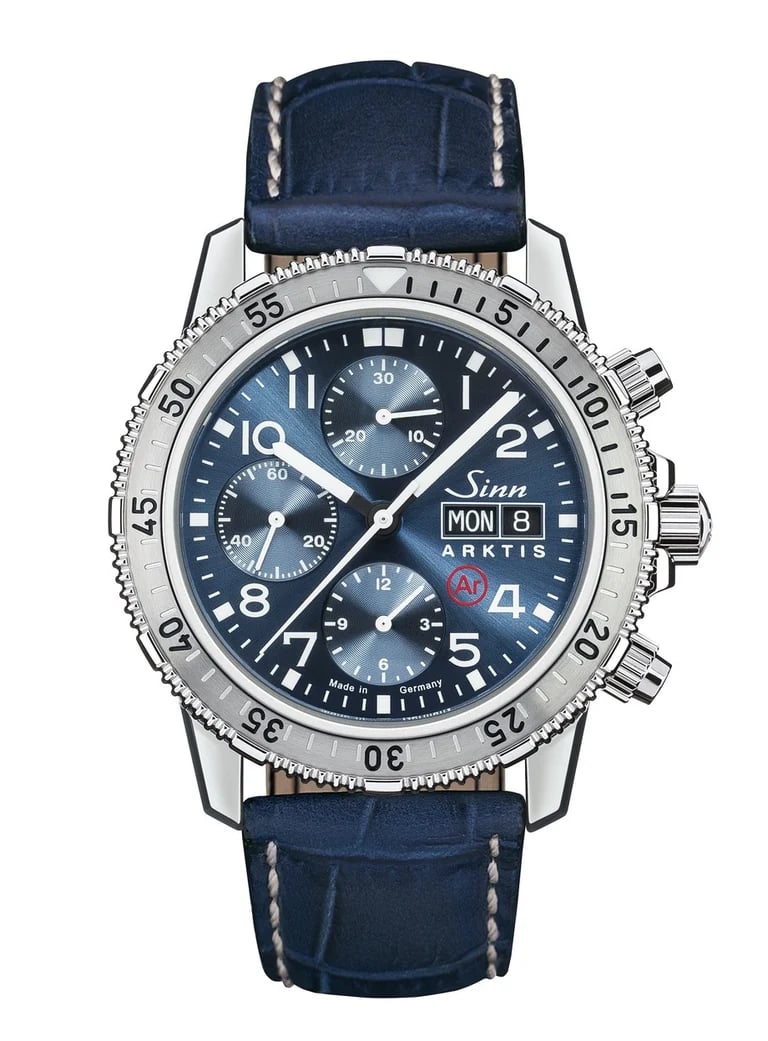
The dial is the main event. A full-calendar moonphase chronograph is inherently busy, but the 206.012 manages the information with a traditional layout. The moonphase aperture adds a softer, more romantic element to an otherwise technical face. The chronograph subdials and calendar indications give the owner plenty to look at, but the overall effect is still restrained by Sinn standards.
Because published reference data does not consistently state every case dimension for this exact reference, collectors should verify the specific example they are buying rather than relying on generic figures. What matters more is the design intent: the 206.012 is a classic chronograph, not a chunky modern tool watch. It is meant to sit close to the wrist and work with a shirt cuff.
The watch is not built around luminous performance. This is a classic dial with polished elements and a formal character, so collectors should expect a different experience from a Sinn pilot watch. Water resistance is adequate for daily life, but this is not a watch for diving or rough outdoor abuse. Treat it as a refined daily chronograph, not a survival instrument.
Wrist feel and balance
The 206.012 wears like a classic chronograph rather than a modern tool watch. The polished stainless steel case gives it a dressier character than Sinn's pilot and dive models, and the leather strap keeps the overall package light on the wrist. It is not a watch that disappears, but it also does not dominate the sleeve.
The balance is the key. The dial is busy enough to reward close inspection, yet the case remains slim enough in profile to slip under a shirt cuff. Collectors who prefer broad, brutalist sports watches may find it restrained; collectors who want a chronograph they can wear with a jacket will find it close to ideal.
The leather strap also sets the tone. A bracelet would make the watch feel more sporty and more robust, but leather pushes it toward traditional dress chronograph territory. That is the right call for this reference. The pin buckle is simple, secure, and easy to service. It also keeps the visual weight on the watch head rather than the wrist hardware.
Accuracy and daily reliability
The Valjoux 7751 is not COSC-certified, and Sinn does not market the 206.012 as a chronometer. Real-world examples typically run within roughly ten to fifteen seconds per day, with some doing better after regulation. That is acceptable for a watch of this type, though collectors who demand chronometer performance should look elsewhere or budget for a regulation service.
The chronograph function is robust, but the full calendar and moonphase assembly means you should not treat it as a heavily abused sports watch. The pushers are designed for occasional timing, not for stopwatch duty at a track day. The moonphase and calendar require correct setting, and owners should avoid changing those functions during unsafe time windows. A good dealer or watchmaker will explain the correct procedure.
Daily reliability is one of the 206.012's strongest arguments. The 7751 is a known movement, and Sinn's construction is sensible. If the watch has been serviced properly and is not water-damaged, it should be a dependable companion. The main risk is buying a neglected example with a stiff calendar mechanism or a moonphase that has been forced.
Occasions and wrist presence
This is a watch that works across formal, daily, dress, and travel situations. It is not a gym watch, and it is not a beach watch. It is a chronograph for the office, a dinner, a weekend in the city, or a trip where you want one watch that can handle a range of dress codes.
The 206.012 has a wrist presence rating of four out of five. It has enough visual complexity and polished shine to register across a table, but it remains a classic chronograph rather than a statement piece. The moonphase adds a conversational detail without turning the watch into a novelty. That balance makes it easy to wear regularly without feeling overdressed.
For collectors, the best use case is probably a rotation watch. It is not the one watch to rule them all, but it is a strong change of pace from a dive watch or a simple three-hander. It also gives younger collectors access to a traditional complication without the fragility and cost of a precious-metal dress chronograph.
Reference variants and family context
The reference reviewed here is the 206.012, a stainless steel model with a black dial and leather strap. Sinn's reference system can be confusing because case finish, crystal, and strap combinations are sometimes catalogued under different numbers, but the core identity remains the same: a full-calendar moonphase chronograph in a classic case.
Within the broader Sinn family, the 206 sits alongside the 203, 103, and 144 as one of the brand's chronograph options. The 103 is the better-known pilot chronograph, the 144 is a more tool-focused chronograph, and the 203 offers a different take on the complicated chronograph theme. The 206.012 is the more formal, complication-rich alternative.
Other notable Sinn models for collectors include the 104, a versatile everyday automatic; the U1, a serious dive tool; and the 556, a clean entry point into the brand. The 206.012 is not the most famous Sinn, but it is one of the more interesting references for collectors who want something beyond the usual pilot-watch conversation.
Similar watches and homages
The most natural alternative is the Longines Master Collection Moonphase Chronograph. It offers a comparable full-calendar moonphase chronograph look with a more traditional dress-watch flavor. The Omega Speedmaster Moonphase is a significant step up in brand cachet and finishing, but it also costs much more. The IWC Portofino Chronograph is cleaner and more formal, while the Breitling Navitimer 8 Chronograph is sportier and more brand-forward.
True homages of the Sinn 206.012 are rare because the full-calendar moonphase chronograph format is expensive to replicate well. The Sugess MoonPhase Master is a low-cost way to get a moonphase complication, but it lacks the Sinn's chronograph architecture and build quality. Collectors should treat such watches as fun placeholders, not substitutes.
Investment value and market position
The 206.012 is not an investment-grade watch in the way a steel Rolex Daytona or a Patek Philippe complication might be. It is a collector's watch with a stable secondary market and a sensible entry price. The current retail price is around $3,600, while pre-owned examples typically trade in the $2,500 to $3,200 range depending on condition, box and papers, and service history.
That spread tells the story. Buying new means taking the usual depreciation hit, but buying pre-owned puts the collector in a much stronger position. The trend is stable rather than appreciating. Sinn's enthusiast base is loyal, and the 206.012 has a specific appeal, but it is not scarce enough to support speculative premiums.
There is no major auction history for this reference. It trades primarily through dealers and enthusiast channels. That is not a red flag; it simply means the market is driven by wearability and value rather than trophy status. The hold recommendation is straightforward: buy pre-owned if you want the moonphase chronograph experience without taking the first depreciation hit. Hold if already owned, but do not treat it as an investment-grade asset.
Service and ownership
Sinn does not publish a single fixed service interval that applies to every owner, and the correct answer depends on wear, climate, and how often the chronograph and calendar are used. As a practical matter, collectors should budget for periodic maintenance and choose a watchmaker with experience on the Valjoux 7751.
Authorized Sinn service is not the only option. Independent watchmakers can handle the movement, but the full calendar and moonphase assembly means this is not a beginner's service job. Ask about parts availability, warranty, and whether the moonphase and calendar functions will be properly adjusted. A cheap service that cuts corners on the complication is a false economy.
The approximate service cost is not fixed in the public reference data, so collectors should request quotes before buying a neglected example. A well-cared-for watch will always be cheaper to own than a bargain example that needs a full mechanical overhaul.
Pros and cons
The pros are clear. The 206.012 offers a full calendar and moonphase at a realistic price, it uses a proven Valjoux 7751 chronograph architecture, it has a classic Sinn design with daily-wear versatility, and it represents strong secondary-market value for the complication.
The cons are equally clear. It is not an investment-grade Sinn reference, the busy dial requires a collector's eye, the movement is industrial rather than haute-horlogerie, and service can be costly if the calendar and moonphase parts need attention. None of these are deal-breakers for the right buyer, but they matter for the wrong one.
Final verdict
The Sinn 206.012 is a smart buy for the collector who wants a moonphase chronograph without the precious-metal tax. It is not a watch to flip, and it will not win a speculation race, but it delivers a genuine complication in a wearable, serviceable package.
Buy it pre-owned, wear it often, and judge it as a long-term companion rather than a commodity. In a market full of hype, that is a refreshingly mature proposition.