Brand context: Speake-Marin's independent path
Speake-Marin was founded in 2002 by British watchmaker Peter Speake-Marin, working from Switzerland. The brand's early reputation was built on the Piccadilly case, a rounded, lug-heavy design that gave even simple time-only watches a strong architectural identity. Over the years, Speake-Marin has moved between classical watchmaking and more sculptural, contemporary pieces, but the through-line has been independence: small-series production, visible finishing, and a design language that does not try to pass as a heritage maison.
The Dual Time sits comfortably within that story. It is a complication watch, but not a maximalist one. The brand's academic and Piccadilly families have long emphasized legibility and mechanical character, and the Dual Time extends that approach into travel. The Terracotta dial is a color statement, but the underlying watch remains a Speake-Marin: restrained in case design, deliberate in dial layout, and finished with the kind of small-batch attention that larger brands cannot always justify.
Case and dial: terracotta without theatrics
The case is stainless steel, and that is the right choice. A precious-metal case would push the Dual Time Terracotta toward formal-only territory; steel keeps it usable with a jacket, a knit, or a travel coat. The crystal is sapphire, as expected at this level. The case design is rounded and clean rather than sharply faceted, with the kind of soft geometry that catches light without demanding attention. The reference's exact case dimensions are not stated here because they should be confirmed against the brand's specification for this reference; what matters is the impression: the watch is designed to sit close to the wrist and read as a dress object rather than a sports tool.
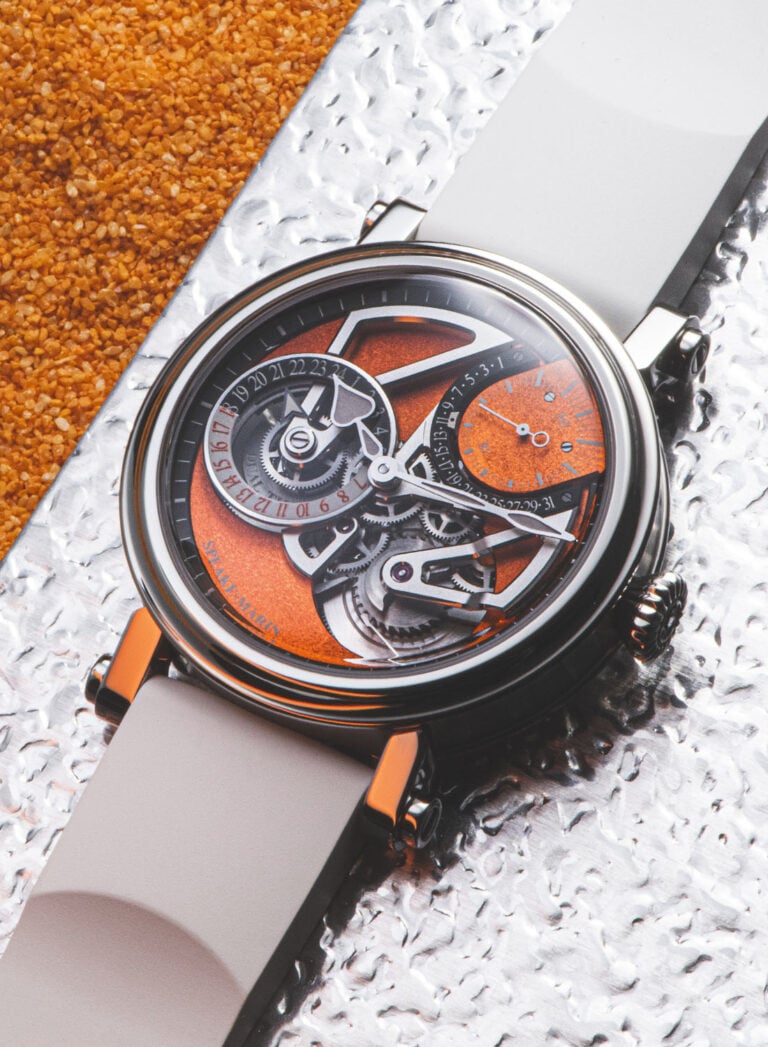
The dial is the center of the review. Terracotta is a difficult color to get right. Too red and it becomes theatrical; too brown and it collapses into sepia. Speake-Marin's interpretation is a warm, clay-like tone that shifts between burnt sienna and muted brick depending on the light. It is not a flat lacquer. The surface has enough depth to keep the dial alive, and the printing and applied elements are arranged with enough negative space that the color never overwhelms the hands.
The dual-time display is handled with restraint. Local time is the primary reading, with central hands doing the everyday work. Home time is presented in a clearly delineated register, keeping the second zone legible without turning the dial into a control panel. This is the correct hierarchy for a travel watch: the wearer should be able to read the local time at a glance and check home time with a deliberate look, not the other way around. The layout respects the fact that most travel is not about constant time-zone math; it is about knowing when to call home.
Lume is not part of the brief here. The Dual Time Terracotta is a dress-oriented travel watch, and the absence of luminous material is consistent with that intent. The hands and markers are finished for low-light legibility through contrast and polish rather than glow. Water resistance is not specified in the material reviewed here, so it should be treated as a dress watch rather than a swimming companion; confirm the rating with Speake-Marin before exposing it to water. The strap is leather, and the clasp is a pin buckle, both appropriate to the watch's formal-casual balance.
Movement: SMA02 and the architecture of a dual time
The Dual Time Terracotta is powered by Speake-Marin's automatic dual-time calibre, understood to be the SMA02. The movement runs at 28,800 vph and carries a 42-hour power reserve. It is not COSC-certified, and it is not a fully vertically integrated in-house movement in the strict sense; it is a Speake-Marin-calibrated automatic with independent finishing and a dual-time mechanism. That distinction matters for collectors who equate independent watchmaking with total vertical integration. Speake-Marin's value lies less in owning every component than in the way the movement is specified, finished, and integrated into the watch.
The architecture is modular in the way most dual-time automatics are: a base automatic movement with a second-time-zone mechanism layered into the display. The engineering goal is not to reinvent the complication but to make it reliable, legible, and pleasant to set. The movement's finishing is consistent with the brand's independent standards, with attention paid to the bridges, rotor, and visible surfaces. This is not a movement designed to be seen through a skeleton dial, but it is finished for the owner who values the mechanical object behind the dial.
The 42-hour reserve is adequate for a daily-wear travel watch. It is not a long-weekend power reserve, but it is enough to rotate the watch through a week without constant resetting if the wearer is disciplined. The 28,800 vph frequency is the modern standard for smooth seconds and stable rate. The absence of chronometer certification is not a red flag; it simply means the buyer should expect good mechanical accuracy rather than a paper guarantee.
On the wrist: balance over bulk
The Dual Time Terracotta wears like a dress watch with a travel secret. The stainless-steel case keeps the weight reasonable, and the rounded profile helps the watch settle into the wrist rather than perch on top of it. The leather strap is the right pairing: it softens the case visually and keeps the terracotta dial from feeling too precious. The pin buckle is simple and period-appropriate, and it keeps the package from drifting into sport-watch territory.
The balance is the key. A dual-time watch can easily become top-heavy or visually busy, but this reference avoids both. The dial's hierarchy keeps the eye moving from local time to home time without confusion, and the case's restrained geometry keeps the watch from feeling oversized on the wrist. It is comfortable for a full day at a desk, and it transitions cleanly to dinner. The watch does not demand a particular wardrobe; it looks as natural with a navy suit as it does with a cashmere sweater and trousers.
Accuracy and daily expectations
Real-world accuracy should be assessed over a week of wear rather than a single day. With a non-COSC automatic, expect a few seconds per day of variation depending on position, temperature, and activity. The SMA02 is a modern-frequency automatic, so the rate should be stable, but the owner should still expect to regulate the watch if it drifts outside personal tolerance. The dual-time mechanism should set cleanly and hold its position; as with any travel watch, the owner should follow the brand's instructions for setting the second zone to avoid confusing the mechanism.
The practical advice is simple: wear it, observe it, and have it regulated by an authorized watchmaker if needed. This is not a watch that promises quartz-like accuracy, and it should not be judged that way. Its appeal is mechanical character, not chronometric certification.
Occasions and wrist presence
The Dual Time Terracotta is at its best in formal, dress, daily, and travel contexts. It is not a sports watch, and it should not be treated as one. The terracotta dial gives it enough personality for a dinner or a gallery opening, while the steel case and leather strap keep it grounded for everyday wear. For travel, the dual-time display is genuinely useful without turning the watch into a pilot's instrument.
Wrist presence is 4/5. It is not a watch that announces itself from across the room, but it rewards a closer look. The terracotta dial is distinctive, the case is well proportioned, and the independent finishing gives it a level of detail that becomes more apparent over time. It is confident without being loud.
Family and variants
The Dual Time family sits alongside Speake-Marin's Academic and Piccadilly lines, sharing the brand's rounded case language and independent approach to finishing. Speake-Marin has offered the Dual Time in other dial treatments, but the terracotta reference is the warmest and most distinctive of the group. The reference 413809020 denotes the terracotta-dial Dual Time on a leather strap; collectors should confirm strap and clasp configuration with the brand or retailer, as independent brands often allow small variations.
Within the broader Speake-Marin catalogue, the One & Two Academic, Ripples, and Velsheda show the brand's range from classical time-only watches to more sculptural contemporary pieces. The Dual Time Terracotta is a useful bridge between those worlds: more complicated than an Academic, less overtly sporty than a Ripples, and more wearable than a dedicated statement piece.
Comparable watches
The obvious comparable is the Jaeger-LeCoultre Reverso Tribute Duoface, which offers a dual-time display in a reversible case with enormous dress-watch credibility. The Grand Seiko Elegance GMT SBGM221 is another option for collectors who want a warm dial and Japanese precision in a classical package. The Nomos Glashütte Zürich Weltzeit is a design-led world-time alternative at a lower entry point, though it lacks the independent finishing character of the Speake-Marin.
For a more accessible dual-time experience, the Seiko 5 Sports GMT SSK003 and the Timex Waterbury GMT offer the basic travel-watch brief at a fraction of the price. They are not homages in the strict sense, but they serve the same functional need. The Speake-Marin's advantage is not the complication itself; it is the way the complication is integrated into a watch with a distinct design voice and independent finishing.
Value, investment, and service
Pricing for the Dual Time Terracotta should be confirmed with Speake-Marin or an authorized retailer, as independent-brand pricing varies by market and configuration. The watch is not a liquid asset, and there is no major auction history to point to. Collectors should buy it for the design, the independent character, and the pleasure of wearing a small-series mechanical object rather than for short-term appreciation. The trend for independent dress watches is stable to soft, and resale will depend on patience, documentation, and the buyer's willingness to engage with a niche brand.
Service should be handled through Speake-Marin or an approved independent watchmaker. The dual-time mechanism and the brand's finishing standards favor authorized channels, even if the base movement is familiar to competent watchmakers. Service intervals and costs vary by condition and location; the owner should budget for proper maintenance rather than treating the watch as disposable. The leather strap and pin buckle are straightforward to maintain, and the sapphire crystal is resistant to everyday scratches.
Final verdict
The Speake-Marin Dual Time Terracotta is a successful independent travel watch because it refuses to overplay its hand. The terracotta dial gives it warmth and identity, the stainless-steel case keeps it wearable, and the SMA02 automatic provides the dual-time function with a 42-hour reserve and 28,800 vph. It is not a chronometer-certified tool, and it is not a vertically integrated in-house statement; it is a Speake-Marin, which means the value is in the design, finishing, and small-series character.
For the discerning collector, the watch makes the most sense as a personal piece rather than a portfolio asset. It rewards close looking, wears comfortably, and offers a dual-time complication without turning the wrist into a cockpit. If the terracotta palette speaks to you, the Dual Time Terracotta is a compelling alternative to the usual steel GMT suspects.