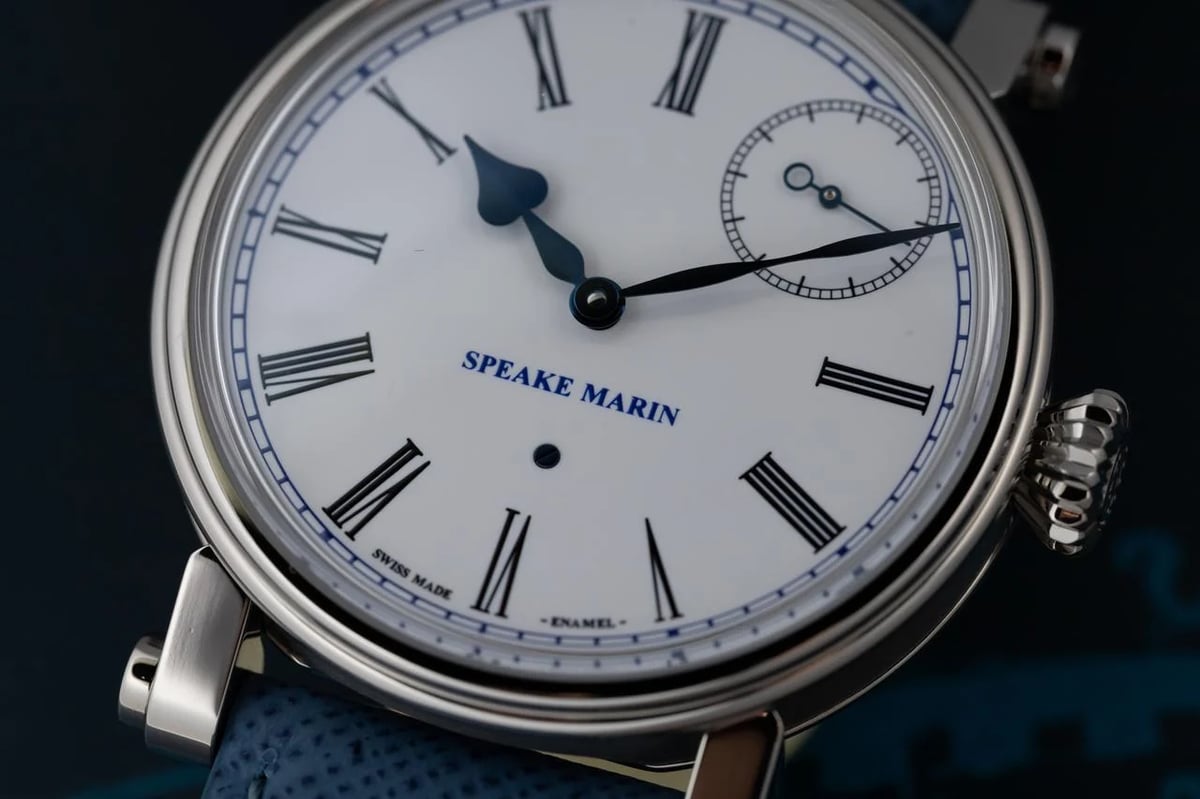
Enamel is supposed to be the fragile one. Titanium is supposed to be the tough one. The Speake-Marin Resilience Grand Feu puts them in the same case and dares you to pick a side. It is a dress watch with a sport watch's skeleton, or a sport watch wearing a dinner jacket — depending on which angle you catch it from. Either way, it is the rare independent piece that understands something most brands forget: collectors today do not want a watch that only works at one address.
Speake-Marin has never been a shouty house. Peter Speake-Marin built the brand on the Piccadilly case, the topping-tool emblem, and a stubborn belief that a watch should look handmade from across the room. The Resilience is where that classical instinct meets the brand's newer, more wearable mood — a fired enamel dial, a stepped case, and hands that read like a signature. Reference 413802000 is the titanium-and-enamel expression of that idea.
This is not a watch for the collector who is still filling gaps. It is for the one who already has the Submariner, already has the Calatrava, and now wants something where the maker's hand is visible — where the dial was fired, not printed, and where the case metal was chosen for the wrist rather than the spec sheet.
The Independent Angle
Speake-Marin was founded in 2002 by Peter Speake-Marin, a British watchmaker who trained at WOSTEP and spent time at Renaud & Papi before going independent. That background matters: this is a house built on complications and hand-finishing rather than on marketing budgets. The early watches — the Piccadilly above all — established a silhouette that is instantly recognisable to anyone who has spent time in independent watchmaking circles: a stepped case, a wide dial aperture, and the topping-tool motif that appears on hands, crowns and rotors.
The brand has since evolved into a broader collection, with the Resilience sitting in the sweet spot between classical dress watch and everyday wear. It is Swiss-based, small-volume, and stubbornly artisanal in an era when 'independent' has become a marketing category. That matters for a watch like this one, because the enamel dial is not a decoration applied by a supplier and forgotten. It is the centre of the object.
For collectors, Speake-Marin occupies an interesting position: more accessible than the top-tier independents, more characterful than the mainstream, and small enough that you are unlikely to see another one at the same dinner. The Resilience Grand Feu is the purest expression of that positioning.
Why Grand Feu Matters
Grand feu enamel is one of the oldest techniques in watchmaking and one of the least forgiving. The process starts with powdered glass, which is laid onto a metal base, fired at extremely high temperature, and then repeated — layer after layer — until the surface reaches the depth and lustre that collectors chase. Each firing carries risk. A dial can crack, blister or shift, and the maker starts again. The result is a surface that does not look painted. It looks like it has depth, because it does.
This is why enamel dials occupy a specific place in the collector hierarchy. They are not more accurate, more durable or more useful than a printed dial. They are simply more human. You can see the hand in them, and you can see the risk. On the Resilience, the enamel is the entire argument: a classical, almost old-world surface inside a modern, lightweight case. The contrast is the design.
It also changes how you wear the watch. An enamel dial makes you slower. You check the time more deliberately. You notice the way light sits on the surface rather than bouncing off it. In a market full of high-contrast, lume-heavy sports watches, that is a genuinely different experience.
Titanium, the Quiet Flex
Titanium is usually reserved for tool watches — dive watches, pilot watches, the kind of thing that gets strapped over a wetsuit. Putting it under an enamel dial is a deliberate provocation. It says: this watch is precious, but it is not precious about itself.
The metal brings real benefits. It is light, it is corrosion-resistant, and it is hypoallergenic, which matters more than most brands admit. It also finishes differently from steel — cooler, greyer, more matte — which suits the Resilience's architectural case. The stepped profile reads as sculpture rather than bulk, and the titanium keeps that sculpture from becoming heavy on the wrist.
The trade-off is that titanium is harder to finish than steel, and the market still associates it with sport rather than dress. That is precisely why it works here. The Resilience Grand Feu is not trying to be a Calatrava. It is trying to be the dress watch you actually wear.
The Movement
Inside is a Speake-Marin in-house automatic, finished in the house style and visible through a sapphire caseback. The brand's approach to movements has always been artisanal rather than industrial: bevels, circular graining, and the topping-tool motif are part of the visual language, not hidden away. This is not a chronometer-certified calibre, and Speake-Marin does not pretend otherwise. The point is the finishing and the architecture, not a certificate.
In practice, that means a movement you will want to look at. The caseback is not an afterthought here — it is part of the ownership experience, and it is one of the reasons collectors gravitate toward independents in the first place. You are not buying a black box. You are buying something someone spent time on.
On the Wrist
The first thing you notice is the absence of weight. Titanium does something psychological to a dress watch: it stops feeling like jewellery you have to protect and starts feeling like something you can live in. The Resilience sits flat and unobtrusive, and because the case is light, the strap does most of the visual work. Leather on titanium reads warmer than you expect — less boardroom, more gallery opening.
Balance is the other win. Speake-Marin builds stepped cases with presence, but the titanium keeps that presence from turning into bulk. On a smaller wrist it wears like a proper dress watch; on a larger one it reads as a deliberate, slightly architectural choice. The only adjustment most owners will want is a strap swap — the case is neutral enough to take suede or textured calf and change character entirely.
The dial is the thing you keep looking at. Grand feu enamel has a softness that photographs badly and lives beautifully. Under office lighting it is quiet; under evening light it glows. That is the kind of detail that separates a watch you own from a watch you wear.
Accuracy and Daily Life
Independent automatics are regulated by hand rather than certified by an observatory, so a well-served example should hold within a handful of seconds a day in normal wear. Give it a few weeks to settle, keep it off the timegrapher for the first month, and judge it by how it behaves across a week rather than a single morning. This is not a watch bought for its rate. It is a watch bought for its dial.
Daily life with the Resilience is easier than the enamel suggests. Titanium shrugs off knocks, sapphire protects the dial, and the leather strap softens with wear. The one caveat is water: this is not a watch you take swimming, and you should treat it accordingly. Enamel and moisture are not friends, and neither is leather.
Occasions
The Resilience Grand Feu is at its best with tailoring — a suit, a knit polo, a good coat. It works for the office, for dinner, for travel where you want one watch that reads as considered rather than loud. It is not a sports watch, and it does not pretend to be, despite the titanium. Think of it as a dress watch with a modern constitution: formal enough for a wedding, relaxed enough for a weekend in the city.
The Market and the Money
Speake-Marin's secondary market is thin, and that cuts both ways. On one hand, you can often find examples at a meaningful discount to retail, which makes the Resilience an attractive entry point into independent watchmaking. On the other, liquidity is limited — this is not a watch you buy on Monday and flip on Friday.
The enamel dial is the value argument. Grand feu work at this price point is rare, and the titanium case gives it a usability that most enamel watches lack. If you are buying for the long term, the combination of craft and wearability is compelling. If you are buying for resale, look elsewhere.
Service is the other consideration. Enamel dials and in-house calibres make the authorized channel the safer route, and lead times can be long. Budget for a full service every several years and confirm availability in your market before you commit.
The Verdict
The Resilience Grand Feu is the rare independent watch that argues with itself — delicate enamel on one side, titanium toughness on the other — and wins. It is not the safest money in horology, and it is not trying to be. It is a watch for the collector who wants the maker's hand on the dial and does not need the rest of the room to recognise it.
If you already own the obvious things and you are looking for something with a point of view, this is a serious candidate. If you are looking for a first dress watch, it is probably too much of a commitment. But for the collector who understands the difference between a dial that was printed and a dial that was fired, reference 413802000 makes a very specific, very persuasive case.