The Quiet Authority of the Sterile Dial
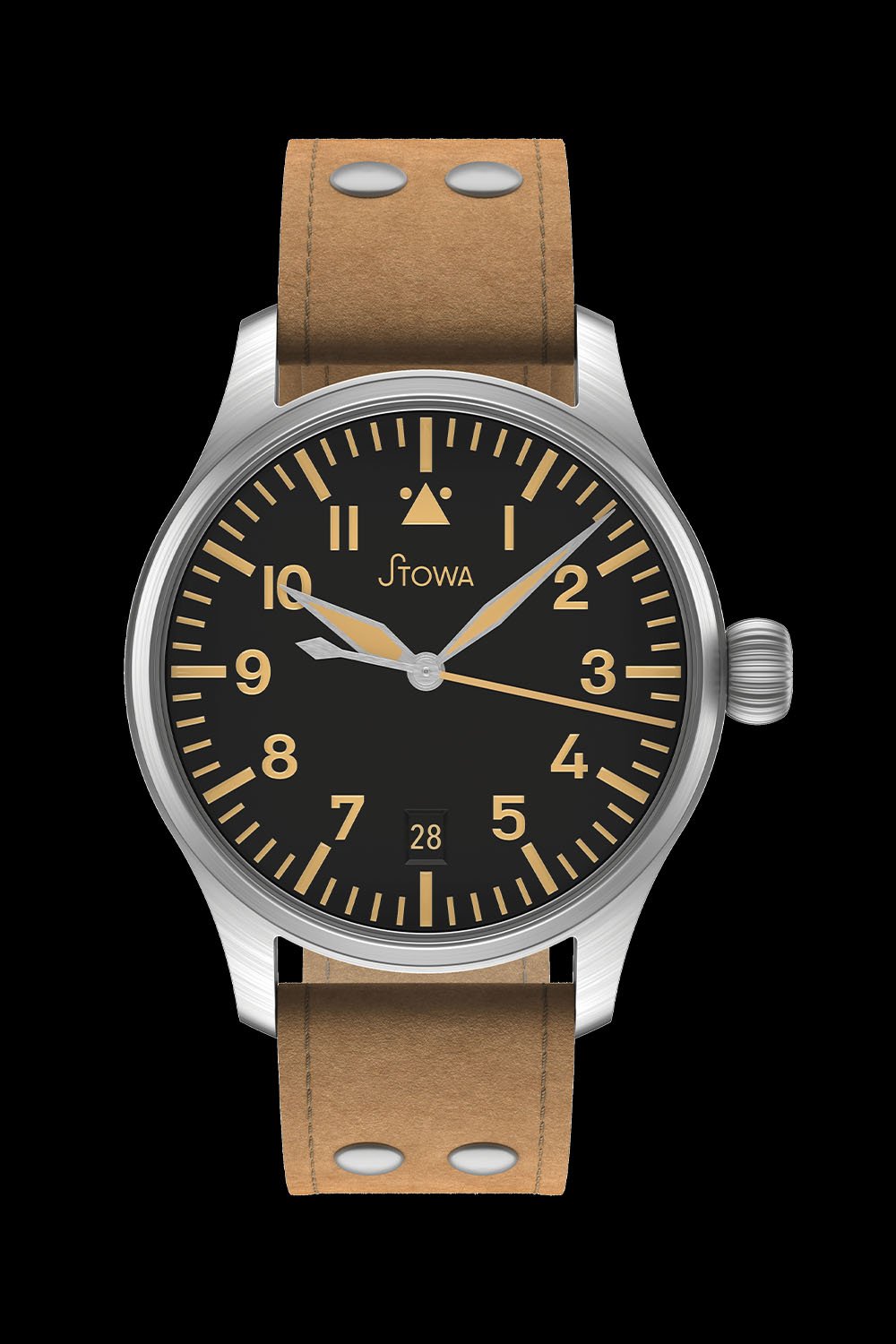
In the hierarchy of horological cool, there is a specific tier reserved for watches that don't feel the need to scream their own name. The Stowa Flieger Classic 40 (Ref. FL32-1-N) is the undisputed captain of this tier. When you look at the dial, you won't find a brand logo, a 'Made in Germany' stamp, or even a date window. This is the 'No Logo' configuration, a design choice that honors the original 1940s Beobachtungs-Uhren (B-Uhr) specifications where branding was omitted to ensure maximum legibility for navigators. In a modern context, this sterile dial acts as a palette cleanser for the eyes—a piece of visual hygiene that stands out precisely because it refuses to participate in the branding arms race.
A Heritage That Actually Matters
Many brands today 'reimagine' history, but Stowa was actually there. In 1940, the German Ministry of Aviation (RLM) required a very specific type of watch for its pilots. These watches had to be 55mm (to be worn over flight suits), highly legible, and incredibly accurate. Only five companies were chosen to produce them: IWC, Laco, Lange & Söhne, Wempe, and Stowa. While some of these brands have moved into the ultra-luxury stratosphere, Stowa has remained remarkably accessible while staying truer to the original proportions than almost anyone else. The Ref. FL32-1-N is the direct descendant of those wartime instruments, scaled down from a gargantuan 55mm to a wearable 40mm for the contemporary collector.
The Alchemy of Heat-Blued Steel
One of the most significant 'flexes' of the Stowa Flieger is the hands. In an era where many watches in the $1,000 to $2,000 range use painted blue hands to save on costs, Stowa uses thermally blued steel. This is a process where the steel hands are heated to exactly 290 degrees Celsius until the surface oxidizes into a deep, cornflower blue. The result is a color that changes depending on the light—appearing almost black in low light and exploding into a vibrant, electric blue when it catches the sun. It is a detail that signifies high-end watchmaking and provides a level of depth that paint simply cannot replicate.
The Pforzheim Precision: Case and Construction
The case of the Flieger Classic 40 is a masterwork of German minimalism. It is crafted in Pforzheim, Germany’s historic jewelry and watchmaking hub. The finish is a fine sandblasting that gives the stainless steel a matte, industrial grey look. This isn't just an aesthetic choice; it’s historical. Original pilot watches were matte to prevent cockpit glare. The case features a thin bezel, which allows the dial to take up as much real estate as possible, making the 40mm watch feel slightly larger and more legible than its dimensions suggest. However, the real magic is the thickness. At 10.2mm, it is one of the thinnest automatic pilot watches on the market, making it an incredibly versatile daily wearer.
Under the Hood: The Top-Grade Sellita SW200-1
While the outside is all German heritage, the inside is pure Swiss reliability. Stowa doesn't settle for the standard version of the Sellita SW200-1. They opt for the 'Top Grade' movement. For the uninitiated, this means the movement is tested in five positions and features upgraded components like a Glucydur balance and a Nivaflex NM mainspring. These are the same technical specifications you would find in watches costing three times as much. Through the sapphire caseback, you can see the movement's finishing—perlage on the bridges and a custom-engraved Stowa rotor. It’s a movement that won't win any 'in-house' awards, but it will keep time within chronometer-adjacent specs for a decade without breaking a sweat.
The Wrist Experience: From the Cockpit to the Cafe
Wearing the Stowa Flieger 40 is an exercise in balance. On the wrist, the 48.6mm lug-to-lug gives it enough 'heft' to feel like a tool watch, but the slim profile ensures it never feels clunky. It’s the kind of watch that bridges the gap between different social spheres. You can wear it with a heavy denim jacket and boots on the weekend, or pair it with a crisp white shirt and a navy blazer for a business-casual look. It has a 'quiet luxury' vibe that doesn't attract the wrong kind of attention, but will always spark a conversation with a fellow enthusiast who recognizes the heat-blued hands from across the room.
Market Context and the Value Proposition
Let's talk numbers. At approximately $1,250 USD, the Stowa Flieger sits in a competitive space. You have the IWC Mark series at the $5,000+ level, and various microbrands at the $500 level. Stowa occupies the 'Golden Mean.' It offers the heritage and finishing of the high-end brands at a price point that remains approachable. Because Stowa sells directly to consumers, they cut out the retail markup, allowing them to put more money into the components—like that Top Grade movement and the heat-blued hands. For a young collector building a 'perfect' three-watch collection, the Stowa Flieger is often the first choice for a pilot/tool watch because the value-to-quality ratio is simply unbeatable.
The Verdict
The Stowa Flieger Classic 40 Ref. FL32-1-N is not a watch for people who need a logo to feel validated. It is a watch for people who appreciate the history of flight, the precision of German engineering, and the beauty of functional design. It is a purist’s dream—a sterile, legible, and beautifully finished instrument that looks as good today as its ancestors did eighty years ago. In the fast-moving world of watch trends, the Stowa Flieger is a permanent fixture. It’s not just a watch; it’s a standard.