The Market Thesis: Why the Verus Matters Now
In the current market cycle, we are seeing a massive correction. The 'hype' watches of 2021—the turquoise dials and the integrated bracelet clones—are seeing their secondary market premiums evaporate. In this environment, the smart money is flowing back into 'foundational' pieces. These are watches with undeniable historical provenance, clean aesthetics, and mechanical reliability. The Stowa Flieger Verus (ref. FL07-11-0-0-5-N) is the poster child for this flight to quality.
When you buy a Verus, you aren't just buying a piece of steel; you are buying into the legacy of the original 1940s Beobachtungsuhr (B-Uhr). While brands like IWC command five-figure sums for their pilot heritage, Stowa offers a nearly identical historical claim at a fraction of the entry cost. For a young collector, this is a 'low beta' asset—low risk, steady value, and high utility.
Historical Pedigree: The 'Original Five' Flex
To understand the value of the Verus, one must understand the history of the Flieger. During WWII, the German Ministry of Aviation (RLM) specified a set of requirements for pilot watches. Only five companies were contracted to build them: A. Lange & Söhne, IWC, Laco, Wempe, and Stowa. Today, owning a Stowa is a direct link to that era.
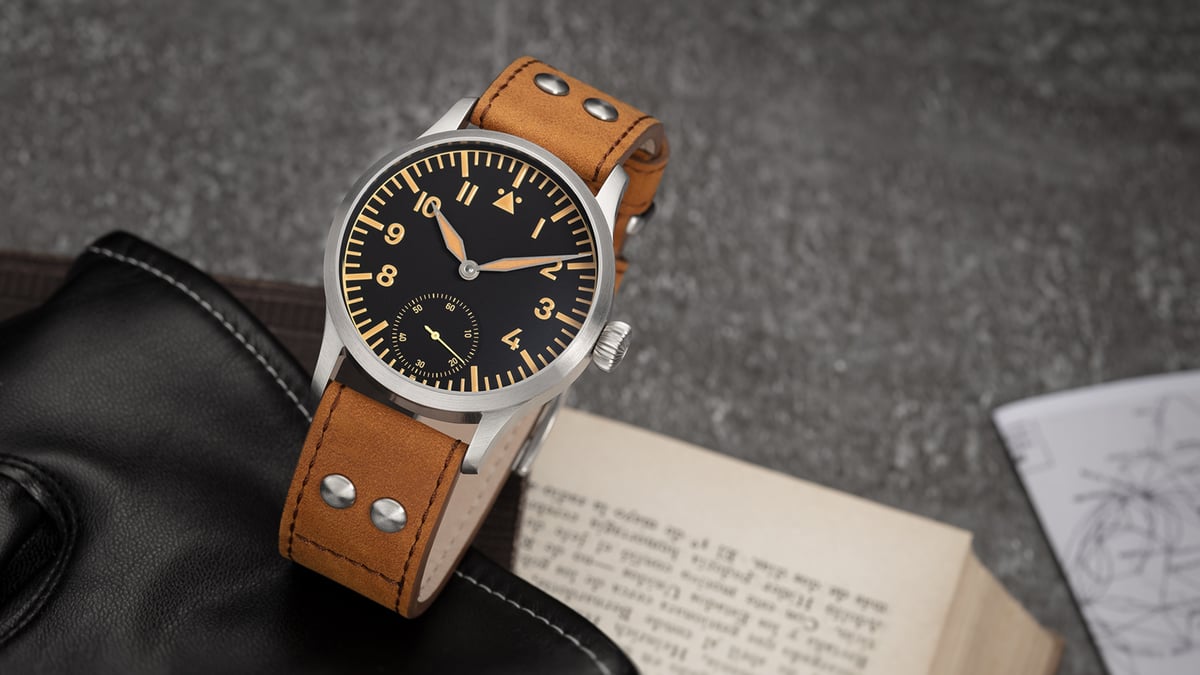
The 'Verus' name is Latin for 'true' or 'genuine.' It represents a modern interpretation of the Type A dial. Unlike the 'Classic' line which uses vintage-style serifs and blued hands, the Verus utilizes a modern, bold typeface and white-painted hands. This isn't a 'reproduction'—it’s an evolution. In the world of art and design, evolution is often more valuable than mere imitation.
Design Analysis: The Bauhaus-Pilot Hybrid
The Verus is a masterpiece of subtraction. There is no logo. There is no date (in the standard ref. FL07-11-0-0-5-N). There is no unnecessary text. What remains is a dial that is arguably the most legible in the entire luxury watch market. The contrast between the matte black dial and the stark white Super-LumiNova BGW9 is jarring in its clarity.
The case is 40mm of sandblasted stainless steel. This finish is crucial for the wealthy collector aesthetic—it doesn't flash or sparkle. It looks like a piece of industrial equipment. It signals that the wearer is too busy closing deals or flying private to worry about polishing a mirror-finish bezel. The 10.2mm thickness is the real 'alpha' spec here. Most pilot watches are unnecessarily thick; the Verus wears like a dress watch but acts like a tool.
Technical Performance: The Pforzheim Standard
Under the hood lies the Sellita SW200-1. In the 'Top Grade' configuration that Stowa utilizes, you are getting a movement that is technically superior to many 'in-house' calibers found in boutique brands. It features a Glucydur balance, an Anachron hairspring, and Incabloc shock protection.
The decision to use a Sellita rather than a proprietary movement is a strategic win for the owner. It keeps the initial acquisition cost low and ensures that the 'total cost of ownership' (TCO) remains manageable. In ten years, you won't have to send this watch to a Swiss fortress for a $1,500 service. Your local watchmaker can handle it for the price of a decent dinner in Manhattan. That is what I call efficient capital management.
The Investment Case: Hold vs. Flip
Let’s talk numbers. The MSRP of the Verus has seen steady, incremental increases over the last five years, tracking well with inflation and brand prestige. On the secondary market, Stowa watches are 'liquid gold.' Because they are sold primarily direct-to-consumer, there is no 'gray market' dump that devalues the brand.
If you purchase a Verus for ~$1,000 today, you can reasonably expect to sell it for $800 tomorrow. That 20% 'usage fee' is significantly lower than the 40-50% hit you take on many mainstream luxury brands. However, the real play here is the 'long hold.' As Stowa continues to move up-market under the Tempus Arte Group (which also owns Lang & Heyne), these early Schauer-era designs will become the 'vintage' icons of the future.
Wrist Experience and Lifestyle Integration
Wearing the Verus is a psychological experience. It feels like wearing a piece of history that has been scrubbed of its baggage and polished for the 21st century. On the black leather strap, it is a discreet companion for a charcoal suit. Swap it onto a grey NATO strap, and it’s ready for a weekend in the Hamptons or a hiking trip in the Alps.
The lume is another standout feature. The BGW9 glows a cool, electric blue that lasts well into the early hours of the morning. For the young collector who values functionality as much as form, the Verus delivers a level of 'wrist satisfaction' that usually requires a much larger investment.
Comparison: Stowa vs. The Field
When compared to its siblings at Laco, the Stowa is noticeably more refined. Laco leans into the 'rugged' and 'authentic' (sometimes even 'artificially aged') look. Stowa, however, feels like a luxury product. When compared to IWC, the Stowa holds its own in terms of case finishing and dial printing, though it lacks the 'Big Pilot' brand recognition. But for our audience—the sophisticated young collectors—the lack of brand recognition is often the point. It’s a secret handshake.
Final Verdict: The Portfolio Stabilizer
The Stowa Flieger Verus (ref. FL07-11-0-0-5-N) is the ultimate buy-side recommendation for anyone looking to enter the world of serious horology without the 'nouveau riche' stigma of a flashy entry-level Rolex. It is a watch with a soul, a history, and a design that will be as relevant in 2050 as it was in 1940. It is the definition of a 'smart' acquisition. Buy it, wear it, and hold it. Your future self—and your portfolio—will thank you.