The Evolution of the Flieger: Beyond the B-Uhr
To understand the Stowa Flieger Verus Black Forest Foxfire (ref. FL40-11-1-1-5-N), one must first understand the historical weight of the Flieger itself. During the 1940s, the German Ministry of Aviation (RLM) defined the specifications for the 'Beobachtungsuhr' (B-Uhr), an observation watch designed for navigators. Only five companies were contracted to build these: IWC, A. Lange & Söhne, Laco, Wempe, and Stowa. While some of these brands have moved into the ultra-luxury stratosphere, Stowa has carved out a unique niche by remaining accessible while maintaining a direct link to its origins.
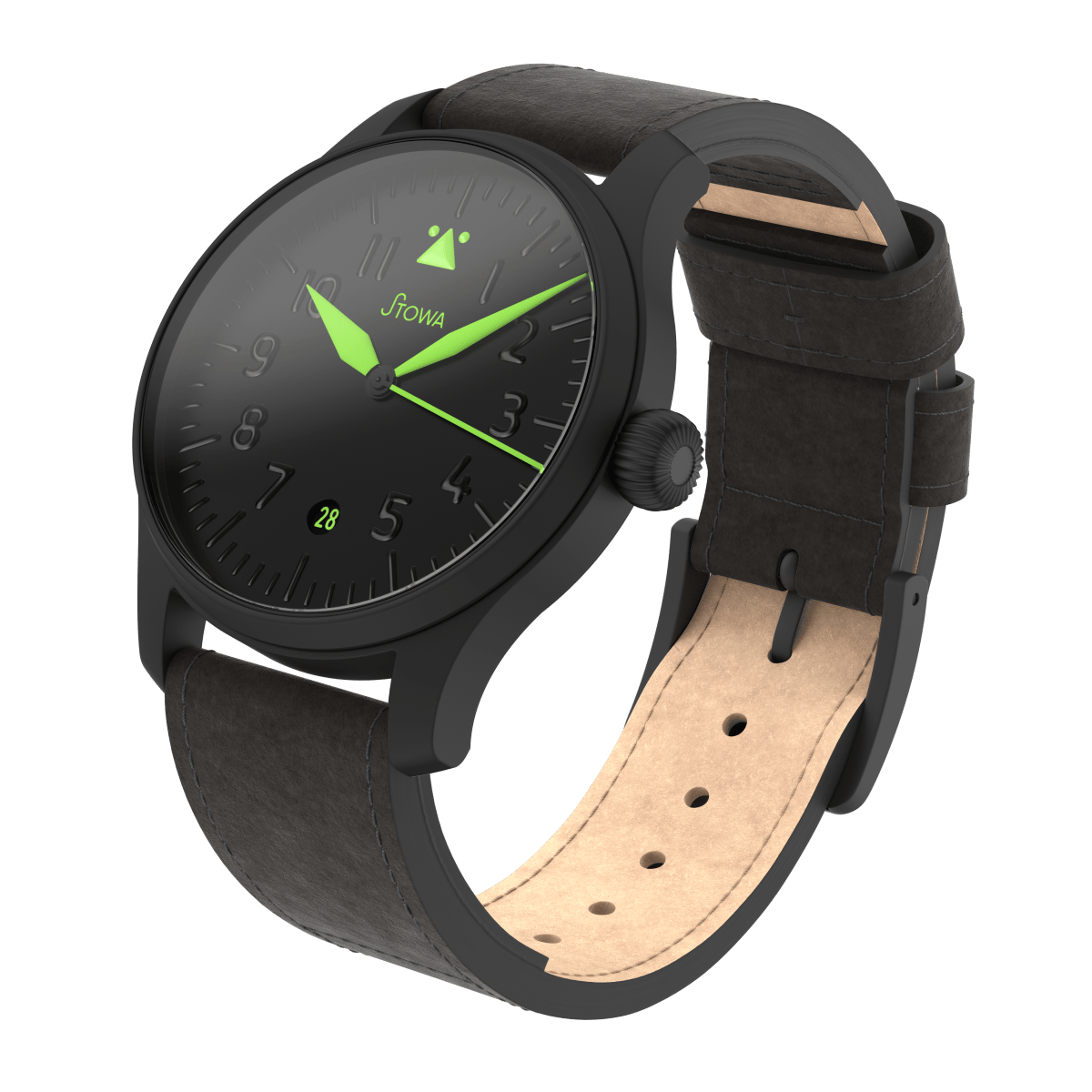
The 'Verus' line is a significant pivot in the Stowa catalog. While the 'Classic' line uses the traditional serif fonts and heat-blued hands, the Verus strips away the ornamentation. It is a 'modernist' pilot watch—cleaner, bolder, and more aligned with 21st-century industrial design. The Black Forest Foxfire edition takes this minimalism and injects a shot of adrenaline via a black-coated case and neon-orange accents.
Technical Prowess: The Sellita SW200-1 Top Grade
In the world of watch investment, the movement is the engine that drives long-term value. Stowa does not merely drop a standard movement into a case. This reference utilizes the 'Top' grade Sellita SW200-1. For the uninitiated, Sellita offers four grades of movements: Standard, Elaboré, Top, and Chronomètre. The Top grade used here is virtually identical to the Chronomètre grade in terms of components—including a Glucydur balance wheel and Anachron hairspring—but lacks the official COSC certification paper, which keeps the retail price lower for the consumer.
From a maintenance perspective, this is an analyst's dream. The SW200-1 is ubiquitous, meaning parts are plentiful and any skilled watchmaker can service it. In an era where 'in-house' movements often lead to 'in-house' service monopolies and $800 repair bills, the Stowa offers a refreshing level of transparency and long-term affordability.
Design Analysis: The Foxfire Aesthetic
The 'Foxfire' moniker refers to the bioluminescence produced by certain species of fungi in decaying wood, a phenomenon found in the Black Forest. Stowa translates this into a high-intensity orange Super-LumiNova X1. Unlike the standard C3 (green) or BGW9 (blue) lumes, this orange provides a high-contrast daytime aesthetic that transitions into a ghostly glow in low light. The sandblasted black coating on the 40mm stainless steel case is executed with precision, offering a tactical, non-reflective surface that complements the 'stealth' nature of the watch.
Market Performance and Investment Outlook
When analyzing Stowa as an asset, we must look at the brand's distribution model. By selling directly to consumers, Stowa eliminates the 30-50% markup typically taken by retailers. This means the 'intrinsic value' of the watch—the quality of the steel, the grade of the movement, and the hand-assembly—is much closer to the MSRP than what you find in a typical Swiss luxury brand.
Limited editions like the Black Forest Foxfire tend to hold their value exceptionally well. On the secondary market, 'standard' Stowa models typically retain 70-80% of their value. However, the 'Black Forest' iterations often trade at or near their original retail price due to their scarcity and the cult following the series has generated. For the collector, this represents a 'safe' entry point; the downside risk is minimal, while the 'cool factor' and historical pedigree are high.
On the Wrist: Ergonomics and Utility
The wearability of the FL40-11-1-1-5-N is one of its strongest selling points. At 10.2mm thick, it is significantly slimmer than the IWC Big Pilot or even most Sinn chronographs. It slides under a shirt cuff with ease, yet the 40mm diameter ensures it isn't lost on the wrist. The lug-to-lug of 48.6mm is the 'sweet spot' for modern collectors, providing enough span to feel substantial without the awkward overhang that plagues larger pilot watches.
Competitive Landscape
How does it stack up against the competition? Sinn offers the 856, which is more technologically advanced with its Tegimented steel and Ar-Dehumidifying technology, but it also carries a significantly higher price tag and lacks the historical B-Uhr connection. Laco offers more historically accurate case shapes, but their 'Original' series can feel bulky and archaic compared to the Verus's streamlined profile. The Stowa sits in the 'Goldilocks' zone: historically authentic, mechanically superior to entry-level options, and priced fairly.
The Vivir Verdict
The Stowa Flieger Verus Black Forest Foxfire is not a 'hype' watch. It won't see a 300% markup on the gray market overnight. Instead, it is a 'value' play in the truest sense. It is a watch for the collector who understands history but isn't a slave to it. It is for the person who wants a tool that can survive a decade of daily wear and still look contemporary. As an investment, it is a stable asset with high utility—a 'hold' for any serious collection of German horology.