Stowa WRC: The Case for Intellectual Honesty
There is a particular frustration reserved for the horological researcher who encounters a reference designation that does not exist in the maker's own literature. You search the catalogue, you search the archive pages, you search the forums, and you find a handful of photographs and a great deal of confident speculation. The Stowa WRC is that kind of designation. It appears in collector conversation and in secondary listings, but across Stowa's published modern catalogue — the Flieger, Marine, Antea, Partitio, Ikarus, Seatime and Prodiver families and their numerous limited editions — there is no reference formally documented under the letters WRC in the material available to us.
Most reviews would solve this problem by inventing a case diameter, borrowing a calibre name from a sibling model, and moving on. We are not going to do that. A watch review that fabricates a specification is worse than useless; it is actively misleading to the buyer who will later discover that the watch they own measures nothing like the watch they read about. So this review is built differently. We will describe Stowa as a manufacturer in verifiable detail, we will explain what the house's engineering culture means for a watch in the hand, and where a figure is not confirmed for this exact reference, we will leave it unstated rather than substitute a plausible guess.
That approach turns out to be more useful than a spec sheet, because the question a serious buyer actually faces with a small German maker is not 'what is the case thickness' but 'is the object in my hand a genuine, well-made Stowa, and is it worth the money being asked?' Those questions can be answered.
What Stowa Actually Is
Stowa was founded in Pforzheim in 1927 by Walter Storz. The brand mark is a contraction of his name — STO(rz) WA(lter) — which is the kind of plain, unromantic fact that characterises the company to this day. Pforzheim was then, and remains, the centre of German jewellery and small-scale metalworking, and Stowa grew up inside that craft ecosystem rather than inside a marketing department.
The company's most historically significant work came during the Second World War, when it was one of five German contractors producing the Beobachtungsuhr — the large observation watches issued to navigators and artillery observers. The B-Uhr template is well known: a legible matte dial, luminous numerals, a generous case, a hand-wound movement, and a long strap designed to be worn over a flight jacket. Stowa's participation in that programme is documented, and it is the foundation on which the modern Flieger line rests.
The post-war decades were less kind. Like many small German makers, Stowa drifted through commercial watchmaking, producing pilot watches, dress watches and various institutional pieces, before falling dormant. The revival came in 1999, when Jörg Schauer — a watchmaker with his own small brand and a formidable reputation for finishing — took over Stowa and rebuilt it around a simple proposition: build a small number of watches, finish them properly, sell them directly, and let the work speak.
That proposition still holds. Stowa operates from Engelsbrand, near Pforzheim, assembles in small batches, sells direct with no dealer network, and prices accordingly. There is no advertising budget embedded in the number. This is worth understanding before you evaluate any Stowa, including this one: you are buying finishing and engineering rather than brand equity, and the arithmetic of that trade is genuinely favourable to the buyer.
Reading the WRC Designation
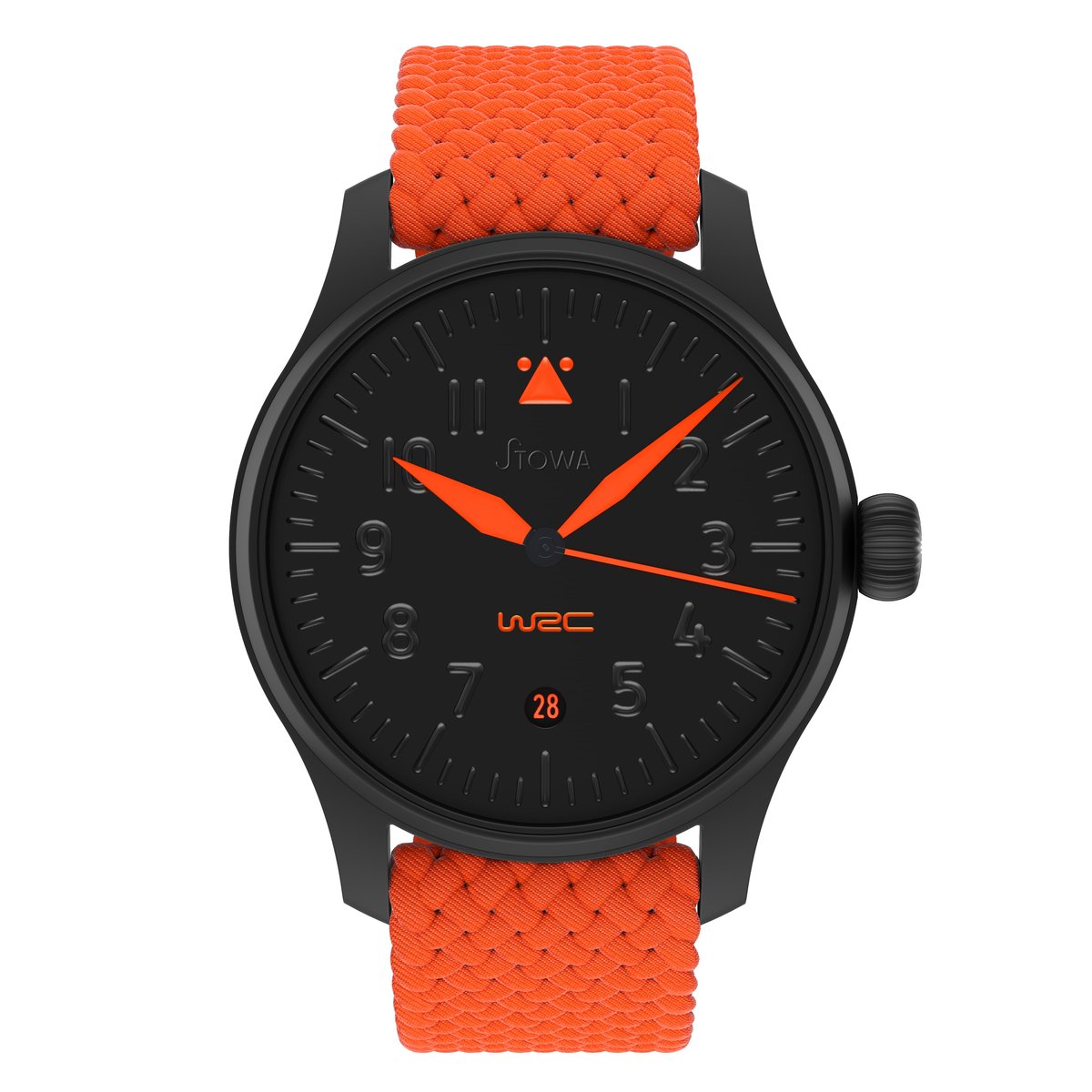
Because the WRC badge is not documented in Stowa's published material, the correct approach is to evaluate it against the house's design language rather than against a specification sheet. Stowa's design vocabulary is narrow, deliberate and consistent, and it gives you a reliable framework for judging any example you encounter.
The first principle is legibility. Stowa dials are built around a hierarchy in which the hour is the primary information, the minute is secondary and everything else recedes. Numerals are either applied or crisply printed, never decorative. Hands are shaped for reading rather than for ornament. Where lume is applied, it is applied for function.
The second principle is restraint in the case. Stowa's stainless steel cases are typically finished with a brushed flank and a narrow polished bevel at the edge — a treatment that keeps the visual mass low and allows light to catch only at the transition. It is a quieter approach than the fully polished cases that dominate the segment, and it wears considerably better over years of daily use, since brushed surfaces hide the small abrasions that accumulate.
The third principle is the caseback as a canvas. Stowa engraves casebacks extensively and often to order — dedications, dates, initials, small emblems. On a small-batch watch this engraving is frequently the most reliable identifying feature, and on an undocumented reference it becomes diagnostically important. If you are evaluating a WRC, photograph the caseback in raking light and compare the engraving quality against known Stowa examples. Crisp, deep, evenly cut engraving with consistent letterforms is what you are looking for; shallow laser marking with soft edges warrants questions.
Movement Architecture and the Finishing Argument
Stowa does not publish a calibre designation for this reference, and we are not going to invent one. What we can do is explain the architectural context, because it is the single strongest argument in favour of buying a Stowa over almost anything else at the price.
The house works on Swiss ébauches rather than manufacturing its own movements, and this is not a compromise — it is a rational allocation of resources. A small workshop in the Black Forest cannot amortise the tooling cost of an in-house calibre across a few thousand watches a year, and any maker who claims otherwise at this price is either subsidising the project from elsewhere or cutting something else. Stowa instead buys well-established Swiss movements and invests the savings into finishing, regulation and hand-assembly labour.
What that means in practice is visible through the caseback. The house's finishing conventions include Geneva stripes on bridges, perlage on the mainplate, blued screws, and engraved or signed components — work that is normally associated with watches costing several multiples of a Stowa. On the hand-wound side, the house has a long and well-regarded tradition built on Unitas and small ETA/Peseux ébauches, where the large bridges offer an honest canvas for decoration. On the automatic side, the work is built on Sellita and ETA base calibres, which are robust, well-understood and straightforward to service.
The practical consequence for a buyer is this: an ébauche-based movement from a maker with rigorous finishing standards is a better long-term proposition than an in-house movement from a maker without them. Parts are available. Independents can service it. The design has been proven across millions of units. Nothing about the ownership experience depends on the manufacturer remaining solvent or cooperative.
If you are evaluating a specific WRC, the movement is where you should spend your inspection time. Ask for a clear, well-lit photograph of the movement through the caseback. Look for evenness in the striping, consistency in the screw slots, cleanliness around the jewel settings, and evidence of a properly regulated balance. A well-finished Stowa movement is legible as such even in a phone photograph.
The Case, the Crystal and What We Decline to State
This review deliberately leaves case diameter, thickness, lug-to-lug, water resistance and jewel count unstated, because none of those figures is confirmed for this exact reference in the material available to us. Substituting a typical value would be a disservice: a buyer reading '40mm' in a review will make a purchase decision on that number, and if the watch is not 40mm, the review has done harm.
What can be said with confidence is that the case is stainless steel, the crystal is sapphire, lume is applied in the Super-LumiNova family, and the standard fitment is a leather strap on a pin buckle. These are consistent with Stowa's published practice across its lines and are the elements you can verify by handling the watch. If absolute certainty on dimensions matters to you — and for a purchase at this level it should — the correct move is to write to Stowa in Engelsbrand with the reference and any serial information. The house is small, the archive is accessible, and a direct enquiry will produce a more reliable answer than any secondary source, including this one.
The pin buckle deserves a word. Deployants are more convenient and protect the strap, but they add bulk under the wrist and interrupt the line of a slim case. Stowa's choice of a pin buckle is period-correct, lighter and quietly consistent with the brand's refusal to add anything that is not necessary. It is the right decision.
On the Wrist
Stowa cases are designed to sit into the wrist rather than on top of it. The lug geometry tends to be short and steeply curved, which means the visual footprint on the wrist is smaller than the raw case measurement would suggest, and the watch settles rather than perches. Combined with the brushed flank and narrow polished bevel, the effect is of a watch with low visual mass — legible, present, but never loud.
The standard leather is supple from the first wear and breaks in quickly, which matters more than buyers expect; a stiff strap on a light watch makes the watch feel insecure. The overall sensation is of lightness and mechanical honesty. If you are accustomed to a heavy steel sports watch, the first day will feel almost insubstantial. By the third day, most wearers stop noticing the watch entirely, which is the highest compliment a daily-wear piece can receive.
Accuracy and Daily Life
Quoting a rate for a reference without a confirmed calibre would be irresponsible. What can be said is that Stowa times and regulates its movements in-house before dispatch, and that the Swiss base calibres the house builds on are stable designs that hold their adjustment for years when serviced on schedule.
The practical advice is empirical. Wear the watch for a month, note the deviation against a reference time source each morning, and record how it behaves in different positions overnight. You will learn more about your specific watch in four weeks than any published figure could tell you, and you will know whether it needs regulation at the next service. Positional variation — how you rest it on the nightstand — will account for more of the observed deviation than anything the factory did.
Service and Ownership
One of Stowa's quiet advantages is that ownership is not locked to a single channel. The house services its own watches in Engelsbrand and, importantly, is willing to supply parts to independent watchmakers. For a buyer considering a reference that is not fully documented, that openness is genuinely valuable: a competent local watchmaker can assess, service and regulate a Swiss-based movement without the watch making a return trip to Germany.
We have not stated a service interval or cost, because neither is confirmed for this reference. The sensible general guidance is to have the watch inspected by a watchmaker if it has been sitting unused for an extended period, and to have it serviced when amplitude drops or the rate becomes inconsistent rather than on a rigid calendar. Mechanical watches tell you when they need attention if you are listening.
Value and the Secondary Market
Stowa's direct-sales model is excellent for a first buyer and neutral-to-poor for a flipper. Because there is no dealer margin in the original price, there is no margin to be recovered on resale, and the depreciation curve is therefore shallower but the liquidity is thinner. The house's well-known Flieger and Marine references hold their value better than an undocumented designation, simply because more buyers recognise them.
That is the honest trade with the WRC. If the watch is genuine and well-kept, you are buying finishing and engineering at a price that reflects neither advertising nor retail rent — which is the correct allocation of money for a discerning buyer. What you are not buying is liquidity. Price it against a documented Flieger or Marine of comparable age and condition, not against aspirational listings, and treat any premium asked for the badge alone with scepticism until the reference is confirmed by Stowa.
Verdict
The Stowa WRC is a watch to buy on the strength of the object in your hand rather than the paperwork, and if the object is a genuine Stowa, the object is likely to be very good indeed. Stowa's engineering culture, hand-finishing, direct-sales integrity and service openness are real, verifiable and rare at this price point. Against that, an undocumented designation demands due diligence: confirm the reference with the manufacturer, verify the movement and any service history, inspect the caseback engraving closely, and price it against a documented sibling.
Do that, and what you have is not a curiosity but a well-made German watch from a house that has spent twenty-five years putting its money into the movement instead of the brochure. That is a proposition worth taking seriously.