A brand built on a grin — and learning when to stop smiling
Studio Underd0g was founded in 2020 by Richard Benc, working out of Hertfordshire with a direct-to-consumer model and a design brief that can be summarised as: take a serious mid-century chronograph layout and dress it in flavours. The Watermelon was the opening statement, and the 01Series that followed — Mint Choc Chip, Blueberry, and a string of collaborations — established a template of small batches, sold at prices that made the mechanical content almost indecent value.
That first series ran the Sea-Gull ST-1901, a hand-wound column-wheel chronograph that gave an entire generation of enthusiasts their first taste of a properly actuated chronograph for the price of a mid-range smartwatch. It was a smart choice, and it carried a limitation: the movement was charming but agricultural, and no brand can graduate to the next tier while its calibre is the least interesting thing about it.
The 02Series is the graduation. By moving to a Swiss Sellita chronograph calibre, Studio Underd0g has removed the only argument its critics had left. What remains is a design question: can a brand known for confectionery dials make something restrained? The Nightshade is the answer, and the answer is yes — provided you accept that restraint here means a dial you have to look at twice rather than a dial that looks at you.
The Nightshade dial: dark matter with a blue bias
The colour is the entire trick, and it is executed with more nuance than the name suggests. In flat, north-facing light the dial settles into something close to charcoal with a cold cast to it — a black watch, essentially, and a very sober one. Tilt it toward a window and the blue rises from underneath the surface like ink blooming in water, saturating the centre first and then pushing outward. It is not a flip-flop effect and it is not a gimmick; it is the sort of layered, angle-dependent finish you normally find two price brackets higher.
Around it, the design is disciplined. The chronograph counters are placed without crowding, the text is minimal, and the whole composition is arranged so that legibility survives the darkness. The hour markers are crisp enough to catch stray light rather than relying on white printing to do the work, which matters enormously on a dial this dark — a black watch with flat, printed indices becomes a silhouette after dusk.
Lume is present in Super-LumiNova, and while this is not a watch built around its night-time performance, the hands and markers hold a readable glow after a few minutes under a lamp. It is a courtesy rather than a feature, which is exactly the right priority for a chronograph of this character.
Case, crystal and the discipline of restraint
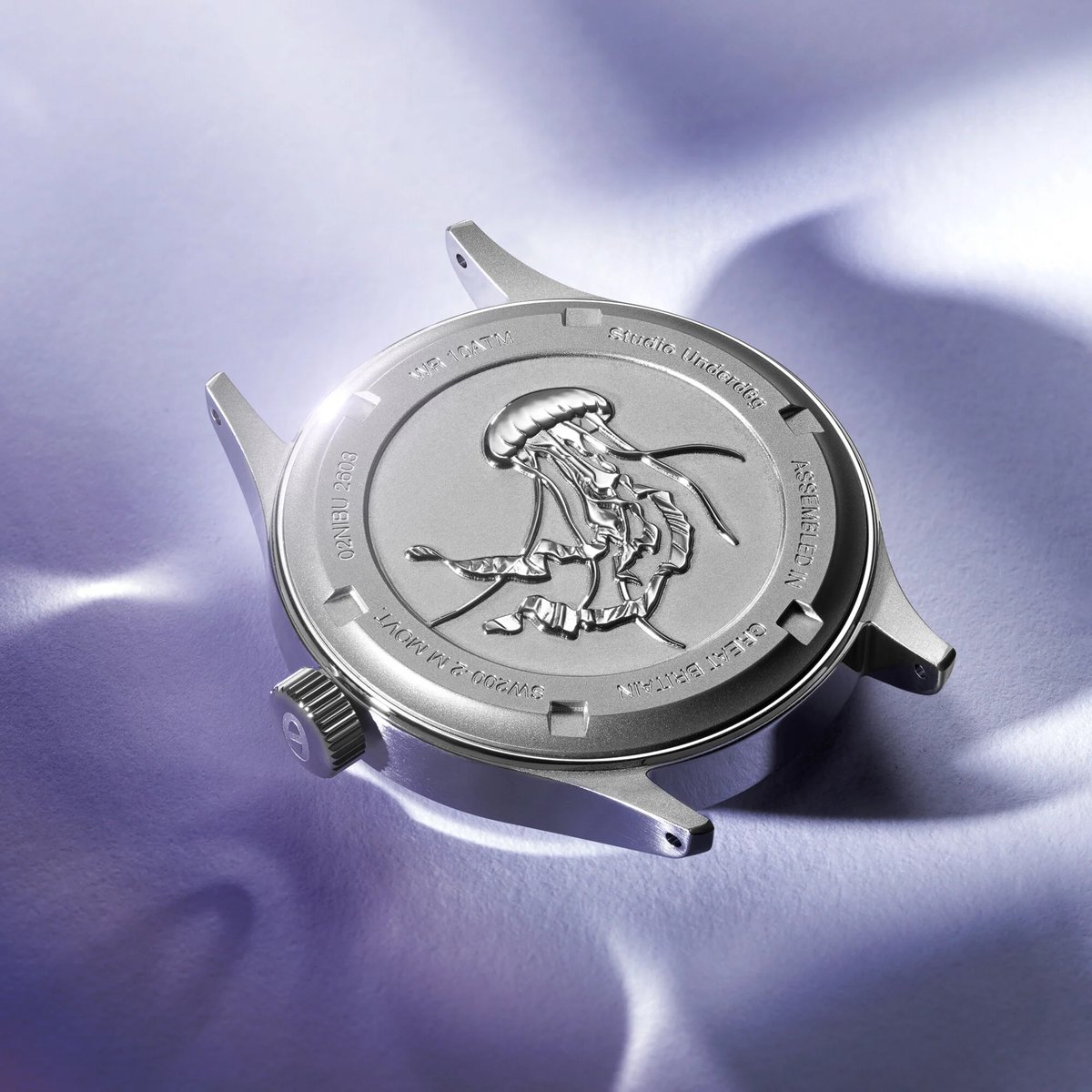
The case is stainless steel, and its proportions are the quiet victory of the 02Series. Studio Underd0g has resisted the temptation to grow the watch into something it is not; the profile is compact, the lugs are shaped to sit down onto the wrist rather than stand away from it, and the whole thing is designed to disappear beneath a shirt cuff. There is a lesson from the mid-century chronographs this watch references: those were not large objects, and their authority came from balance rather than bulk.
Sapphire covers the dial — a necessity rather than a luxury at this point in the market, and the right call for a watch intended to be worn. The finishing across the case is a sensible split of brushed surfaces and polished edges, with enough contrast to keep the steel from reading flat without turning the watch into a mirror. It is a treatment that ages gracefully; polishing is easy to refinish at service, brushing is easy to restore, and nothing here is so elaborate that a decade of wear becomes a problem.
The leather strap is the correct pairing for this dial in a way a bracelet would not be. A bracelet lightens the case and adds a metallic edge that competes with the blue; leather lets the watch sit in shadow, which is where the Nightshade does its best work. The pin buckle is simple and appropriate, and the strap is supple from the first wear rather than requiring a fortnight of breaking in.
Calibre: the Sellita SW510 M b
This is the heart of the argument, and it deserves to be examined properly. The SW510 family descends directly from the Valjoux 7750, an architecture that has been in continuous production since the early 1970s and has been fitted to everything from workmanlike tool chronographs to six-figure halo pieces. Its endurance is not romantic — it is a function of good engineering and a supply chain that will outlive most of us.
The 'M' matters: this is the hand-wound variant, which removes the automatic winding module and the rotor along with it. In practice that means a slimmer movement, a cleaner view of the bridges, and one of the great small pleasures of watch ownership — the daily ritual of winding. The 'b' suffix denotes the version with the modified chronograph function, and the whole assembly runs at 28,800 vibrations per hour, or four beats per second, which gives the sweep a proper mechanical liveliness.
Power reserve is quoted by the marque at approximately sixty hours, which is the figure that changes how you live with the watch. Sixty hours means you can take it off on Friday evening and pick it up again on Monday morning without resetting anything. It also means the mainspring spends most of its life in the flatter, more stable part of its torque curve if you wind it fully and consistently — a point that will matter to anyone who checks their watch against a phone clock out of habit.
Architecturally, this is a cam-actuated chronograph with an oscillating pinion driving the seconds-recording wheel. That is an older solution than the column wheel, and it is the right one here: cam switching is robust, easy to adjust, and produces a positive, slightly mechanical feel at the pushers rather than the silken click of a high-end column wheel. It is honest about what it is. Finishing is commercial-grade Sellita work — clean, consistent, and industrial in intent rather than decorative. Nobody is going to mistake it for a hand-finished calibre, and at this price nobody should.
On the wrist
The first thing you notice is the absence of a rotor. Without that swinging mass behind the dial, the watch carries its weight as a single dense block centred on the case rather than distributed across it. It is a subtle distinction, but it changes the way the watch moves with you — less pendulum, more object. For anyone accustomed to automatic chronographs, the sensation is quietly pleasing in the way that a well-balanced knife is pleasing.
The second thing you notice is that the case stays out of the way. There is no crown digging into the back of the hand, no lug overhang, no sense of a watch wearing you. The strap sits flush against the case at the lugs, and the whole assembly settles within minutes rather than days. This is a watch you can wear from breakfast to a dinner where nobody is supposed to notice your wrist, and it will behave correctly in both settings.
The winding ritual is the dividing line. If you find the idea of thirty seconds with a crown each morning tedious, the Nightshade will annoy you within a month. If you find it a small ceremony — a moment of contact with the mechanism before the day starts — it becomes the reason to own a hand-wound watch in the first place. The pushers, for their part, are firm without being stiff, and the reset snaps back cleanly.
Accuracy and the ownership experience
Sellita's SW510 is regulated to a workmanlike specification rather than a chronometer standard, and no COSC certification is claimed. Expect something in the region of minus five to plus ten seconds per day once the watch has settled after a few weeks of running. Consistency of winding matters more than usual here: a fully tensioned mainspring delivers steadier rates than a half-spent one, so wind it fully at the same time each day and check it against a reference weekly rather than obsessively.
Servicing is the quiet advantage of buying a Sellita-engined watch. The architecture is one of the most widely supported chronograph movements in the world, which means that even where a microbrand's own service network is thin, any competent independent watchmaker can strip, clean and regulate it. That is a real form of long-term value, and it is worth more than a certificate.
Value, service and the secondary market
At just under four figures, the Nightshade sits in the awkward middle of the market — above the quartz-and-meca-quartz tier, below the heritage brands. What the money buys is specific: a Swiss hand-wound chronograph calibre, a dial finished to a standard rarely seen at this price, and a case designed by someone who understands that a chronograph does not need to be large to be authoritative.
What it does not buy is appreciation. Studio Underd0g's production runs sell through quickly, which keeps pre-owned examples close to retail rather than above it, and there is no auction history to speak of. Buy it as a watch; treat any residual value as a bonus rather than a thesis. The trend is stable, and stable is a perfectly good outcome for a design-led microbrand piece.
Verdict
The Nightshade is the moment Studio Underd0g stopped being a punchline and started being a watchmaker. The Sellita SW510 M b gives it a mechanical foundation with decades of service life ahead of it, the Nightshade dial gives it a personality that survives the second look, and the compact stainless case gives it the discipline that the brand's earlier work deliberately avoided.
It is not a watch for anyone chasing a certificate, a complication count or a return on capital. It is a watch for someone who wants a serious, quietly strange chronograph — one that hides in a cuff and then blooms blue when the light finds it — and who intends to wind it every morning. That is a narrower audience than the Watermelon found. It is also a more interesting one to belong to.