Every collection has a drawer watch. Not the beater you take to the gym — the one you reach for when the outfit is already doing the talking and the wrist just needs to agree. For a certain kind of collector, that watch says Timex on the dial. The Addison, in its TW2Y23700 configuration, is the most persuasive argument yet that the American house understands something the Swiss still struggle with: restraint is a flex.
Timex has spent the past decade quietly rebuilding a reputation that never should have needed rebuilding. The Marlin brought back mid-century mechanical charm. The Q reissue turned a plastic-cased oddity into a cult object. The Giorgio Galli S2 proved the brand could play above its weight class without embarrassing itself. The Addison sits at the opposite end of that spectrum — the entry point, the gift watch, the first 'nice' watch for someone who doesn't yet know they're a collector.
Which is exactly why it deserves a proper review. Entry-level watches get dismissed as shopping decisions rather than design decisions. But the Addison is where Timex's design language gets tested hardest, because there is nowhere to hide. No complications to distract the eye. No finishing to admire under a loupe. Just proportion, dial, and the way a bracelet falls off the wrist.
Timex, in one paragraph
Founded in Waterbury, Connecticut in 1854 as the Waterbury Clock Company, Timex is one of the oldest continuously operating watchmakers in America — and the only one that ever genuinely cracked the mass market. The Timex name debuted in 1950 and became the corporate identity in 1969, carried through the 1961 Marlin, the 1986 Ironman and the 1992 arrival of INDIGLO. That lineage matters here for one reason: Timex has always been a design-first, price-conscious house. The Addison isn't a stripped-down luxury watch. It's a fully realized object that was designed to hit a number from the very first sketch, which is a harder discipline than most enthusiasts give it credit for.
What the Addison actually is
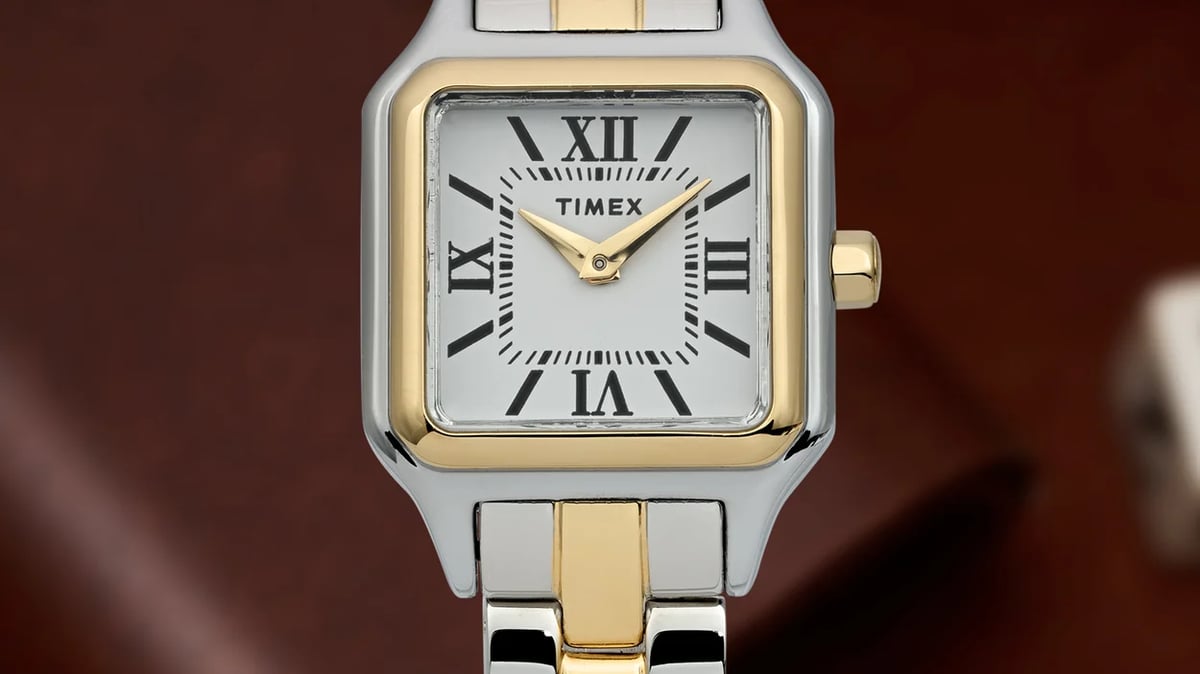
Strip away the marketing and the Addison is a slim, round, stainless-steel dress watch with a clean dial and a fine-gauge mesh bracelet. That's it. That's the whole idea. And in a market that spent the late 2010s drowning in oversized cases, skeleton dials and 'statement' pieces nobody actually wanted to wear, that simplicity is the feature.
The design language is jewelry-adjacent rather than tool-adjacent. The case is deliberately shallow, the lugs are discreet, and the dial is uncluttered enough that the eye lands on the whole object rather than on any one element. There is no lume, no bezel, no crown guards, no branding screaming across the upper half. Timex's own logo is small and quiet. In a category where brands usually over-sign, the Addison under-signs, and it reads as more expensive for it.
The mesh bracelet is the single most important decision in the whole package. Fine-gauge mesh has a fluidity that stamped link bracelets at this price simply cannot replicate — it drapes rather than clanks, it catches light in a way that flatters the steel, and it visually narrows the wrist instead of squaring it off. Mesh is also the great democratizer of dress watches: it's the reason a piece at this price can sit next to a Swiss bracelet watch at a dinner table without looking out of place.
The crystal is mineral, which is the honest compromise at this price. It will pick up hairline scratches over a year of daily wear. You'll notice them in raking light and nobody else ever will.
On the wrist
The Addison's whole pitch is that you forget it's there. The case is shallow and sits low against the wrist, which means cuffs close over it without a fight — the single most underrated quality in a dress watch and the one most brands get wrong by chasing presence. There is no crown digging into the back of the hand, no slab-sided case rocking on the wrist bone.
On a smaller wrist it reads as jewelry rather than as a scaled-down men's watch, which is a distinction the entire entry-level category has historically failed to make. Sized properly, it balances slightly head-light — the correct bias for a piece you'll wear with a blazer, since a top-heavy watch is a watch that migrates around the wrist every time you gesture.
Wrist presence is about a two out of five. It is a whisper, not a statement. It reads as tasteful from across a table and disappears under a cuff, and if that sounds like faint praise, it isn't. There is a specific kind of confidence in wearing a watch that isn't asking to be noticed, and the Addison is built for exactly that person.
The movement, and why it doesn't matter
Inside is a conventional Timex quartz analog module. Timex doesn't publish a caliber designation for the Addison and nothing about the watch asks you to care. It's a stepping quartz movement built for battery-swap simplicity at any jeweler's counter, which means ownership consists of setting it twice a year at daylight saving time and otherwise never thinking about it.
Accuracy is typical quartz: a handful of seconds of drift per month rather than the daily variance of a mechanical. There's no positional variation to learn, no break-in period, no winding ritual. If you want a watch that rewards attention, this isn't it. If you want a watch that never asks for any, this is precisely it — and for a drawer watch, that's the correct answer.
The trade-off is real, though. There is no romance here. No rotor spinning up, no escapement ticking, no relationship between your hand and the mechanism. The Addison is a tool for looking right, and it makes no apology for that.
What Timex doesn't tell you
Timex doesn't publish case dimensions for this reference in the way a Swiss brand would, and we're not going to invent them. What we can say is that the Addison is built around a deliberately compact, shallow case — the kind that slips under a shirt cuff and sits flat on the wrist. Water resistance isn't the point of this watch either; treat it as a desk-to-dinner piece and take something else to the pool.
What is worth flagging is the variant churn. Timex refreshes Addison dial-and-strap combinations seasonally under separate TW2Y references, which means the case and movement stay constant while the dressing changes. If you're shopping, confirm the exact suffix — you may find the same watch on leather, on mesh, or on an expansion band, and the bracelet is the decision that matters most.
The competition
At this price the Addison is fighting on three fronts.
First, Japanese quartz: Seiko's Essentials dress series and Citizen's Eco-Drive models. Seiko matches the brief with a slightly more technical accent and comparable build. Citizen is the more interesting threat, because Eco-Drive removes the battery change entirely — a genuine ownership upgrade for roughly double the money. If you wear a watch daily and hate the idea of a battery swap, that's a real argument.
Second, Swiss entry-level: Tissot's Everytime gives you sapphire crystal and the word 'Swiss' on the dial. It's a better-specified watch. It is also a less interesting one, and it costs meaningfully more for the privilege.
Third — and this is the fight that actually matters — the direct-to-consumer minimalists. Daniel Wellington, MVMT and their many imitators built an entire category on the same aesthetic the Addison occupies, and they did it with borrowed brand equity and no watchmaking history. Timex has 170 years of it. When the design briefs converge, heritage is the tiebreaker, and the Addison wins that on a walk.
Value and ownership
The Addison sits comfortably under $150 and usually closer to $85, which puts it in the rare zone where a watch is cheap enough to buy on impulse and good enough to keep for a decade. It will not hold value. Quartz dress watches at this price are consumables, not assets, and the secondary market will treat it accordingly — expect to lose most of the purchase price the moment it leaves the store.
But that framing misses the point. At this number, depreciation is measured in coffees rather than thousands. Battery replacement is a walk-in service at any jeweler. There is no service interval to budget for, no authorized-only servicing network to navigate, no parts scarcity to worry about. The total cost of ownership over ten years is the purchase price plus two or three batteries.
The Addison is also, quietly, one of the best gift watches on the market. It's the right answer for a graduation, a first job, a wedding-adjacent present, or a partner who wants a nice watch and has no interest in movements. It photographs well, it wears well, and it doesn't require the recipient to learn anything.
The Vivir verdict
The Addison TW2Y23700 is not trying to win an argument about watchmaking; it's trying to win an argument about taste, and it does. It is the rare sub-$150 watch that looks considered rather than assembled, and it slots into a rotation as the piece you wear when you don't want the watch to be the subject of conversation.
Buy it as a gift. Buy it as a first dress watch. Buy it as the thing you keep in the drawer for weddings and interviews and the dinners where somebody's parents are watching. Just don't buy it expecting it to appreciate — buy it expecting to wear it, which is the only thing this watch was ever designed to do.
Who it's for: the collector who already has the loud pieces and needs a quiet one; the person buying their first real watch; anyone who believes a wrist doesn't need to shout.
Who it's not for: mechanical purists, water-sports wearers, and anyone who measures a watch by its resale chart.