The Genesis of Legibility
In 1977, the horological world was in the midst of a tectonic shift. The quartz crisis was no longer a looming threat but a realized reality, and Timex, a brand built on the principle of accessibility, was at the forefront of this movement. The introduction of the Easy Reader was a direct response to a fundamental human need: the ability to tell time instantaneously, without ambiguity. While the Swiss houses were struggling to redefine luxury in the face of electronic precision, Timex leaned into the technology to create a watch that was unapologetically functional.
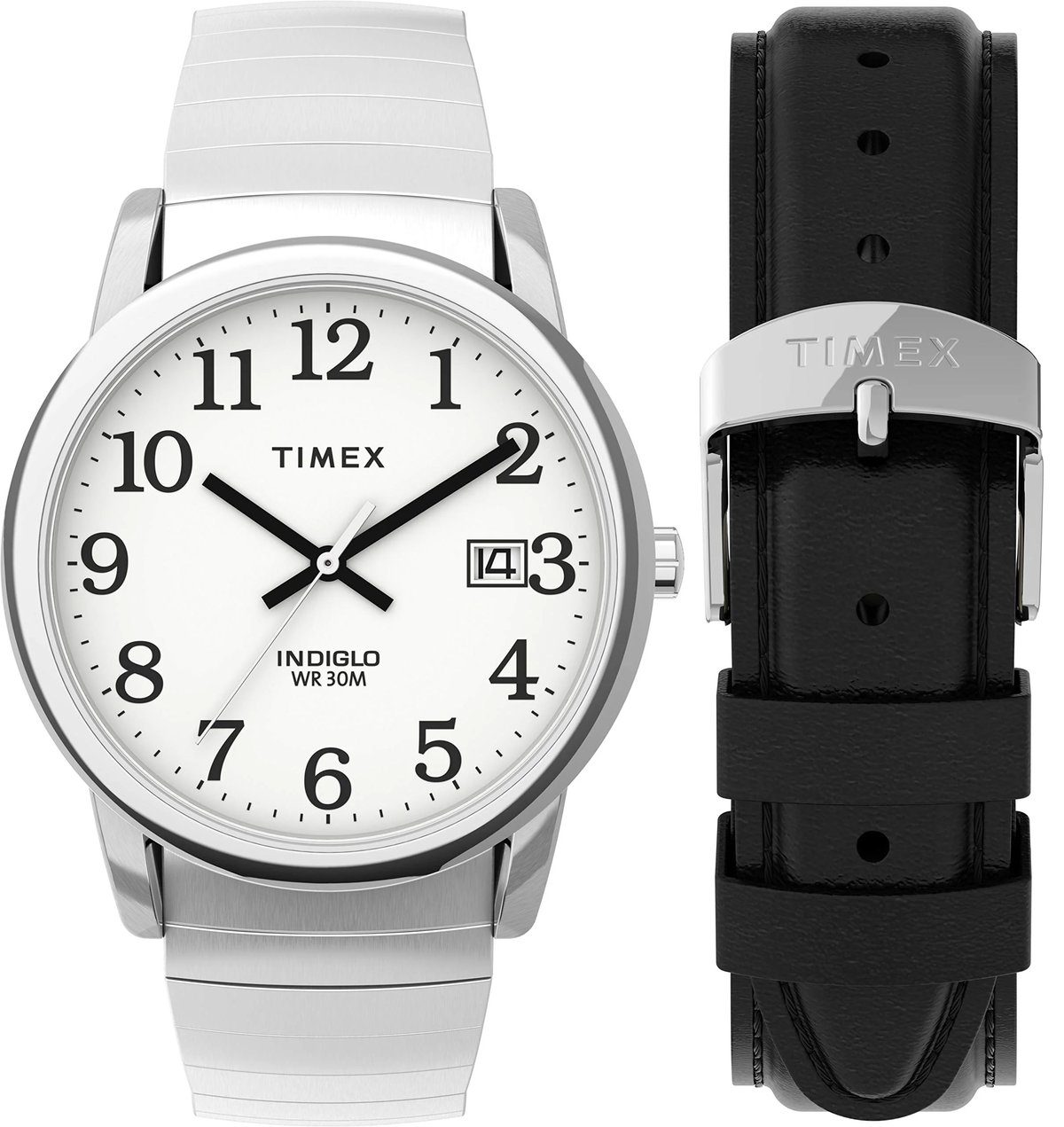
The design of the Easy Reader is often overlooked because of its ubiquity, but from a technical standpoint, it is a triumph of information hierarchy. The high-contrast Arabic numerals are rendered in a bold, sans-serif typeface that maximizes the surface area of the dial. There are no applied indices to catch the light and create distracting reflections; there are no sub-dials to clutter the visual field. It is a pure expression of the 'form follows function' doctrine, a philosophy that Marcus Aldridge has long championed as the bedrock of enduring design.
Architecture and Materiality
The case of the Easy Reader Classic, particularly the 35mm reference, is a study in classic proportions. In an era where 42mm has become a standard, the 35mm diameter serves as a refreshing reminder of mid-century elegance. The case is typically constructed from brass, which is then finished with a high-polish chrome or gold-tone plating. While this choice of material is a concession to cost, it allows for a level of lightness that enhances the overall ergonomics of the piece.
The crystal is a flat mineral glass, which sits slightly proud of the bezel. While mineral glass does not possess the Vickers hardness of sapphire, it offers a period-correct warmth and excellent clarity. The lugs are short and curve downward, ensuring that the strap integrates closely with the wrist. This tight integration prevents the watch from 'floating,' a common issue with entry-level timepieces with poor lug geometry. The case back is stainless steel, snapped into place to protect the movement while maintaining a slim profile of just 8mm.
The Indiglo Revolution
One cannot discuss the Easy Reader without addressing the Indiglo night-light. Introduced in 1992, Indiglo revolutionized the way we interact with watches in low-light conditions. Unlike traditional phosphorescent lume (such as Super-LumiNova), which requires charging by an external light source and fades over time, Indiglo utilizes an electroluminescent panel as the dial itself. When the crown is depressed, an electrical current is passed through a thin layer of zinc sulfide, causing the entire dial to emit a soft, blue-green light.
From a technical perspective, the integration of an EL panel into a watch dial requires precise engineering. The panel must be thin enough to not interfere with the hand stack height, yet durable enough to withstand the vibrations of daily wear. The light produced is perfectly uniform, providing a level of legibility in total darkness that even the most expensive Swiss divers struggle to match. It is a proprietary technology that remains a hallmark of the Timex brand, and its presence in the Easy Reader elevates the watch from a simple time-teller to a sophisticated tool.
The Movement: Quartz Precision
Inside the Easy Reader beats a quartz movement that is the epitome of 'set it and forget it' reliability. While the specific caliber designation—often part of the M-series modules—may not carry the prestige of a chronometer-grade mechanical movement, its performance is objectively superior in terms of timekeeping. The quartz crystal oscillates at 32,768 Hz, a frequency that allows for a degree of precision that mechanical escapements, oscillating at 4 Hz, simply cannot achieve.
The movement is designed for efficiency, with a battery life that typically spans three to five years depending on the frequency of Indiglo usage. The simplicity of the movement architecture also means that it is remarkably robust. Without the delicate balance staff or hairspring of a mechanical watch, the Easy Reader is capable of surviving shocks and drops that would necessitate a costly repair for a luxury timepiece. This is the 'Takes a Licking' heritage in its modern, electronic form.
Wrist Experience and Versatility
Wearing the Easy Reader is an exercise in horological humility. It does not announce itself with the weight of gold or the shimmer of ceramic. Instead, it provides a quiet confidence. The 18mm lug width opens up a world of strap possibilities, though the stock leather strap is surprisingly competent. On a NATO strap, the watch takes on a field-watch persona; on a fine-grain calfskin, it becomes a minimalist dress watch that would not look out of place at a gallery opening or a board meeting.
The lack of a screw-down crown and the 30-meter water resistance rating clearly define its boundaries. This is not a watch for the surf or the shower. It is a watch for the urban environment, for the traveler navigating time zones, and for the professional who values the economy of motion. The 'tick' of the movement is distinct—a rhythmic pulse that serves as a reminder of the watch's mechanical heartbeat, even if that heart is powered by a battery.
The Collector's Perspective
Why does a publication like Vivir, dedicated to luxury and sophistication, cover a watch that costs less than a bottle of vintage Champagne? The answer lies in the concept of horological integrity. A collection that only consists of five-figure timepieces is, in some ways, incomplete. It lacks the context of the industry's broader history. The Easy Reader is a reminder that good design is not exclusive to the wealthy.
For the young collector, the Easy Reader is often the first 'real' watch—the one that sparks an interest in the mechanics of time. For the seasoned veteran, it is the 'beater' that is worn when a Patek or a Rolex would be inappropriate or at risk. It is a watch that transcends social class, worn by US Presidents and factory workers alike. Its appeal is universal because its purpose is singular.
Conclusion
The Timex Easy Reader Classic T2H281 is a masterclass in restraint. It avoids the pitfalls of trend-chasing and unnecessary complication, focusing instead on the fundamental promise of a wristwatch: to tell time clearly, reliably, and affordably. Its 35mm case is a nod to tradition, its Indiglo dial is a triumph of American innovation, and its legacy is one of democratic excellence. In the grand tapestry of horology, the Easy Reader is a thread that connects us all to the simple, profound act of measuring our days. It remains, decades after its debut, a definitive piece of design that deserves a place on every wrist.