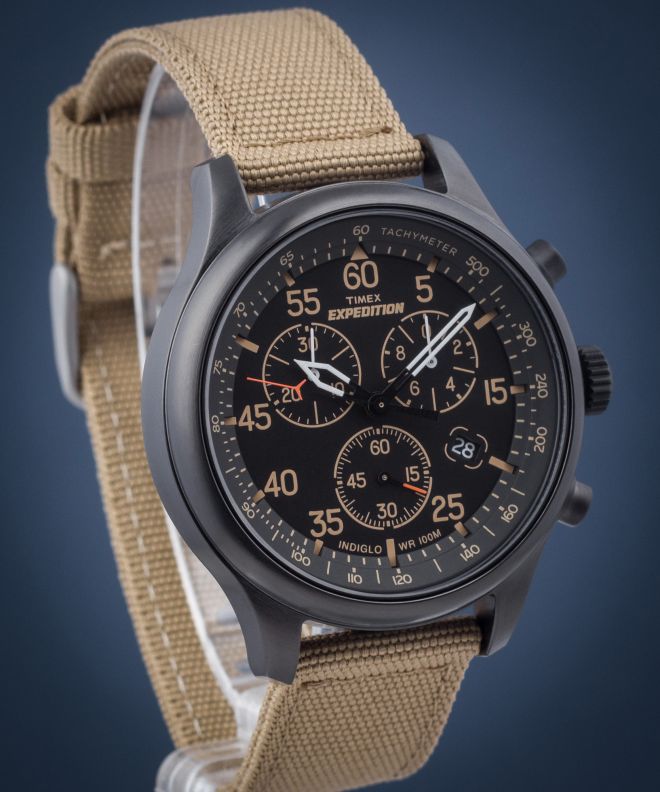
The Watch You Stop Noticing
Most watch writing is about aspiration. This one is about use. The Timex Expedition Field Chronograph spent a week on my wrist — through a desk, a school run, a wet Saturday, two airports and one unfortunate encounter with a doorframe — and the most interesting thing about it is how little I had to think about it. That is a compliment, and in this bracket it is close to the highest compliment available.
Timex has been building the Expedition line for outdoor use since the 1990s, and the Field Chronograph is its most visible ambassador: a three-register quartz chronograph in a matte steel case, with a dial that reads at a glance in bad light, a strap that costs less than lunch, and INDIGLO. It is not trying to be a Hamilton Khaki. It is not trying to be a Speedmaster. It is trying to be the watch you grab when you don't know what the day holds, and on that brief it delivers without fuss.
What follows is deliberately wear-focused: how it sits, how it reads, how the chronograph feels to use, what the finish does after a week of real life, and where the money actually goes. Where Timex does not publish a figure, I say so rather than invent one.
Waterbury, 1854: The Brand That Made Time Ordinary
Timex descends from the Waterbury Clock Company, founded in 1854 in Connecticut's Naugatuck Valley — then the centre of American brass and clockmaking. Its defining contribution came in 1896 with the Ingersoll Yankee, a pocket watch that sold for a dollar and put a timepiece in the pocket of the American working class. The Timex name itself arrived in 1950. In 1992 the brand introduced INDIGLO, the electroluminescent dial that remains the most recognisable thing about a Timex in a dark room.
That history is not decoration; it explains the product. Timex's genius has always been manufacturing scale applied to legibility and durability rather than finishing for its own sake. The Expedition Field Chronograph is a direct descendant of that idea. There is no anglage here, no applied logo, no attempt to convince you that the caseback is interesting. What there is instead is a watch built to a specification and then built millions of times, which is why the specification can include things — a chronograph, 100-metre water resistance, dial lighting — that would be unthinkable from a Swiss house at the same price.
The Expedition family itself sits at the utility end of the catalogue, alongside the Scout and the newer Expedition North Field Mechanical. The Field Chronograph is the busiest of them, and the one most likely to be bought by someone who wants a single watch rather than a collection.
Inside: A Quartz Chronograph, and No Apologies
Timex does not publish a caliber designation for the module inside the Expedition Field Chronograph, and I will not invent one for the sake of a spec sheet. What can be said is that it is a battery quartz chronograph driven by the standard 32,768 Hz quartz oscillator, with a central chronograph seconds hand and the customary multi-register layout of a three-sub-dial chrono. Quartz at that frequency is not glamorous. It is, however, the reason a watch at this price can offer chronograph functionality at all, and the reason you will never pay for an overhaul.
There is nothing to admire through a display back, because there is no display back. That is the honest arrangement: you are not buying architecture, you are buying a mechanism that will run for years on a coin cell and cost you almost nothing to keep alive. Judged as an object of desire the movement is a nullity. Judged as a means of telling time and timing things, it is entirely adequate — and adequacy, delivered reliably, is underrated.
One thing worth flagging for the spec-led reader: Timex publishes very little technical documentation for this reference. There is no jewelled count to quote, no stated frequency beyond the quartz standard, no rated battery life. If you need a datasheet, this is not the watch for you. If you need a chronograph that works, it very much is.
What the Specification Actually Buys You
The case is stainless steel with a matte, blasted-looking finish that is the single best decision in the whole design. Polished surfaces at this price show every micro-scratch within a fortnight and look cheap doing it. Matte surfaces simply absorb wear and begin to look purposeful. After a week of keys, doorframes and a cuffed jacket, the case showed nothing I would call damage — just a slight softening at the lug edges that read as character rather than neglect.
The crystal is mineral, not sapphire. This is the most defensible place to save money on a watch like this, and also the place you will notice. Mineral shows fingerprints generously and collects fine hairlines within weeks. It will not shatter from a knock the way sapphire sometimes can, and it is cheap enough to replace without a second thought, but if you are the sort of person who cannot tolerate a scratched crystal, budget for a polish or a swap.
Water resistance is rated to 100 metres, which is the correct figure for a field watch and far more than most owners will ever use. It means washing your hands, walking through rain, and being splashed at a sink without a second's anxiety — and it means the watch is worth taking on a hike. The strap is leather with a pin buckle, and the less said the better; more on that below.
Lume is present on the dial and hands, and Timex does not specify the compound. In practice it glows and fades on a normal schedule. The real nighttime story is INDIGLO: press the crown and the whole dial lights up an even, slightly cool green-white that makes every index readable at once. It is not elegant. It is enormously effective, and after a week I used it more often than I used the lume.
On the Wrist: Balance, Weight, and the Strap Problem
The Expedition Field Chronograph wears like what it is: a broad, flat-bottomed tool watch on a strap that does most of the ergonomic work. The case sits low against the wrist rather than perching on it, and the lugs curve away quickly enough that there is no digging at the edges of the wrist when you type. Weight is a non-event — you notice the strap long before you notice the watch, which is the correct hierarchy for something in this category.
The supplied leather is the weak link. It starts stiff, creases visibly within days, and the pin buckle sits slightly proud on a slender wrist. Swap it to a NATO or a perlon and the whole thing relaxes immediately; the watch is at its most comfortable on fabric, which is also where it looks most at home. This is not a criticism so much as an instruction: treat the stock strap as a shipping protector and budget twenty dollars for something better.
The chronograph pushers are the other thing you feel before you see. They are positive, with a short, slightly grainy travel and a clean return — not the silky click of a mechanical column wheel, but nowhere near the mushiness this price bracket usually delivers. The crown is small but grippable and pulls cleanly to its single setting position. Nothing about the interaction is luxurious; everything about it is unambiguous, which is what you want at seven in the morning.
Legibility deserves its own sentence. The dial is a study in restraint: printed numerals with strong contrast, hands with enough width to be seen at a glance, and a chapter ring that does not fight the registers for attention. Reading the time while walking is effortless, and reading it in a dark car park is one button away.
Accuracy and the Chronograph Test
A quartz chronograph at this level should be judged against a simple standard: does it drift enough that you notice and adjust? Expect something in the region of fifteen to twenty seconds a month — Timex publishes no tighter guarantee for this module, and none should be assumed. Over a week that is invisible. Over a quarter you will nudge the crown once and forget about it.
The chronograph itself is the more interesting test. Start, stop and reset it repeatedly and the central seconds hand should return to twelve consistently; here it does. That consistency matters more than absolute rate, because a chronograph that resets off-zero is a chronograph you stop trusting, and a chronograph you stop trusting becomes a watch with three useless sub-dials. The pushers also resist accidental activation well enough that I never found the chrono running without knowing why.
There is no hacking seconds to worry about, no power reserve to manage, no positional variation to chart. The ownership experience of a quartz chronograph is essentially the absence of an ownership experience, and for a watch that lives in a bag or a glovebox or on a wrist that does not want to be fussed over, that is the entire point.
Where It Goes
This is a daily wearer first and everything else second. On leather it passes in an office where nobody is inspecting wrists; on a NATO it is a weekend and travel watch without qualification. It is at its best on a hike, in an airport, at a market, or anywhere the day is unpredictable. It is not a dress watch and should not pretend to be one — the matte case and printed dial will read as casual no matter what strap you fit.
Travel is its strongest secondary use. Two time zones are not on the menu, but a chronograph is genuinely useful for timing a connection, and the INDIGLO backlight is a small revelation in a darkened cabin. Add 100-metre water resistance and a case that does not care about being shoved into a rucksack pocket, and you have a watch that improves a trip rather than requiring care during one.
The Variants and the Family
Timex cycles Expedition colourways relentlessly, and the reference most buyers will encounter is the T49905 — black dial, white printed numerals, brown leather. The T499059J is the retail-channel catalogue code for the same watch; functionally there is nothing to choose between them, and which one you find depends on market and stock. Beyond that, treat the model as a design language rather than a fixed specification: dial colours, strap materials and case finishes rotate constantly, and Timex does not maintain a stable, documented reference ladder in the way a Swiss house would.
The wider Expedition family is worth understanding before you buy. The Scout is the simpler time-only sibling. The Expedition North Field Mechanical is the enthusiast's choice, with a hand-wound movement and a more considered case. The Metal Field and Rugged models sit between them. If you specifically want a chronograph, the Field Chronograph is the answer; if you want the best Expedition for the money and do not need the registers, the mechanical North is the more interesting watch.
Alternatives Worth Considering
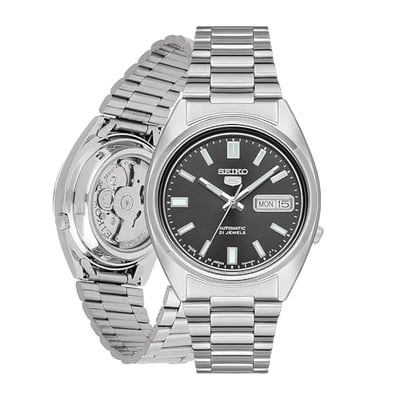
If you want an automatic field watch for a little more, the Seiko 5 Sports SRPG27 delivers the same visual intent with a mechanical movement and a bracelet. If you want to eliminate the battery entirely, the Citizen Eco-Drive Chandler Chronograph charges from light and steps up the case finishing. If you want the value-quartz-chronograph formula without the field styling, Seiko's Essentials SSB chronographs are the closest direct rival. And if you are already planning an upgrade before you have bought this one, the Hamilton Khaki Field Mechanical is the watch most Expedition owners eventually talk themselves into — at roughly four times the price, and with four times the emotional weight.
Below the Timex, the Lorus RT3 series and the Casio Edifice EFV-100D both do a version of this job for less. Neither is better. Both make clear how much the Timex is getting right at its price.
Value, Service, and the Honest Maths
At a street price somewhere in the hundred-dollar range — and often less on promotion — the Expedition Field Chronograph is one of the least complicated value propositions in watches. Pre-owned examples trade well below retail, which means the secondary market is a genuine option and the depreciation is real but irrelevant at this scale. This is not a watch that will appreciate, and no one should pretend otherwise. No notable auction history exists for the reference, and none ever will.
Servicing is a battery swap at any jeweller, plus a gasket check whenever the caseback comes off. Timex does not publish an official service interval for the module, and no overhaul schedule is required. That is a meaningful ownership advantage: there is no looming five-hundred-dollar service bill to weigh against the purchase, and no decision about whether the watch is worth fixing. It either runs or it needs a new cell.
The correct way to think about the money is cost per wear against usefulness. A watch that you wear four days a week for five years and that never asks anything of you has justified its price several times over, regardless of what it is worth on a forum.
Verdict
The Timex Expedition Field Chronograph is not a watch you covet; it is a watch you use, and it is unusually good at being used. Its chronograph feels better than the price suggests, its dial is legible in the dark, and it survives water, doors and Monday mornings without complaint. The strap is mediocre and the crystal will scratch, and neither of those things matters as much as the fact that you will never hesitate to put it on.
Buy it as a first chronograph, a travel watch, or the thing you keep in the glovebox. Just do not buy it expecting the strap to be the best part — and do not buy it expecting it to be worth more later. Buy it because a legible, waterproof, illuminated chronograph that you never think about is a genuinely rare thing, and this one costs less than a decent dinner.