Brand history and context
Timex traces its origins to the Waterbury Clock Company, founded in 1854 in Connecticut. The brand became a global byword for dependable, affordable timekeeping, and the Weekender distills that democratic brief into a simple field watch. Where many heritage brands trade on exclusivity, Timex built its reputation on availability: watches that could be bought, used and relied upon by people who were not collectors.
The Weekender belongs to that lineage. It is not a reissue of a military-issued watch, nor is it a precious object with a carefully managed production run. It is a modern interpretation of the field watch idea: clear numerals, a high-contrast dial, a strap that can be swapped quickly and a case that does not demand careful handling. The TW2R92100 continues that tradition with a leather strap and a cream-toned dial that feels slightly more refined than the fabric-strap versions.
Case, dial and crystal
The TW2R92100 uses a 38mm brass case with a stainless steel case back. The size is one of the Weekender's quiet strengths: it is large enough to read easily but small enough to avoid dominating the wrist. The brass case gives the watch a warm, slightly informal character, and it will develop a patina over time. That is not a flaw in a watch at this price; it is part of the ownership experience. The case is rated to 30 meters, which is enough for daily wear and accidental splashes but not for swimming or diving.
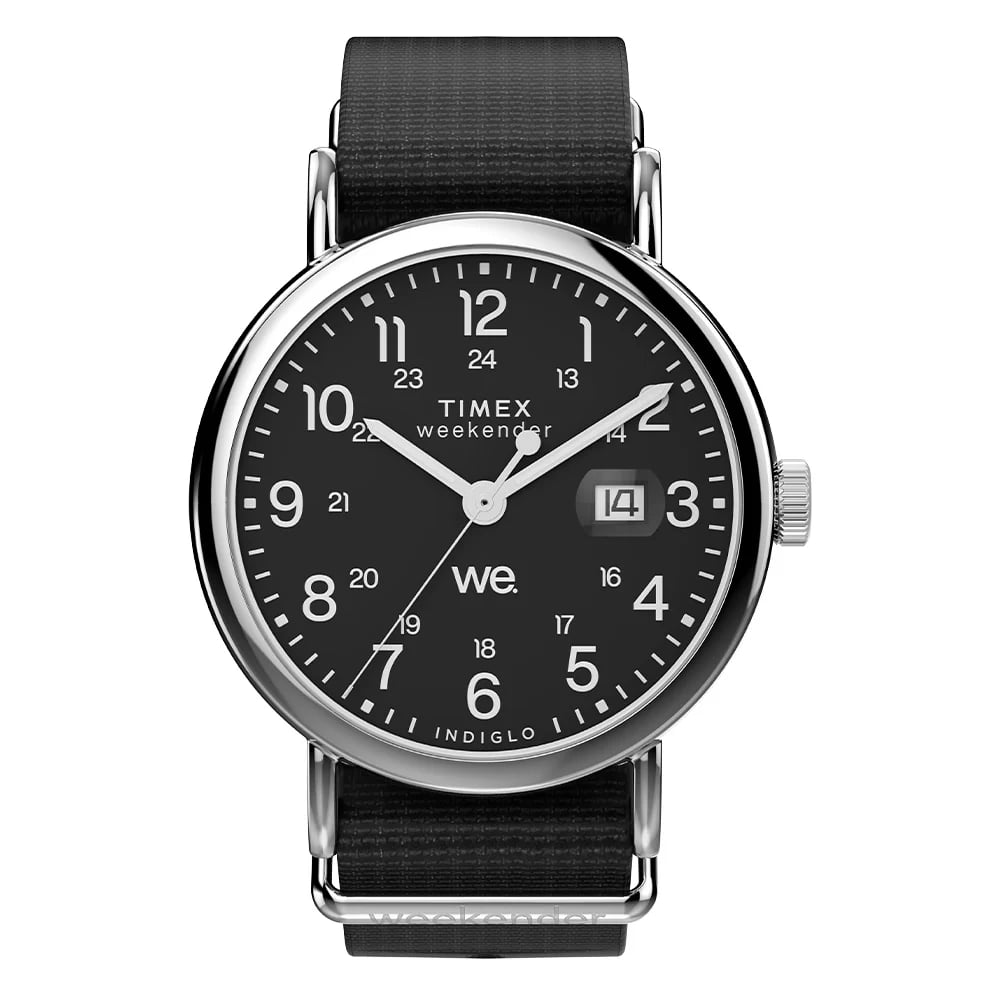
The dial is the heart of the Weekender. It is cream-toned, with bold Arabic numerals and a simple minute track. The layout is clean and unfussy, and the absence of a date window keeps the symmetry intact. Legibility is excellent in most lighting conditions, and the Indiglo backlight provides on-demand illumination at night. There is no lume, so the Weekender relies on Indiglo rather than phosphorescent paint. For a field watch, that is a reasonable trade-off: Indiglo is brighter and more consistent than most entry-level lume.
The crystal is mineral glass. It is not as scratch-resistant as sapphire, but it is appropriate for the price and easy to replace if it does pick up marks. The leather strap is secured by a pin buckle, which is simple, reliable and easy to adjust. The strap itself is the main variable in the ownership experience: a supple leather strap makes the watch immediately comfortable, while a stiffer one may need a few days to break in.
Movement and accuracy
The TW2R92100 is powered by a Timex quartz analog movement. Timex does not publish a caliber designation for this reference, and there is no decorative finishing to discuss. That is not a criticism. The movement is chosen for reliability, low cost and low maintenance. It runs on a battery with an expected life of roughly one to two years, depending on usage and the Indiglo backlight. The quartz oscillator runs at 32,768 Hz, as is standard for quartz watches.
Accuracy is typical of a good quartz movement: expect variation in seconds per month rather than seconds per day. The Weekender is not COSC-certified, and it is not presented as an in-house calibre. What matters is that it starts instantly, keeps time predictably and does not require winding or setting if it is worn regularly. When the battery begins to fade, the Indiglo backlight may dim or the seconds hand may stutter. That is the signal to have the cell replaced.
For collectors accustomed to mechanical watches, the quartz movement may feel anonymous. But the Weekender is not trying to compete on movement architecture. It is competing on utility, and on that front the quartz module is the correct choice. It keeps the watch affordable, light and dependable, which are the qualities that matter most in this category.
Wrist feel and presence
On the wrist, the Weekender reads as a small, light, unobtrusive watch. The 38mm brass case and leather strap keep mass low, and the pin buckle allows a wide range of adjustment. It sits close and disappears under a cuff, but the dial remains legible at a glance. The strap is the main contact point; a supple leather strap makes it comfortable from day one, while a stiff one may need break-in.
The watch does not feel precious, and that is part of its appeal. There is no heavy bracelet to balance, no sharp case edge to manage and no sense that the watch must be protected from daily life. It is the sort of piece that can be worn for a full day without a second thought, which is exactly what a field watch should deliver. Wrist presence is low: this is a 2/5 watch in the best sense. It is not trying to be noticed, and it does not need to be.
Occasions and daily use
The Weekender is at its best as a daily watch. It is casual enough for weekends, robust enough for travel and legible enough for sport. It is not a formal watch, and it does not pretend to be. The cream dial and brown leather strap give it a slightly warmer character than the black-dial fabric-strap versions, which makes it easier to wear with casual shirts and knitwear. It is also an excellent travel watch: light, easy to read and inexpensive enough that losing it would not be a catastrophe.
For collectors building a small rotation, the Weekender serves as a useful palate cleanser. After a week of wearing a heavy automatic, the Weekender feels almost weightless. It is a reminder that a watch does not need to be complex to be satisfying. It also works well as a first watch for someone who is not yet ready to think about mechanical servicing, power reserves or winding routines.
Reference variants and family context
The TW2R92100 sits within a broad Weekender family. The reference under review pairs a cream-toned dial with a brown leather strap. The T2N654 is a closely related Weekender with the same field-watch formula, while the T2N651 offers a darker, more utility-focused look with a black dial and black fabric NATO strap. Other family references include the TW2R63100 and the Weekender Chronograph, which add different case sizes and complications to the same basic design language.
Within Timex's wider catalogue, the Weekender sits alongside the Marlin, the Q Reissue, the Expedition and the Ironman. Each serves a different purpose. The Marlin leans more dressy, the Q Reissue leans more design-led, the Expedition leans more outdoor-focused and the Ironman leans more athletic. The Weekender is the everyman of the group: the simplest, most versatile and least self-conscious option.
Similar watches and alternatives
Buyers considering the Weekender often cross-shop a few obvious alternatives. The Seiko 5 Sports SRPG27 is an automatic field-style watch with more mechanical character and a higher price. The Hamilton Khaki Field Mechanical is the step-up mechanical field watch for buyers who want hand-winding and heritage. The Casio MQ24 is a near-disposable quartz alternative that shares the Weekender's low-cost, legible brief. The Braun BN0032 is a design-led quartz watch with a cleaner, more architectural dial.
True homages to the Weekender are rare, because the watch is already at the affordable end of the market. The Casio MQ24-7B is not a direct copy, but it shares the same low-cost, no-fuss intent. For most buyers, the Weekender is the original affordable field watch, and there is little reason to look for a cheaper imitation.
Investment value and ownership
The Weekender is not an investment. Its MSRP is around $60, current retail is typically around $55, and pre-owned examples trade in the $20-$40 range. The trend is depreciating, as it is for most quartz watches at this price. Auction history is essentially nonexistent. That is not a criticism; it is simply the nature of the category. The Weekender is a utility purchase, and its value is realized on the wrist rather than in a safe.
Service is equally straightforward. Battery replacement is inexpensive and widely available, and there is no need to send the watch to an authorized service center for routine maintenance. Any competent watchmaker can replace the cell. The brass case will develop patina over time, which some owners will enjoy and others will not. The mineral crystal can scratch, but it is easy and inexpensive to replace. Overall, ownership costs are low, which is part of the watch's appeal.
Pros and cons
The Weekender's strengths are clear: excellent legibility, a light and comfortable case, the Indiglo backlight, affordable service and remarkable strap versatility. Its weaknesses are equally clear: the mineral crystal can scratch, the quartz movement lacks mechanical character, there is no date function and the brass case will develop patina. For some buyers, the absence of a date is a virtue; for others, it is a dealbreaker. The same is true of the brass case. This is not a watch for someone who wants a pristine, scratch-resistant object. It is a watch for someone who wants a legible, comfortable daily companion.
Final verdict
The Timex Weekender TW2R92100 is not a luxury object, and it does not pretend to be. It is a precise, legible, comfortable quartz field watch that delivers the essentials with unusual clarity. For young collectors, it is a useful benchmark: a reminder that good design and honest utility can coexist without a five-figure price. It will not hold value, and it will not impress anyone who judges a watch by its movement. But it will tell the time, look good doing it and ask almost nothing in return. That is a rare combination at any price.