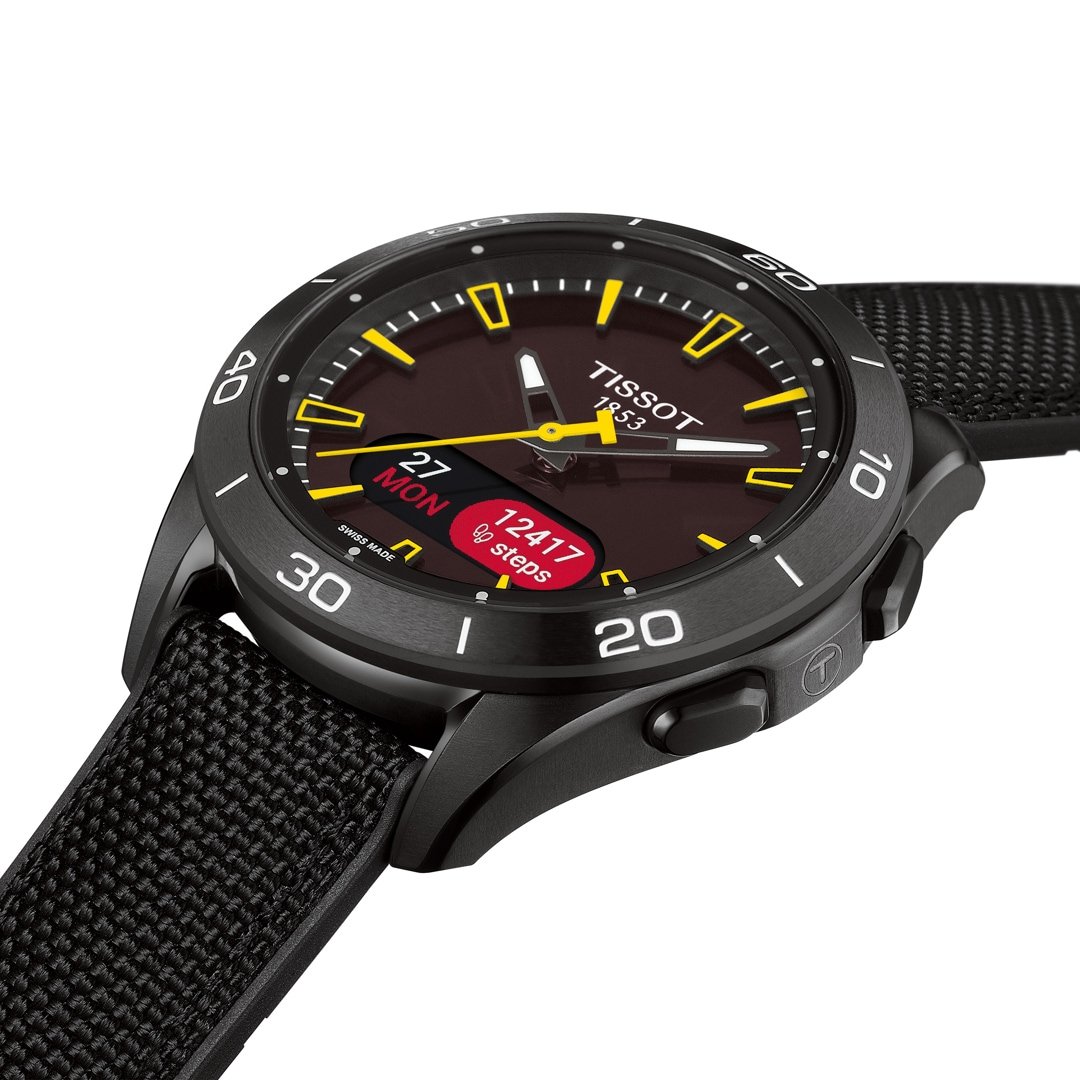
First impressions: a Tissot that happens to be connected
Most connected watches start with the screen and work backwards. The T-Touch Connect Sport starts with a watch. There is a titanium case, a bezel that means business, a sapphire crystal with the capacitive layer Tissot has been refining since the original T-Touch of 1999, and a pair of physical hands sweeping over a digital display that you mostly will not notice until you want it. Only then do you register the Bluetooth radio, the sensors, the app.
That ordering matters more than any single specification. A connected watch lives or dies on whether you want to wear it on the days you do not need it, and the Connect Sport clears that bar comfortably. The Jungfraubahn edition adds a story — the railway climbing to the Jungfraujoch, one of the defining pieces of Swiss alpine engineering — and dresses the platform accordingly. What it does not do is change the fundamentals, which is why this review is mostly about the platform and only partly about the edition.
Tissot in thirty seconds
Founded in Le Locle in 1853 by Charles-Félicien Tissot and his son Charles-Émile, Tissot has spent the last several decades as the Swatch Group's value-and-volume standard bearer: the brand that gives you genuine Swiss watchmaking at prices that make the Swiss-ness feel like a bonus rather than a tax. It is also, quietly, the group's technology laboratory for consumer-facing watch tech. The T-Touch was the first touch-screen watch, full stop, and the crystal-as-interface idea has survived every generation since.
The Jungfraubahn tie-in is not as random as it looks. Tissot has a long history of alpine and expedition-adjacent tool watches, and a watch with a compass, an altimeter and a barometer is a natural partner for a railway that spends its entire existence climbing a mountain. You are not buying a piece of railway history — you are buying a themed version of a capable outdoor watch — but the connection is coherent rather than mercenary.
What the edition actually changes
Let us be clear about this, because special editions are where watch brands do their most creative accounting. The Jungfraubahn edition is a T-Touch Connect Sport with edition-specific detailing and presentation. The case material, the crystal, the interface, the module and the sensor set are the platform's, not the edition's. If you are weighing this against a standard Connect Sport, the decision should be made on the aesthetics and on whether the alpine references appeal to you, not on any assumption that the special series is a better watch.
Where the edition earns its keep is in restraint. This is not a novelty watch with a mountain printed across the dial; the tie-in is expressed in the finishing and the detailing rather than in a shout. That means it will still look appropriate in five years, which is more than can be said for most themed sports watches. It also means it will not appreciate, so do not let anyone sell you a story about collectability.
On the wrist: the part that matters
The Connect Sport is titanium, and titanium is doing a lot of work here. On the wrist the watch is light in a way that reframes the whole category: there is no pendulum swing when you turn your hand, no sense of a device hanging off you, none of the wrist fatigue that makes people take a smartwatch off at seven in the evening. The case is broad across the top rather than tall, so it sits flat and stable, and the bezel is shaped in a way that does not constantly catch on a shirt cuff. That last point sounds trivial until you have spent a week with a watch that snags on everything.
The rubber strap is integrated into the case design rather than dangling off thin lugs, and that is the difference between a watch that stays put and one that rotates around your wrist all day. I wore it loose enough to be comfortable through a full working day and it never migrated. The buckle is a conventional pin, which I prefer to a deployant on a rubber strap — fewer moving parts, less to catch, easier to adjust when your wrist swells in the heat.
The one caveat is visual footprint. This is not a small watch, and it is not trying to be. On a slim wrist it will read as a proper piece of outdoor kit, which some people love and others find overbearing. Try it on. If you are coming from a conventional 42mm-plus sports watch, the transition will feel like a relief rather than a shock.
Legibility: the hybrid advantage
Here is where the analogue-plus-digital layout quietly beats both pure smartwatches and pure analogue tool watches. In bright sun, the physical hands with their lume are readable instantly, without waking a screen or angling your wrist. Indoors, in a meeting, at night, the digital layer takes over and gives you time, date and whatever function you have dialled up, in a display that can be dimmed to something socially acceptable.
The tactile sapphire does take a little learning. It is not a phone touchscreen, and it is not trying to be; the interaction is deliberate, sometimes fiddly, and rewards muscle memory. By day three I had stopped thinking about it. By day seven I was navigating without looking, which is the correct test for any interface. If you expect iPhone immediacy you will be disappointed; if you expect a tool watch that happens to have a screen, you will be fine.
The connected layer, honestly assessed
The Connect Sport pairs with Tissot's app over Bluetooth and pushes notifications, tracks activity, and gives you the sensor suite: compass, altimeter, barometer, plus the timers and alarms you would expect. It does the job. It is not a Garmin, and Tissot has never pretended otherwise — there is no serious training analytics, no maps, no recovery metrics worth the name. What there is, is a watch that tells you the time, tells you when someone is trying to reach you, and can point north when the fog comes down on a ridge.
The notification behaviour is the part I found most useful in real life: a discreet buzz, a glance, no need to pull a phone out of a pocket in a meeting or on a train platform. And because the watch looks like a watch, nobody at the table thinks you are checking Instagram. That is a small thing that adds up over a week.
The honest limitation is that connected features are the fastest-ageing part of any watch. Software support, app compatibility and smartphone Bluetooth standards will all move on. The case will still be titanium in a decade; the connected experience is on a shorter clock. Buy accordingly.
Solar, quartz and the no-charger life
The movement is a hybrid: a conventional quartz timekeeping side driving the hands, and a connected side with its own electronics. Solar assistance is the headline, and its practical benefit is that in watch-only mode you simply do not think about power — the dial does the work, and the watch keeps going. How often you need to top it up depends entirely on how hard you lean on the connected functions. Heavy notification use and frequent sensor sessions ask more of the battery; a week of watch-first wearing asked almost nothing.
There is no romance here. No balance wheel, no finishing to admire through a caseback, no servicing ritual every five years. What you get instead is a tool that does not need your attention. For a daily wearer, that is a legitimate trade — arguably a more honest one than a mechanical watch that demands winding and a service bill.
Accuracy
In connected use the watch syncs time from your phone, which syncs from the network, which means it is effectively exact. That is the mode most owners will live in and it removes the quartz-versus-mechanical accuracy argument entirely. Standalone — Bluetooth off, phone left at home — it behaves like a conventional quartz watch, with the usual tolerance that technology implies, and you will want to resync if you care about being within a few seconds.
Over a week of mixed use, including a long stretch deliberately out of range of my phone, it never needed adjusting and the hands stayed aligned with the digital layer. That alignment is the classic failure point on hybrid watches, so it is worth checking on any example you buy, new or pre-owned.
Strap and buckle
The rubber strap is the right call for this watch and, I suspect, the configuration most people should buy. It is comfortable from the first hour, indifferent to sweat and rain, and it makes the titanium case feel even lighter than it is. The pin buckle is simple, secure and easy to adjust. The titanium bracelet versions exist and look sharper with tailoring, but they add weight and formality to a watch whose whole appeal is that you forget you are wearing it.
A week of occasions
This is a genuine one-watch week. It went under a shirt cuff without drama, handled a wet weekend without complaint, sat through meetings without drawing attention, and did not embarrass itself at dinner. It is not a dress watch and it does not pretend to be — a PRX or a Le Locle will do that job better — but as a daily wearer that covers work, travel, sport and everything in between, it is remarkably complete.
I would not treat it as a dive watch, and I would check Tissot's current stated rating before planning anything involving prolonged immersion. This is a mountain-and-city watch, not a dive computer, and the Jungfraubahn edition in particular is pointed at altitude rather than depth.
Price and value
The Connect Sport sits in the low four figures in US dollars, and the Jungfraubahn edition lands in the same neighbourhood — roughly one thousand to twelve hundred dollars depending on market, configuration and how the edition is packaged. That is a meaningful amount of money, and it is worth being precise about what it buys: a titanium Swiss case, a tactile sapphire, solar-assisted independence, a mature interface and a watch that looks like a watch. It does not buy you a Garmin's analytical depth, and it does not buy you an appreciating asset.
On the secondary market these trade well below retail, as connected quartz watches always do, because the electronics age faster than the casework. If you are patient, a used example is the smarter purchase. If you want the edition, buy it because the detailing pleases you and accept that the premium is emotional rather than financial.
Service and ownership
Ownership is straightforward but not open-ended. The casework is standard titanium sports-watch fare, but the sealed sensor and connectivity module is not something an independent watchmaker will want to open, so service runs through Swatch Group's authorised network. Budget for that, and accept that at some point in the watch's life the connected side may become the limiting factor rather than the movement. That is the price of admission for the category, not a Tissot-specific flaw.
Alternatives worth considering
If data depth matters most, a Garmin Fenix or an Apple Watch Ultra will run rings around this — at the cost of looking like a device. If you want the same solar-and-sensors brief for less money, the Casio G-Shock GBD-H2000 and the Pro Trek line deliver an astonishing amount of function. If you want luxury-smartwatch presentation, TAG Heuer's Connected is the obvious step up, at four times the price. The T-Touch Connect Sport's case rests on being the most watch-like connected watch at its price, with genuine Swiss casework and a solar system that means watch-only use never needs a charger. That is a narrow but real advantage.
Verdict
The T-Touch Connect Sport Jungfraubahn is a better watch than it is a gadget, and that is meant as praise. It is light, flat, legible and comfortable enough that you forget the technology until you want it, and the alpine edition dresses the package with enough restraint that it will not date badly. The connected layer will age, the resale will fall, and the special-edition badge is worth nothing at auction. None of that changes the central fact: as a thing to wear every day, it works.
Buy it if you want one watch for work, travel and the outdoors that still feels like a piece of Swiss watchmaking. Skip it if you need real training analytics, or if you are buying with any expectation of holding value. Those are two different purchases, and Tissot has been honest about which one it is selling.
Pros
- Light, flat and genuinely comfortable on titanium and rubber
- Solar assistance means watch-only mode never needs a charger
- Analogue hands plus digital layer work in every light condition
- Reads as a tool watch rather than a gadget
- Swiss case finishing at a price the smartwatch establishment cannot match
Cons
- Connected features date quickly and drag resale down with them
- Service is authorised-network only
- The tactile crystal interface has a learning curve
- Special-edition status adds no long-term value
- Generous visual footprint — try before buying if your wrists are slim