Trilobe Trente-Deux (Ref. 3201AS) – The Investor’s Conundrum
The luxury watch market is a strange beast. We’ve seen the meteoric rise of steel sports watches, the absurdity of the Patek Philippe Nautilus hype, and the recent cooling of the secondary market. In this climate, the independent watchmaker is a double-edged sword. They offer exclusivity that the big conglomerates can’t, but they lack the liquidity that makes a watch a true asset. The Trilobe Trente-Deux sits firmly in this camp.
Let’s be clear: this is not a watch for the faint of heart or the weak of portfolio. It’s a cerebral machine that challenges the very concept of reading time. But when you’re dropping north of $12,000 on a steel watch with a leather strap, you have to ask yourself: what’s the exit strategy? In this review, we’ll dissect the 3201AS from a market perspective, analyzing the brand’s trajectory, the movement’s technical merit, and the cold, hard reality of its resale value.
Brand History: The French Paradox
Founded in 2013 by Gautier Massonneau, Trilobe is a relatively young player in the high-end independent scene. Unlike the seasoned artisans of the Vallée de Joux, Trilobe is a Parisian operation that leverages modern design and outsourced base components (initially) to create a distinct identity. Their early work, the Une Fois, used a modified ETA movement. The Trente-Deux, however, marks a significant leap forward as it houses the DTH-1 caliber, a fully in-house movement developed in partnership with the renowned movement maker Le Cercle des Horlogers.
This is a crucial point for investors. The transition to an in-house movement signals brand maturity and a long-term commitment to high-end manufacturing. It also justifies the price tag, at least on paper. However, the brand’s distribution is still incredibly limited, and their presence in the secondary market is almost non-existent. This is the paradox of the modern micro-brand: they produce exceptional pieces, but they lack the historical depth that drives auction prices.
Movement Analysis: The DTH-1 Caliber
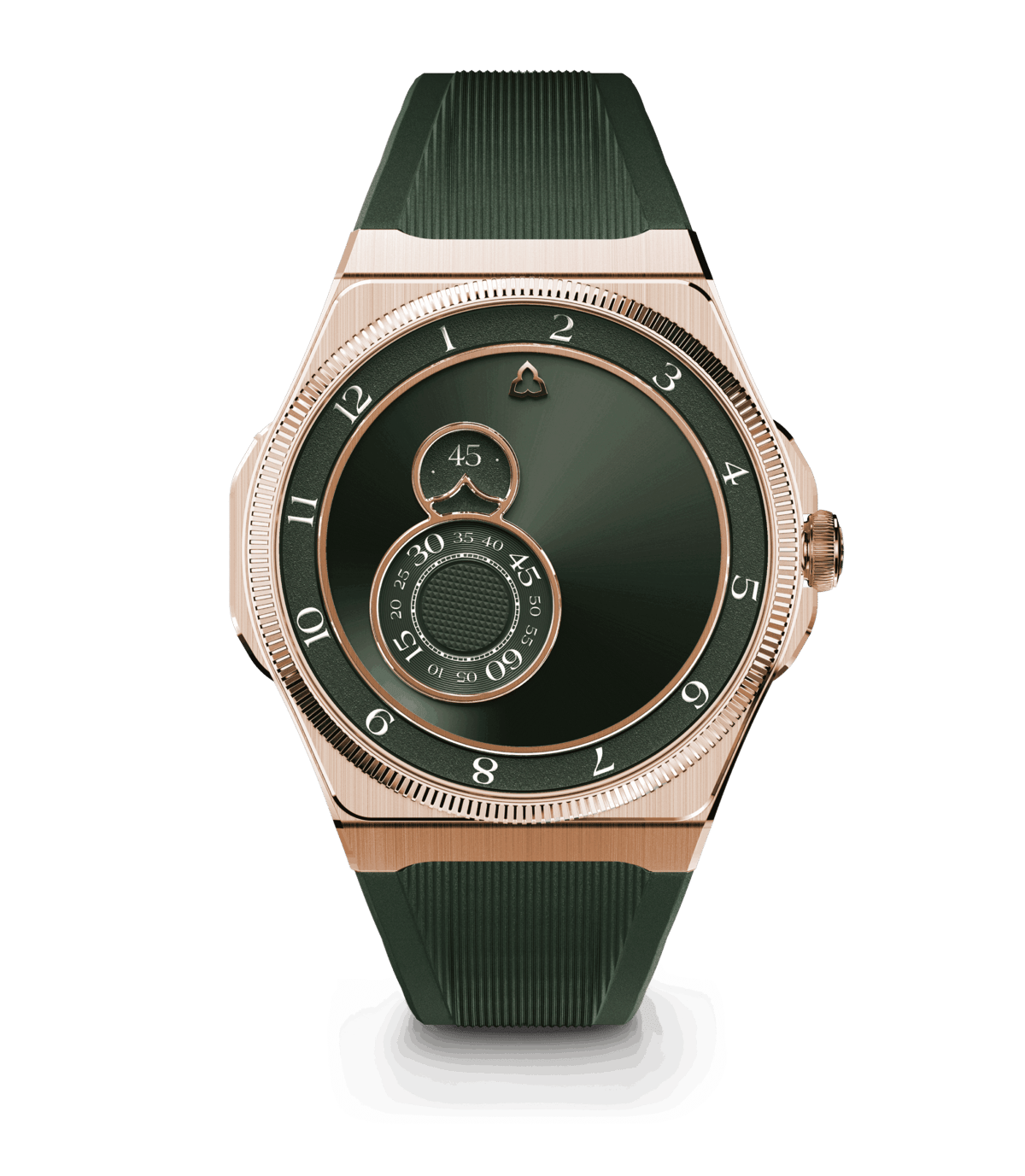
The heart of the Trente-Deux is the Calibre DTH-1. This is a marvel of micro-engineering. Instead of traditional hands, the time is displayed on three concentric rotating discs. The hours are indicated on a disc at the 12 o’clock position, the minutes on a large disc that dominates the lower half of the dial, and the seconds on a small disc at the 6 o’clock position. A fixed pointer—the 'poetic complication'—on the sapphire crystal indicates the time.
Technically, it’s fascinating. The micro-rotor in 22k gold is beautifully skeletonized, and the bridges feature a contemporary angular design that appeals to modern collectors. It runs at a standard 28,800 vph and offers a 48-hour power reserve, which is on the lower end for modern standards. The finishing is good, but it’s not Haute Horlogerie level. There’s no hand-bevelling or black-polished screws; it’s more architectural and industrial. For the money, you’re paying for the intellectual property and the complexity of the module, not for the traditional finishing.
Case & Design: The Anti-Flex
The 40.5mm case is a lesson in restraint. It’s not a sports watch, but it’s not a classic dress piece either. It’s an 'anti-flex' that signals a deep understanding of horology. The brushed steel case is understated, allowing the dial to do the talking. The dial, with its concentric rings and the absence of hands, creates a sense of depth that is mesmerizing.
Wearing it, you’ll find that it’s surprisingly comfortable. The 9.5mm thickness is a triumph, especially given the complexity of the movement. It slides under a dress cuff with ease. The lume, Super-LumiNova X1, is applied to the discs and the pointer, ensuring legibility in the dark, which is a nice touch. But the strap is a letdown. At this price, a simple pin buckle on a leather strap feels cheap. You’d expect a deployant clasp, at least.
Market Performance & Resale
Here’s where the rubber meets the road. The MSRP for the 3201AS is $12,500. On the pre-owned market, you can find these for around $8,000 to $9,500. That’s a depreciation of roughly 30% immediately. This is not a 'safe queen' investment. It’s a car that loses value the moment you drive it off the lot.
Why? Because the demand curve is incredibly shallow. The pool of buyers looking for a handless French watch is tiny. You’re competing with the likes of H. Moser, Laurent Ferrier, and even Greubel Forsey. These brands have a stronger collector base and a more established history. Trilobe is still in its infancy, and the market is waiting to see if they can sustain their momentum.
If you’re looking to flip this for a profit, you’ll be disappointed. However, if you’re building a diversified collection and want a piece that represents the cutting edge of contemporary watchmaking, this is a strong 'hold' candidate for a 10-20 year period. If Trilobe becomes the next big thing (and they have the potential), the Trente-Deux will be a coveted first-generation piece.
Alternatives & The Competitive Landscape
In the same price bracket, you have the H. Moser & Cie Pioneer Centre Seconds, which offers a superb in-house movement and better brand recognition. You also have the Ressence Type 1, which uses a similar oil-filled disc system, though it’s more expensive and even more niche. For the investor, these alternatives offer better liquidity. For the collector, the Trilobe offers a unique aesthetic that is arguably more original than anything else on the market.
Final Verdict
The Trilobe Trente-Deux (3201AS) is a masterpiece of design and a testament to the creativity of independent watchmaking. But as an investment, it’s a speculative asset. It’s a 'buy to keep' for the true enthusiast, not a 'buy to flip' for the flipper. If you have the disposable income and appreciate the poetry of a handless dial, this is a worthy addition. Just don’t expect to make a profit.