Tudor Pelagos Review: The Titanium Diver That Refuses to Be a Status Symbol
There is a specific kind of collector who buys a Pelagos. They are not the person who wants to be asked about their watch at dinner. They are the person who wants to be asked about their watch by another diver, on a boat, in the rain, at 6 a.m. The Tudor Pelagos has spent more than a decade as the quiet answer to a loud question, and in a market where every brand is chasing hype, that has quietly become its own kind of flex.
Launched in 2012 as Tudor's modern titanium tool diver and rebuilt from the inside out in 2015 with an in-house movement, the Pelagos occupies a strange, enviable pocket of the market. It delivers genuine 500-metre capability, a helium escape valve, a full titanium case and bracelet, and a movement with a 70-hour power reserve — for roughly the price of a steel chronograph from a mid-tier Swiss house. Nothing about it is designed to impress a stranger. Everything about it is designed to survive one.
This review covers the core 42mm Pelagos, reference 25600TN, along with the wider family — the Pelagos 39, the FXD, the LHD, and the new-for-2025 Pelagos Ultra — and explains why this line matters more to the modern dive-watch conversation than its sales figures suggest.
Born to Dare, Built to Get Wet
Tudor was registered as a brand by Hans Wilsdorf in 1926 and started producing watches in the early 1930s, positioned deliberately below Rolex: same distribution muscle, same obsession with reliability, less precious metal and less ceremony. The strategy worked because Tudor went where Rolex was too expensive to go — onto the wrists of actual working divers.
From the 1950s through the 1980s, Tudor Submariners were issued to the French Navy's Marine Nationale and to US Navy dive units. Those watches were beaten, salt-crusted, and repaired with whatever parts were on hand. They are also, today, some of the most collectible Tudors in existence — a fact that gives the Pelagos a legitimacy no marketing campaign can manufacture.
The Pelagos name comes from the Greek word for the open sea, and when Tudor revived the idea in 2012 it went further than a Submariner homage. The original reference 25500TN arrived as a 42mm titanium diver with 500 metres of water resistance, a helium escape valve, and a matte black dial with the brand's signature snowflake hands. It ran an ETA 2824. Good watch, borrowed heart.
Then came 2015 and the reference 25600TN, which is the watch most people mean when they say Pelagos. Tudor dropped in the in-house MT5612, added COSC certification, and effectively declared independence from the supplier-movement era. It was the moment Tudor stopped being Rolex's budget arm and started being Tudor.
Who Actually Wears It
Tudor's ambassador roster — David Beckham, Lady Gaga — sells the Black Bay. The Pelagos sells itself to a different crowd. It is the watch you see on the wrist of the sailor, the offshore engineer, the pilot who dives on weekends, and the collector who already owns a Submariner and wants something he can actually scratch.
The strongest cultural signal came in 2021, when Tudor developed the Pelagos FXD directly with the French Navy's Marine Nationale — a rare case of a modern dive watch built to a military brief rather than a marketing one. The carbon-cased Alinghi Red Bull Racing editions that followed pushed the same platform into America's Cup sailing, and the FXD chronograph took it into endurance racing. The Pelagos is the one line in Tudor's catalogue that earns its credibility outside of a boutique.
The Movement: MT5612
The MT5612 is an automatic, in-house, COSC-certified calibre with a 70-hour power reserve and a 4 Hz beat rate. It uses a silicon balance spring — resistant to magnetism and temperature drift — along with a variable-inertia balance with micro-adjustment screws and a transverse balance bridge for stability under shock. Winding is bidirectional, which keeps the rotor quiet and the power reserve topped up on the move.
Finishing is industrial rather than decorative. You will find sandblasting and clean, purposeful surfaces rather than Geneva stripes and hand-bevelled bridges, and Tudor does not pretend otherwise. This is a movement designed for a life of service intervals and saltwater, not for a display caseback. The Pelagos has always had a solid caseback, and that is a philosophy statement as much as a cost decision.
In practice, the 70-hour reserve is the specification owners brag about. Take the watch off Thursday night, put it back on Monday morning, and it is still running and still accurate. That is a genuinely useful feature, not a spec-sheet flex.
Case, Bezel, and the Clasp That Steals the Show
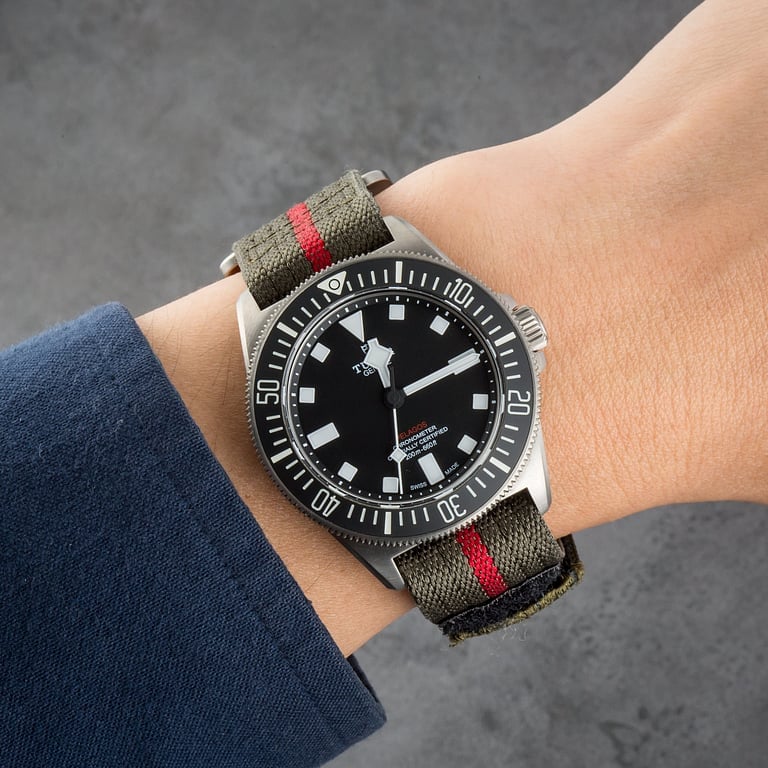
The 42mm case is titanium, satin-brushed throughout, and rated to 500 metres. A helium escape valve sits on the left flank for saturation divers — a feature almost nobody will use and almost everybody likes having. The crystal is sapphire with anti-reflective treatment, the dial is matte with high-contrast white markers, and the date sits at 3 o'clock without a cyclops, which keeps the dial clean and the symmetry intact.
The bezel is unidirectional with a matte insert and lume-filled graduations, and the action is firm and precise — the kind of bezel you can set with wet gloves and trust not to drift.
Then there is the bracelet. Tudor's titanium bracelet for the Pelagos uses a folding clasp with a spring-loaded auto-adjust system: the bracelet physically expands and contracts with your wrist as temperature and blood flow change. It also carries a diver's extension for wetsuit wear. It is the single most over-engineered, most useful piece of hardware in the entire dive-watch segment at this price, and it is the reason a lot of owners never take the included rubber strap out of the box.
How It Wears
Titanium changes everything. The Pelagos feels dramatically lighter than a steel Submariner of comparable presence — you notice it when you pick it up, and then you stop noticing it entirely, which is the point. The matte grey finish keeps it visually quiet and hides scratches better than polished steel, though it will pick up scuffs and character over time.
The 42mm case is the honest caveat. On a smaller wrist it wears large, and the slab-sided profile makes it read bigger than the number suggests. If you are under roughly seven inches of wrist, the Pelagos 39 exists precisely for you, and it is not a compromise — it is arguably the better watch. On a larger wrist the 42mm sits exactly where a tool diver should: substantial, balanced, and completely unbothered by a shirt cuff.
One more thing worth saying plainly: titanium scratches. It will not polish back to new the way steel does, and the matte finish collects honest wear. If that bothers you, this is the wrong watch. If it does not, the Pelagos will look better in five years than it does today.
Accuracy in the Real World
The MT5612 is COSC-certified, which means it left the factory running within -4 to +6 seconds per day. In practice, owners routinely report better than that — most examples settle into a range of roughly -2 to +4 seconds per day, and many run within a second or two of perfect. The silicon balance spring helps here: it shrugs off the magnetic fields that wreck conventional movements, which matters in a world of laptop speakers, phone cases and hospital corridors.
Expect to check it against a reference time once a month, adjust it once, and forget about it. That is the correct relationship to have with a tool watch.
The Family: Every Pelagos You Can Buy
The core 25600TN is the black-dial titanium-bracelet version; the 25600TB is the same watch with a blue dial. Both ship with a rubber strap in the box. The 25610TNL, known as the LHD, moves the crown to the left side for left-handed wearers and uses cream-coloured lume for a warmer, more vintage-leaning look.
In 2021 Tudor went back to its military roots with the Pelagos FXD, developed with the Marine Nationale. The FXD uses fixed strap bars instead of spring bars, drops the date and the helium valve, is rated to 200 metres, and runs a bidirectional bezel with a countdown scale for underwater navigation. It is the purest expression of the line. Carbon-cased Alinghi Red Bull Racing editions and an FXD chronograph followed, pushing the platform into racing as well as diving.
The Pelagos 39, reference 25407N, arrived in 2022 and answered the single loudest complaint about the original: size. At 39mm, with 200 metres of water resistance, no date, and a T-fit clasp, it is the Pelagos for people who like the idea of a Pelagos more than the reality of wearing one. It has become the enthusiast favourite of the family.
And in 2025, Tudor pushed the line into genuinely extreme territory with the Pelagos Ultra: a 43mm titanium diver rated to 1,000 metres and certified as a Master Chronometer by METAS, making it the most technically ambitious Pelagos yet.
The Competition
Against the Rolex Submariner Date, the Pelagos loses on finishing, brand gravity and resale — and wins on titanium, water resistance, power reserve and price by a wide margin. The Submariner is jewellery that dives. The Pelagos is a dive instrument that happens to look good.
Against the Omega Seamaster Diver 300M, it is a closer fight. The Omega brings METAS Master Chronometer certification, a ceramic dial and a dressier, more polished presence. The Tudor brings titanium, a more legible dial and a genuinely better clasp. Pick based on whether you want a watch that looks expensive or one that looks employed.
The Sinn U50 and U1 offer German submarine steel, Tegimented cases and tool-watch purity for less money — but no titanium, no in-house movement and far less wrist presence. The Blancpain Fifty Fathoms Bathyscaphe sits several tiers up in price and history; it is the ancestor, not the competitor.
Homages and the Budget Route
The Pelagos is one of the most homaged dive watches on the market, largely because its design language — matte dial, snowflake hands, squared markers, titanium grey — is easy to approximate and hard to nail. San Martin's titanium Pelagos-style divers deliver the silhouette and the material for around $250, with a reliable Japanese-derived automatic inside. Tandorio's titanium NH35 divers go even lower, near $175, and are a legitimate way to test whether the look works on your wrist before committing four figures.
What you do not get at that price is the movement, the 500 metres, the helium valve or the clasp. You get the costume, not the capability. That is a fair trade for some buyers and a dealbreaker for others.
Value, Resale, and Whether to Buy
Tudor's US pricing for the 42mm titanium-bracelet Pelagos has sat in the mid-$4,000s to just under $5,000 in recent years, with the Pelagos 39 landing slightly below it and the FXD and Ultra above. That puts the Pelagos in direct competition with the Omega Seamaster 300M and comfortably below the Submariner — a positioning Tudor has exploited ruthlessly.
On the secondary market, expect the 42mm Pelagos to trade in the $3,000 to $4,200 range depending on reference, condition and whether the box and papers are present. Earlier ETA-powered 25500TN examples sit at the bottom of that band. The trend is mildly depreciating: this is not a watch that appreciates, and Tudor has never pretended otherwise.
Which is exactly why it is a good buy. Buy a Pelagos because you want to wear a titanium dive watch with an in-house movement and a 70-hour reserve every day for the next fifteen years. Do not buy one as an investment. There is no auction market for Pelagos references — the saleroom action sits with its ancestors, the Tudor Submariners issued to the Marine Nationale, which trade for multiples of a new Pelagos when they surface.
Servicing
Tudor does not publish a hard service interval, and the honest answer is that a healthy MT5612 can go five to seven years between services, longer if it is running well and staying dry. A full service through an authorized Tudor centre typically runs several hundred dollars, and parts availability strongly favours the authorized route. Independent watchmakers can and do work on the MT56xx family, but if you want genuine components and a warranty on the work, go through Tudor.
Pros and Cons
Pros: titanium case and bracelet at a price no competitor matches; 500 metres of water resistance with a helium escape valve; a genuinely excellent in-house movement with 70 hours of reserve; the best auto-adjusting clasp in the segment; and a design that has aged without a single embarrassing update.
Cons: the 42mm case wears large on smaller wrists; titanium scratches and cannot be polished back to new; the solid caseback hides the movement; resale is soft; and if you want a watch that gets noticed, this is not it.
The Verdict
The Tudor Pelagos is the most honest watch in the $5,000 bracket. It does not pretend to be a Submariner, it does not chase trends, and it does not ask you to baby it. It is a titanium instrument with a serious movement, a serious depth rating, and a clasp that embarrasses watches costing three times as much.
If you have the wrist for 42mm, buy the 25600TN and wear it into the ground. If you do not, buy the Pelagos 39 and stop reading reviews. Either way, you are getting the best value in modern Swiss diving — and a watch that will still be relevant when the hype cycle has moved on to something else.