Introduction: The Quiet Return of the Flieger
The pilot watch is having a renaissance. Not the flashy, oversized, multi-register chronographs that dominated the early 2000s, but the clean, three-hand, Type A flieger that traces its DNA back to the Luftwaffe's original B-Uhr specifications. Tutima has been building these since before most of today's hype brands existed, and the Grand Flieger Classic ref 6102-01 is their modern take on the genre. It doesn't scream for attention, and that's exactly the point.
I spent a week with the 6102-01 — the black dial, leather strap configuration — wearing it to the office, on a weekend trip, and through a few too many airport security lines. What I found is a watch that understands its job: legibility above all, with a build quality that feels more expensive than the price tag suggests. But in a market flooded with affordable flieger homages and luxury icons like IWC, does the Tutima carve out a meaningful space? Let's dig in.
This isn't a watch for the flex. It's for the person who knows that a true tool watch doesn't need a ceramic bezel or a display caseback to prove its worth. It's for the collector who'd rather have a German-made movement ticking away quietly than a logo that everyone recognizes. And in 2025, that's a surprisingly refreshing proposition.
Brand History: From Glashütte to the Modern Era
Tutima was founded in Glashütte, the historic heart of German watchmaking, in 1927. After World War II, the company relocated to Lower Saxony, where it continues to produce pilot watches with a focus on legibility and robustness. The Grand Flieger line is a direct descendant of the brand's military aviation heritage, originally supplying chronographs to the German Air Force in the 1940s. That legacy matters — it's not a marketing gimmick; Tutima actually built instruments for pilots who relied on them in life-or-death situations.
Today, Tutima occupies a middle ground in the German watch landscape: above the budget microbrands like Laco and Stowa, but below the luxury tier of A. Lange & Söhne or Glashütte Original. The Grand Flieger Classic is their bread-and-butter model, a watch that has remained largely unchanged for years because it doesn't need to change. It's a tool, and tools are perfected, not redesigned every season.
Movement: A Workhorse, Not a Showpiece
Inside the Grand Flieger Classic beats an automatic movement based on either the ETA 2824-2 or Sellita SW200-1 — Tutima doesn't officially disclose which, but both are functionally identical. It's a 25-jewel, 28,800 vph caliber with a 38-hour power reserve, hacking seconds, and a quickset date at 3 o'clock. No, it's not in-house, and no, it's not COSC-certified. But it's a movement that has powered millions of watches for decades, and for good reason: it's reliable, accurate enough, and cheap to service.
Finishing is utilitarian. You won't find Geneva stripes or perlage through the solid caseback, but the rotor is signed and the regulation is solid out of the box. If you're the type who flips a watch over to admire the movement, this isn't for you. If you're the type who sets it, forgets it, and checks the time three days later to find it's still within a minute, you'll be happy.
Specs and Build Quality
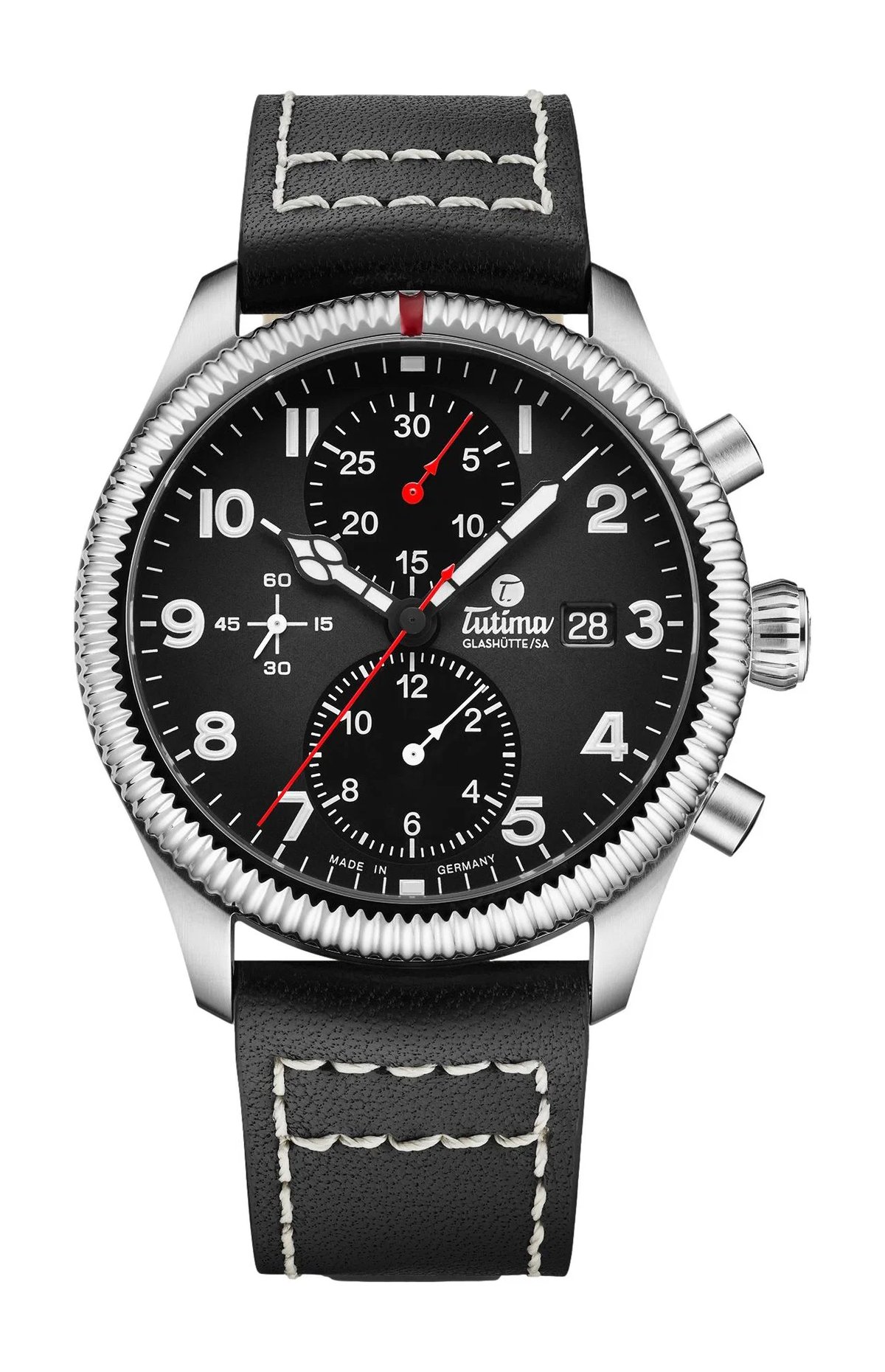
The case is 41mm in diameter, 12.5mm thick, and 50mm lug-to-lug — dimensions that hit the sweet spot for a modern flieger. It's made of stainless steel with a brushed finish that hides scratches well, and the sapphire crystal is flat with anti-reflective coating on the inside. Water resistance is 100 meters, which is more than enough for daily wear and the occasional splash, though I wouldn't take it diving.
The dial is the star: matte black with large white Arabic numerals, a triangle at 12 o'clock, and syringe hands filled with Super-LumiNova. The lume is decent but not exceptional — it glows green for a few hours after a full charge, but it won't compete with Seiko's Lumibrite or Rolex's Chromalight. The date window at 3 o'clock is white-on-black, which keeps the dial symmetrical and unobtrusive.
The strap is a thick, supple leather with contrast stitching and a signed pin buckle. It's comfortable out of the box and will develop a nice patina over time. No bracelet option on this reference, but the lug width is 20mm, so you can easily swap in a NATO or aftermarket bracelet if you want.
Wrist Feel: Comfortable and Purposeful
On the wrist, the Grand Flieger Classic wears exactly as a pilot watch should: present but not obnoxious. The 41mm case is large enough to maintain the instrument-panel aesthetic, but not so big that it overhangs a shirt cuff. The 12.5mm thickness keeps it low-profile, and the curved lugs hug the wrist nicely. The leather strap is supple from day one, with a signed pin buckle that feels secure without being fussy.
Weight is balanced, with the stainless steel case providing a reassuring heft without becoming a burden during all-day wear. The crown is large and easy to grip, a nod to the original pilot watches that were designed to be operated with gloves. There's no micro-adjustment on the clasp, but the strap has enough holes to find a comfortable fit for most wrist sizes.
Accuracy: What to Expect Day to Day
Out of the box, expect the ETA/Sellita base to run within +/- 10 to 15 seconds per day. Mine settled at +8 seconds per day after a week of wear, which is perfectly acceptable for a non-COSC movement. The hacking seconds make it easy to set precisely, and the movement is stable across different positions. If you're picky, any competent watchmaker can regulate it to within a few seconds per day for a small fee.
Occasions and Wrist Presence
This is a daily wear watch, pure and simple. It works with jeans and a t-shirt, business casual, and even a suit if you're not too precious about dress watch conventions. It's also a great travel companion — the legibility is superb in low light, and the 100m water resistance means you don't have to baby it. Wrist presence is a 3.5 out of 5: understated but purposeful. It won't stop conversations, but it earns quiet respect from those who know what they're looking at.
Reference Variants and Family
The reviewed reference 6102-01 is the black dial on leather. Tutima offers the Grand Flieger Classic in other dial colors — blue, silver, and white — and with a stainless steel bracelet on some variants, though exact reference numbers vary by market. Within the Grand Flieger family, you'll also find the Airport (with a more modern dial design), the Classic Chronograph, and the earlier 38mm Automatic. Other notable Tutima models include the M2 Seven Seas dive watch, the Saxon One, and the high-end Patria line.
Competition and Alternatives
The flieger space is crowded. At the luxury end, the IWC Pilot's Watch Mark XX is the benchmark, with an in-house movement and a price tag around $5,000. Stowa's Flieger Classic 40 is a direct competitor from another German brand with similar heritage and a more affordable price (around $1,000). Sinn's 556 A offers a cleaner, more modern dial and excellent build quality for about $1,300. And Laco's Augsburg 42 is a budget-friendly option at under $500. The Tutima sits comfortably in the middle: more refined than the Laco, less expensive than the IWC, and with a heritage story that rivals Stowa's.
Homages and the Value Proposition
If you just want the look, there are plenty of homages. The Seiko SNK809 at $150 is a beloved entry-level pilot watch with a similar dial layout. The Orient Flight at $200 adds a day-date complication. And the Tisell Pilot 40mm at $250 nails the B-Uhr aesthetic at a fraction of the cost. But none of these have the build quality, heritage, or long-term serviceability of the Tutima. You're paying for the name, yes, but also for the assurance that this watch was designed by people who actually built instruments for pilots.
Investment and Service
The Grand Flieger Classic retails for around $1,800, and pre-owned examples typically trade between $1,000 and $1,500. It's a stable value, not an appreciating asset. Buy pre-owned if you can find one in good condition — the depreciation hit is already absorbed, and the watch will hold its value reasonably well as a niche German tool watch. There's no major auction history; these trade hands quietly on forums and secondary markets.
Service is straightforward: the ETA/Sellita base movement can be serviced by any competent independent watchmaker for around $300 every five years. No need to send it back to Germany unless you want the full factory treatment.
Final Verdict
The Tutima Grand Flieger Classic is a textbook example of a watch that knows exactly what it is and refuses to pretend otherwise. It's not flashy, not innovative, and not trying to be the next hype piece. What it delivers is a pure, legible, comfortable pilot watch with genuine German heritage and a price that feels fair. If you want a flieger that you can wear every day without worrying about scratches or service costs, this is a strong contender. Just don't expect it to turn heads at the country club.