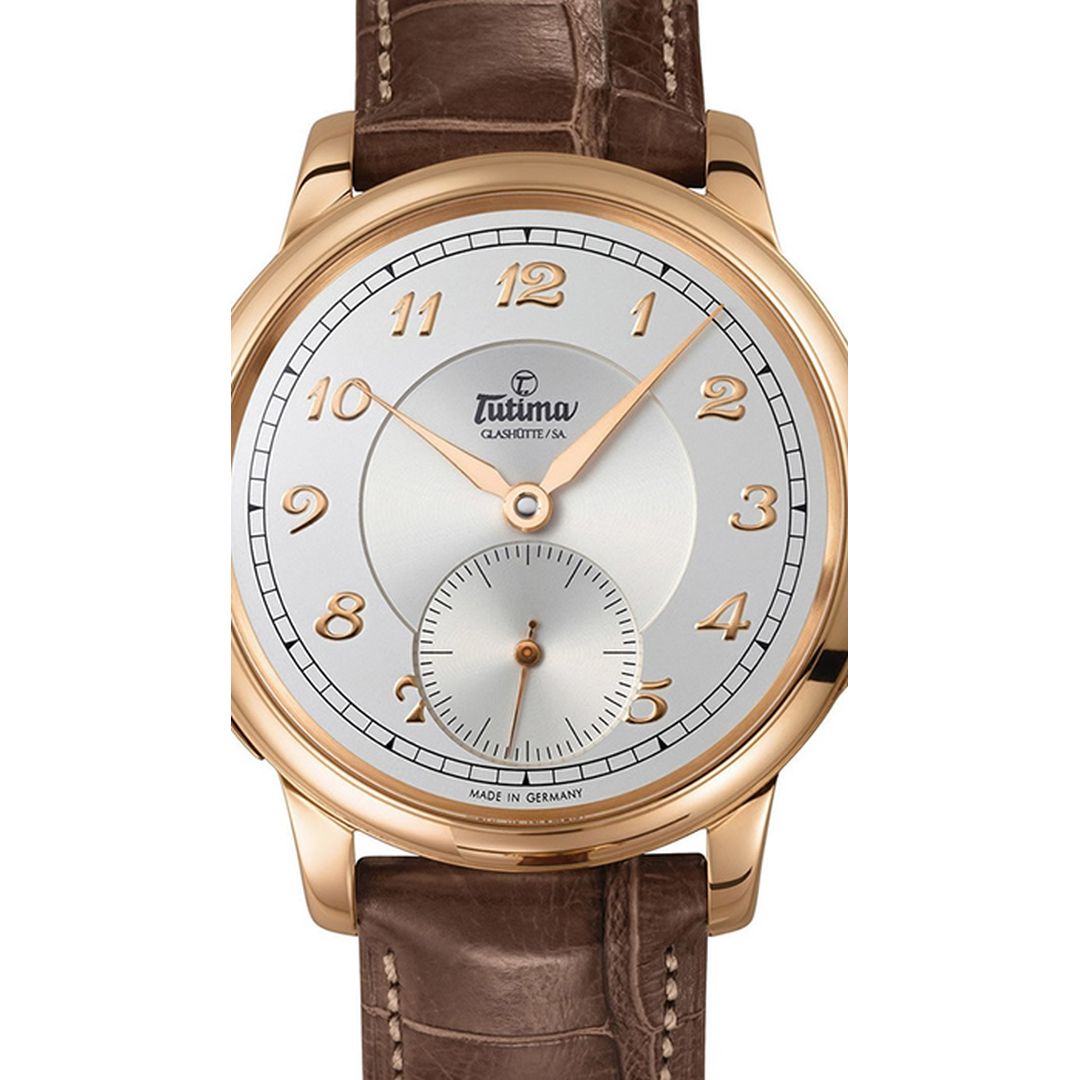
Tutima Hommage Ref. 6800-02: A Glashütte Chronograph in the Classical Manner
There is a particular pleasure in a chronograph that does not need to announce itself. The Tutima Hommage ref. 6800-02 is that kind of watch: a precious-metal, hand-wound chronograph from Glashütte with a restrained dial, a traditional movement architecture, and a finish that rewards close looking. It is not a sports watch dressed in gold, nor a heritage reissue that leans on nostalgia alone. It is a modern interpretation of the classical chronograph, made by a brand with a long and unusually varied history in Saxony.
For young collectors who have moved past the first flush of hype-driven buying, the Hommage offers something more durable: mechanical substance, a clear design language, and a movement that is genuinely in-house. The reference 6800-02 sits at the quiet end of the luxury chronograph spectrum. Its appeal is not in loud branding or oversized proportions but in the relationship between dial, case, and caliber.
The watch is best understood as a civilised chronograph. It has the technical credentials of a serious movement and the visual calm of a dress watch. That combination is rare, and it is the reason the Hommage deserves a place in a considered collection.
Manufacture History
Tutima was founded in 1927 in Glashütte by Ernst Kurtz. The company built its reputation on precision instruments and chronographs, including military-issue timepieces that earned a place in the history of German watchmaking. After the upheavals of the twentieth century, Tutima re-established itself in Glashütte and gradually rebuilt a collection that ranges from robust pilot watches to finely finished dress pieces.
That history matters because the Hommage is not a random exercise in nostalgia. It draws on the brand's chronograph heritage and on the Saxon tradition of hand finishing, but it does so in a contemporary, wearable form. The ref. 6800-02 is the more discreet precious-metal version of the Hommage chronograph, intended for collectors who value the movement and the dial more than the flash of the case.
Movement Architecture
At the heart of the ref. 6800-02 is the Tutima Caliber 617, a hand-wound chronograph movement developed and finished in Glashütte. It uses a column wheel and a horizontal clutch, the architecture traditionally associated with the most respected chronographs. The result is a pusher feel that is precise and mechanical rather than soft or vague, with a clear engagement at the start and stop of the chronograph.
The movement runs at 21,600 vibrations per hour and offers a power reserve of approximately 60 hours. That combination is practical for a manually wound watch: it allows for a winding routine every two or three days, while the slower beat gives the chronograph a classical, measured character. The caliber is not COSC-certified, which is normal for a German in-house movement of this type; accuracy is a matter of regulation and finishing rather than external certification.
Finishing follows the Glashütte code. The three-quarter plate is decorated with ribbing, the screw-mounted gold chatons add warmth and depth, and the hand-engraved balance cock gives the movement a human signature. This is not decoration for its own sake. It is the visible evidence of a watchmaking culture that treats the movement as part of the object, not merely as an engine hidden behind a dial.
Winding and operating the watch is part of the experience. The crown offers enough purchase for a comfortable daily wind, and the pushers have a crisp, deliberate action. The chronograph starts, stops, and resets with the kind of mechanical clarity that makes a column-wheel movement worth the extra complexity. It is a movement that invites interaction rather than passive ownership.
Case, Dial, and Finishing
The case is made of gold, and its design is intentionally classical. The lugs are shaped to flow into the strap, the bezel is slim enough to let the dial breathe, and the chronograph pushers are integrated with restraint. The watch is paired with a leather strap and a pin buckle, a combination that suits its formal character. A sapphire crystal protects the dial, and there is no lume, which is appropriate for a dress chronograph that is not intended as a tool watch.
The dial is silver-toned and built around two chronograph registers. The layout is clean and legible, with the kind of symmetry that makes a chronograph feel calm rather than busy. The markings are precise without being clinical, and the hands are shaped to read clearly against the light dial. It is a dial that looks best in natural light, where the subtle contrasts and the finishing of the case come together.
The overall effect is one of controlled luxury. The gold case gives the watch presence, but the silver dial and the leather strap keep it from feeling ostentatious. This is a chronograph that can be worn with a suit, with a jacket and knitwear, or even with a dark polo shirt on a weekend evening. It does not demand attention, but it rewards it.
On the Wrist
On the wrist, the Hommage feels balanced and composed. The gold case has a satisfying weight, but it does not feel top-heavy or unstable. The lugs curve in a way that keeps the watch close to the wrist, and the leather strap softens the overall impression. The pushers fall naturally under the thumb and forefinger, and the crown is easy to grip for the daily winding ritual.
It is a watch that works across a wide range of occasions. It is formal enough for a dress watch, elegant enough for evening wear, and practical enough for daily use and travel. The absence of a date keeps the dial clean, and the absence of lume reinforces its role as a civilised chronograph rather than a sports instrument. On the wrist, its presence is best described as confident but discreet: a four out of five, because it has real substance without shouting.
Accuracy and Daily Use
Real-world accuracy from a well-regulated Caliber 617 should be entirely acceptable for daily wear. Owners can expect a few seconds per day of variation, depending on winding habits, temperature, and position. Because it is a manually wound movement, the watch encourages a routine: a few turns in the morning, a check of the power reserve by feel, and a moment of connection with the mechanism. That ritual is part of the appeal.
The chronograph function is smooth and precise, with a column-wheel action that feels deliberate. The lack of a date and the absence of lume make it less of a do-everything watch, but they also make it more coherent. It is not trying to be a tool. It is a mechanical object for people who enjoy the act of wearing and operating a fine watch.
Reference Variants and Family
The Hommage chronograph family is small and focused. The ref. 6800-01 is the rose-gold sibling, with a warmer case tone and the same hand-wound Caliber 617. The ref. 6800-02, reviewed here, is the more discreet precious-metal version, with a silver dial and a leather strap. Both references share the same classical dial layout and the same emphasis on movement finishing.
As a family, the Hommage chronographs sit apart from Tutima's pilot and sports collections. They are not mass-market watches, and they are not intended to be. They are collector's pieces in the traditional sense: limited in production, technically serious, and designed to be worn rather than stored.
Comparisons and Alternatives
In the broader landscape, the Hommage ref. 6800-02 invites comparison with other precious-metal, hand-wound chronographs. The A. Lange & Söhne 1815 Chronograph is the obvious Saxon reference, with a more intricate movement and a significantly higher price. The Patek Philippe 5170 offers a different interpretation of the classical chronograph, with a Swiss emphasis on slimness and understatement. The Vacheron Constantin Historiques Cornes de Vache 1955 brings a vintage-inspired case and a more overtly romantic design.
For collectors who want the Glashütte chronograph experience at a more accessible level, there are also homages and affordable alternatives. The Seagull 1963 is a manual-wind chronograph with a vintage military character. The Dan Henry 1964 Gran Turismo offers a retro dial and a playful sense of history. The Timex Marlin Chronograph is a budget-friendly way to enjoy a vintage-inspired chronograph layout. None of these is a substitute for the Tutima, but they show how enduring the classical chronograph formula remains.
Value, Service, and Verdict
The Hommage ref. 6800-02 is a niche watch, and its value should be judged accordingly. It is not a liquid asset, and it is unlikely to appreciate like a steel sports watch from a larger brand. What the price buys is a hand-wound, in-house Glashütte chronograph with a precious-metal case and a level of finishing that is increasingly rare at this scale of production. The secondary market is thin, so buyers should purchase with the intention of wearing and keeping the watch rather than trading it.
Service should be entrusted to Tutima or an authorized Glashütte-trained watchmaker. The in-house caliber and the finishing details require proper handling, and the cost of service should be factored into ownership. The watch is robust enough for daily use, but it is not a tool watch, and it should be treated with the care that a fine mechanical chronograph deserves.
The pros are clear: an in-house hand-wound chronograph with column-wheel architecture, traditional Glashütte finishing, a balanced and elegant dial, and a precious-metal case that feels special without being flashy. The cons are equally clear: limited availability, a thin secondary market, no date or lume, and high service costs. For the right collector, those trade-offs are part of the charm.
The final verdict is that the Tutima Hommage ref. 6800-02 is a connoisseur's chronograph. It is not the obvious choice, and it does not try to be. It rewards an appreciation of movement architecture, hand finishing, and restrained design. For a young collector building a collection with depth rather than noise, it is a watch worth seeking out.