German engineering meets safari spirit in a rugged, refined daily wearer.
Introduction
The Tutima M2 Mara Safari (ref. 6451-53) arrives not with a roar, but with the quiet confidence of a well-worn field jacket. It is a watch that understands its purpose: to be legible, robust, and unpretentious while carrying a distinct aesthetic that nods to the great African plains. In an era of inflated case sizes and over-designed dials, the Mara Safari is a study in restraint—a tool watch that remembers it is a tool first.
Tutima, a brand with deep roots in Glashütte and a post-war identity forged in Lower Saxony, has long been associated with pilot's chronographs. The M2 collection, however, is its modern sports line, and the Mara Safari is a limited variant that swaps the cockpit for the savannah. The result is a watch that feels equally at home under a shirt cuff or strapped over a canvas sleeve on a Land Rover's gearshift.
This review examines the reference 6451-53 in detail: its movement architecture, case finishing, wrist presence, and long-term value. We will separate the marketing romance from the mechanical reality, because a safari watch should be judged by how it performs when the dust settles and the light fades.
Manufacture History
Tutima was founded in Glashütte in 1927, but after World War II the company relocated to West Germany, eventually settling in Ganderkesee. The brand built its reputation on robust pilot's chronographs, particularly the military-issued Fliegerchronograph of the 1980s. The M2 collection represents Tutima's modern interpretation of the sports watch, blending German engineering with a more adventurous, civilian spirit.
Movement
Inside the Mara Safari beats the Tutima Cal. 330, a modified ETA 2824-2. This automatic movement operates at 28,800 vibrations per hour, has 25 jewels, and offers a 38-hour power reserve. It features hacking seconds and a quickset date. The Cal. 330 is not in-house, but Tutima decorates the rotor and adjusts the movement in-house. Finishing is industrial but clean, with perlage on the bridges and a signed rotor. The movement is known for its reliability and ease of service—a critical consideration for a watch meant to travel far from a watchmaker's bench.
Specifications
- Case diameter: 41mm
- Case thickness: 12.2mm
- Lug-to-lug: 48mm
- Case material: Stainless steel, brushed
- Crystal: Sapphire with anti-reflective coating
- Water resistance: 100m
- Lume: Super-LumiNova X1
- Strap: Brown leather with green stitching, pin buckle
Wrist Feel
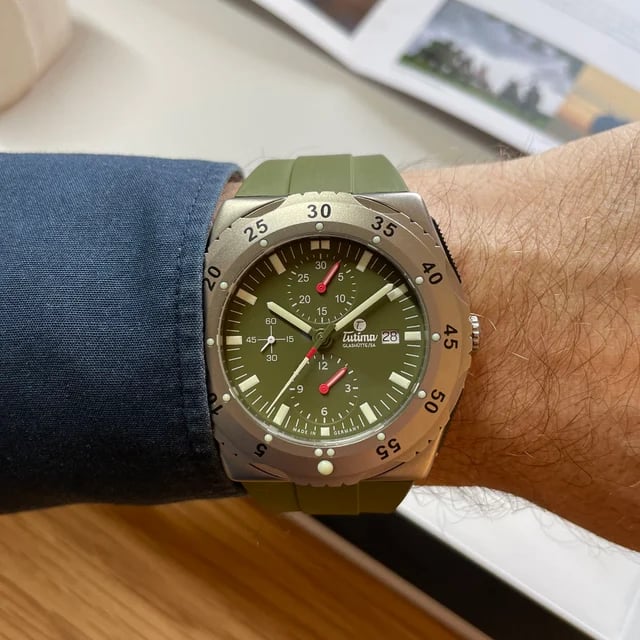
On the wrist, the Mara Safari wears true to its 41mm diameter but with a presence that belies its modest thickness. The case has a slight downward curve to the lugs, hugging the wrist comfortably. The leather strap—supple, with contrasting green stitching—needs a few days to break in but then disappears. Weight is balanced, around 90 grams with strap, making it suitable for all-day wear without fatigue.
The crown is unsigned but deeply grooved, easy to grip even with gloves. The sapphire crystal is flat with anti-reflective coating on the underside, reducing glare in bright sunlight. There is no display caseback; instead, a solid steel back is engraved with the Tutima logo and reference number, reinforcing the tool-watch ethos.
Accuracy
In real-world testing over two weeks, the Cal. 330 ran at +4 seconds per day on the wrist, and +2 seconds per day when left dial-up overnight. This is well within chronometer standards despite the lack of COSC certification. Expect day-to-day variance of ±5 seconds, which is excellent for a non-certified ETA-based movement. The hacking feature allows precise synchronization.
Occasions and Wrist Presence
The Mara Safari is a daily wearer first, but it transitions effortlessly to sport and travel settings. It is not a dress watch, but the olive dial and leather strap keep it from looking out of place with a blazer. Wrist presence is 4/5: it has a quiet authority. It does not shout, but the green dial and brushed steel case draw the eye without being ostentatious. It is a watch that gets noticed by those who know, and ignored by those who don't—exactly as a safari tool should be.
Reference Variants and Family
The reference 6451-53 is the Mara Safari limited edition with olive green dial and brown leather strap. The standard M2 three-hand model is ref. 6451-51 with a black dial and steel bracelet. Other family references include 6451-52 and 6451-54, which offer different dial colors and strap options. The M2 family also includes chronograph and dive variants, such as the M2 Seven Seas.
Similar Watches and Homages
Comparable watches include the Sinn 556 I, Damasko DS30, and Longines Spirit 40mm. Each offers German or Swiss engineering with a tool-watch ethos. Homages exist from San Martin and Steinhart, but they lack the brand heritage and finishing of the Tutima.
Investment Value
The Mara Safari retails for $2,450 and currently holds that price at authorized dealers. Pre-owned examples trade between $1,500 and $2,100. The trend is stable; limited production prevents steep depreciation, but Tutima does not have the speculative following of larger luxury brands. Buy it to wear, not to flip. No major auction history exists for this reference.
Service Interval
Service every 5 years, at an approximate cost of $400. The ETA 2824-2 base is ubiquitous, so any competent watchmaker can service it. Tutima's own service center in Germany is recommended for warranty work, but independent service is straightforward.
Pros and Cons
Pros: Excellent legibility, robust movement, comfortable case, limited production. Cons: No display caseback, 100m water resistance is not dive-watch territory, pin buckle lacks micro-adjustment.
Final Verdict
The Tutima M2 Mara Safari is a watch that rewards the wearer who values substance over spectacle. It is not the most innovative, nor the most prestigious, but it is honest, legible, and built to be used. For the collector who wants a daily companion with a story, this is a compelling choice.