Introduction: The Anti-Hype Diver
Let's cut through the boutique incense and Instagram filters. The Tutima M2 Seven Seas (ref. 6151-01) is not the watch your finance bro friends are flexing on a waitlist. It's not going to make your financial advisor call you with congratulations. What it is, however, is a brutally honest tool watch from a brand that survived the Cold War, the quartz crisis, and the death of Glashütte's old guard—only to be ignored by the hype machine. That's precisely why it deserves a hard look from anyone who actually wears their watches instead of flipping them for a quick profit.
At $2,900 MSRP, the M2 Seven Seas sits in a no-man's land: too expensive for the Seiko crowd, too obscure for the Rolex aspirants, and too German for the Italian flex. But on the secondary market, it's a different story. Pre-owned examples trade between $1,500 and $2,200, which means you can pick up a 500m dive watch with a modified ETA movement, sapphire crystal, and a bracelet that feels like it was machined from a Panzer tank for less than a used Oris Aquis. That's not a hype play—that's a value play.
So, is the M2 Seven Seas a hold or a flip? Spoiler: it's a wear-it-until-the-wheels-fall-off kind of watch. But if you're the type who checks Chrono24 more than your portfolio, here's the full breakdown.
Brand History: From Glashütte to Ganderkesee
Tutima was founded in Glashütte, Germany, in 1927 by Dr. Ernst Kurtz. The name comes from the Latin 'tutus' meaning 'safe' or 'protected'—fitting for a brand that would later build military chronographs for the Luftwaffe. After World War II, the company was expropriated by the East German state, and the Kurtz family fled to West Germany, eventually re-establishing Tutima in Ganderkesee, Lower Saxony. The M2 line is Tutima's modern sports collection, named after the 'M2' military specification for rugged, reliable field watches. The Seven Seas is the dedicated dive watch within that line, built to withstand 500 meters of pressure and the kind of abuse that would make a Submariner blush.
Movement: A Workhorse, Not a Showpiece
Inside the M2 Seven Seas beats the Tutima Cal. 330, which is a modified ETA 2824-2. That means 25 jewels, 28,800 vibrations per hour, and a 38-hour power reserve. It's not in-house, it's not COSC-certified, and it's not going to win any Geneva Seal awards. What it is, however, is bulletproof. The rotor is decorated with Tutima's gold seal, the bridges have perlage, and the screws are blued—but this is still a mass-produced movement at heart. The good news? Any watchmaker on the planet can service it for under $400, and parts are plentiful. That's a feature, not a bug.
Specs: Built Like a Panzer
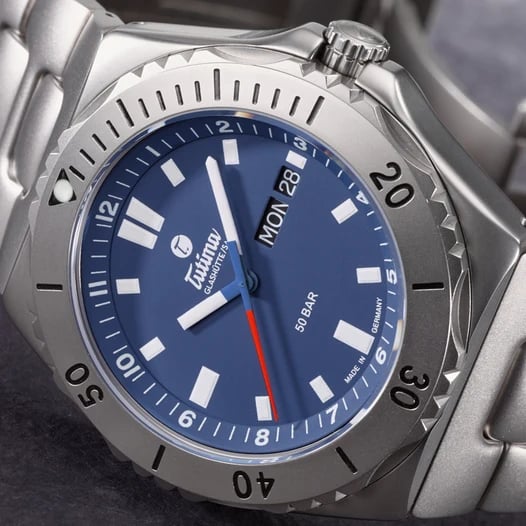
The case is 44mm in diameter, 13.5mm thick, and 52mm lug-to-lug, all in stainless steel. The crystal is sapphire with anti-reflective coating, and the water resistance is a legit 500 meters—not a marketing gimmick. The bezel is unidirectional with 120 clicks, and the lume is Super-LumiNova, applied generously to the hands and indices. The bracelet is a solid stainless steel affair with a folding clasp and diver's extension. It's heavy, it's industrial, and it feels like it could survive a direct hit from a depth charge.
Wrist Feel: Heavy but Honest
On the wrist, the M2 Seven Seas is a presence—but not an obnoxious one. The 44mm case wears smaller than the spec sheet suggests thanks to a relatively short lug-to-lug of 52mm and a curved caseback that hugs the wrist. The stainless steel bracelet is substantial, with solid links and a machined clasp that includes a diver's extension. Total weight is around 200 grams, which is heavy but balanced; you won't forget you're wearing it, but it won't fatigue you over a full day.
The crown at 4 o'clock is a smart ergonomic choice—it never digs into the back of your hand, even during desk diving. The bezel action is firm and precise, with 120 clicks and zero backplay. If you're used to the buttery smoothness of a Submariner bezel, this feels more industrial, like a well-oiled machine tool. That's not a criticism; it's a character trait.
Accuracy: Good Enough, Not Great
Expect real-world accuracy of +/- 5 to 10 seconds per day from the ETA 2824-2 base. It's not COSC-certified, but a good example will run within chronometer spec after a simple regulation. If you're the type who obsesses over daily drift, this movement is easy and cheap to regulate—any competent watchmaker can do it for under $100. For a dive watch that's meant to be worn hard, that's perfectly acceptable.
Occasions and Wrist Presence
The M2 Seven Seas is a sport/daily/travel watch. It's too thick for a dress shirt cuff, but it works with a t-shirt, a wetsuit, or a casual blazer. Wrist presence is 4/5—it has a tool-watch gravitas that reads as intentional, not flashy. On a rubber strap, it's a serious dive companion; on the bracelet, it's a daily beater with a Germanic edge.
Reference Variants and Family
The ref. 6151-01 is the classic black-on-black stainless steel model. Other variants include a blue dial (6151-02), green dial (6151-03), and a titanium case version (6151-04). Within the M2 family, you also have the smaller Seven Seas S (40mm), the M2 Pioneer Chronograph, and the M2 Coastline. Tutima's broader catalog includes the Grand Flieger, Saxon One, and Patria—all worth a look if you're into German watchmaking.
Similar Watches and Homages
If you're cross-shopping, the Sinn U1 is the closest competitor—German, tool-focused, similar price. The Oris Aquis Date offers better brand recognition but less water resistance. The Longines HydroConquest is a mainstream alternative, and the Seiko Marinemaster is a Japanese icon at a lower price. For homages, the Steinhart Ocean One and Squale 1521 offer similar specs for a fraction of the cost, but they lack the Tutima's unique design language.
Investment Value: The Depreciation Curve
MSRP is $2,900, and that's what you'll pay at an authorized dealer. Pre-owned, expect to pay $1,500 to $2,200 depending on condition and box/papers. The trend is depreciating—this watch loses 30-40% the moment you walk out of the boutique. There's no auction history to speak of; these trade privately or through grey market dealers. Hold recommendation: buy pre-owned and hold for personal use. This is not a flipper's watch. If you must sell, expect to lose money, but the loss is front-loaded—after the initial drop, values stabilize.
Service and Maintenance
Service interval is every 5 years, and the approximate cost is $400. You don't need to send it to Tutima; any competent independent watchmaker can handle the ETA 2824-2. That's a huge advantage over in-house movements that require factory service and a six-month wait.
Pros and Cons
Pros: 500m water resistance, sapphire crystal, robust build, distinctive German design, excellent pre-owned value, cheap and easy servicing.
Cons: 44mm case is too large for smaller wrists, no in-house movement, no COSC certification, no brand cachet, depreciates 30-40% from MSRP, limited dealer network outside Europe.
Final Verdict
The Tutima M2 Seven Seas is a watch for people who actually dive, actually travel, and actually don't care what the guy at the next table is wearing. It's overbuilt, underhyped, and priced like a secret. Buy it pre-owned, wear it hard, and forget about resale value—this one's a keeper, not a flipper.