The Genesis of a Glashütte Icon
In the landscape of modern horology, few stories are as compelling as the return of Tutima to its ancestral home in Glashütte. While the brand maintained its reputation for producing robust pilot's watches during its decades in Ganderkesee, the opening of the new manufacture near the Glashütte railway station in 2011 signaled a shift toward the haute de gamme. The Tempostopp Ref. 6650-01 stands as the most technically significant fruit of this labor, a watch that does not merely look back at history but mechanically re-engineers it.
The name 'Tempostopp' is a direct nod to the flyback function, a complication that allows the chronograph to be reset and restarted with a single press of a button. This was a critical tool for pilots in the 1940s, and Tutima’s original Caliber 59 was the first German movement to offer it. With the Ref. 6650-01, Tutima has developed the Caliber T659, an entirely new, in-house movement that serves as a spiritual and technical successor to that legendary wartime engine.
Movement Architecture: The Caliber T659
The heart of the Tempostopp is the Caliber T659. For the technical purist, this is where the watch justifies its nearly $30,000 price tag. Unlike many modern chronographs that utilize modular constructions or cam-actuated systems, the T659 is a fully integrated, manual-wind, column-wheel chronograph. The architecture is airy and expansive, allowing the observer to trace the mechanical path from the column wheel to the lateral clutch and the flyback lever.
The finishing is exemplary of the Glashütte style. The bridges are made of rose-gold-plated German silver, providing a warm, vintage hue that contrasts beautifully with the steel components of the chronograph works. One will find traditional Glashütte ribbing (similar to Côtes de Genève but wider and more pronounced), hand-beveled and polished edges, and perlage on the base plate. The balance cock is hand-engraved with a floral motif, a signature of the highest tier of German watchmaking, ensuring that no two movements are exactly alike.
Technically, the T659 operates at a steady 21,600 vibrations per hour (3Hz). While some might prefer the 4Hz beat of a modern Zenith or Rolex, the 3Hz frequency is a deliberate choice, reflecting the historical cadence of the original Caliber 59 and allowing for a more leisurely, visible oscillation of the balance wheel. The movement provides a generous 65-hour power reserve, ensuring that even if left off the wrist for a weekend, the Tempostopp will remain ready for action.
Case and Dial Aesthetics
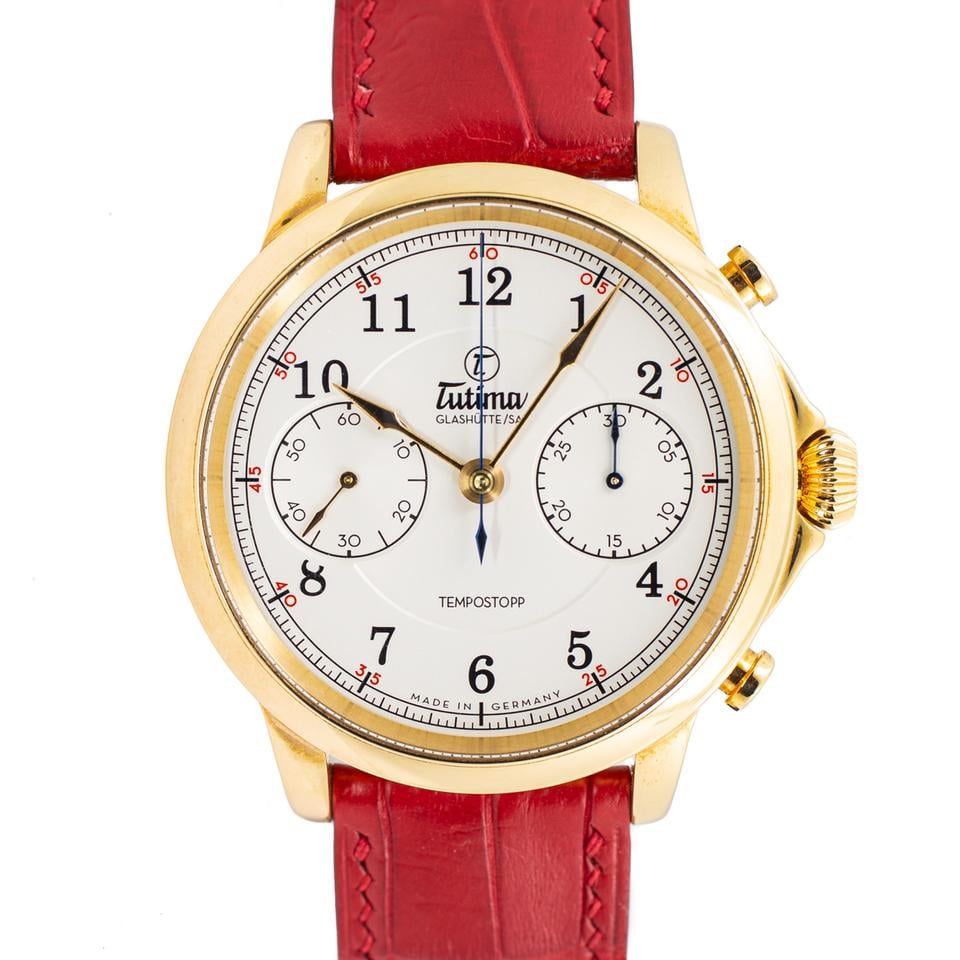
The Ref. 6650-01 is housed in an 18k rose gold case measuring 43mm in diameter. In an era where many collectors are moving back toward 38mm or 39mm, 43mm is a bold choice. However, the scale is necessary to accommodate the expansive architecture of the T659 movement. The case design is classically round, with a stepped bezel and elegant, down-turned lugs that help the watch wrap around the wrist. The crown is large and deeply fluted, providing excellent grip for the daily ritual of manual winding.
The dial is a masterclass in legibility and restraint. Finished in a matte opaline silver, it features a dual-register layout: a small seconds sub-dial at 9 o'clock and a 30-minute chronograph counter at 3 o'clock. The hands are crafted from blued steel, providing a sharp, chromatic contrast against the silver backdrop. The peripheral tachymeter scale is finely printed, allowing for the calculation of speeds over a measured distance—a nod to the watch's 'tempo' stop heritage. There is no date window to clutter the symmetry, a decision that I applaud as it keeps the focus entirely on the timing functions.
The Flyback Experience
Operating the Tempostopp is a tactile delight. In a standard chronograph, one must stop, reset, and then start the timing sequence—three distinct presses. The flyback mechanism of the T659 allows the user to press the reset pusher at 4 o'clock while the chronograph is running. In a flash, the central seconds hand and the minute counter fly back to zero and immediately begin timing again. This requires a complex arrangement of levers and hearts within the movement to ensure that the reset happens cleanly without damaging the delicate gear teeth. Tutima’s execution here is flawless; the reset is crisp, and the hand alignment is perfect every time.
Market Positioning and Investment Value
At an MSRP of approximately $28,500, the Tutima Tempostopp sits in a competitive space. It is priced similarly to the A. Lange & Söhne 1815 Chronograph in the pre-owned market and competes directly with the Glashütte Original Senator Chronograph. The choice comes down to brand perception versus technical rarity. While Lange carries more social cachet, the Tutima Tempostopp is arguably more exclusive, produced in much smaller numbers and representing a specific, niche chapter of German history.
From an investment standpoint, the Tempostopp is a 'hold.' It is unlikely to see the volatile price swings of a Patek Nautilus or a Rolex Daytona. Instead, it is a piece of 'quiet luxury' horology that will likely retain its value among enthusiasts who understand the difficulty of producing an in-house integrated chronograph. It is a watch for the man who doesn't need his timepiece to be recognized from across the room, but who takes immense satisfaction in knowing the quality of what is strapped to his wrist.
Final Thoughts
The Tutima Tempostopp Ref. 6650-01 is a rare bird. It is a watch that successfully marries the rugged utility of a pilot's tool with the refined finishing of a high-complication dress watch. By looking back to the Caliber 59, Tutima has found the path to its future. For those who appreciate the mechanical poetry of a manual-wind chronograph and the austere beauty of Glashütte design, the Tempostopp is nothing short of a masterpiece. It is a precise, technical, and deeply reverent tribute to the art of timekeeping.