Ulysse Nardin Blue Max Review: A Daily-Wear Marine Chronometer
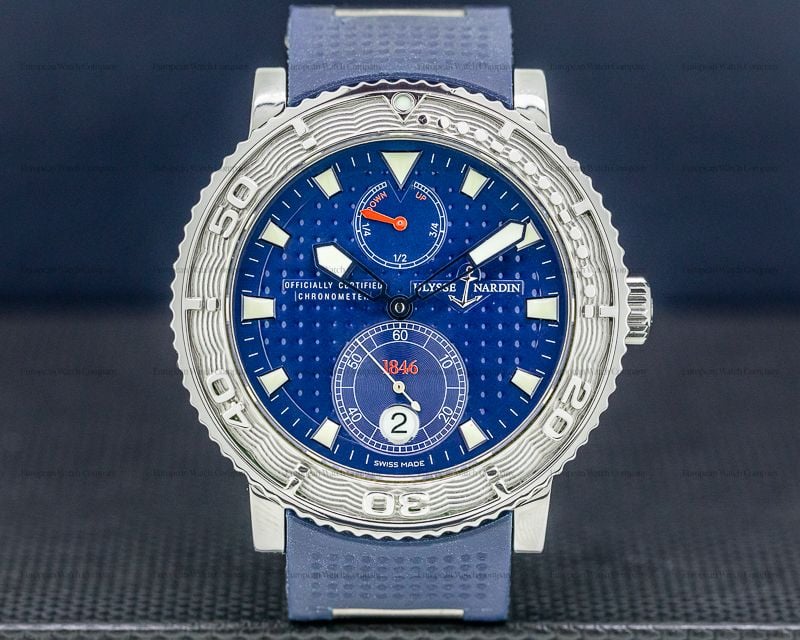
The Ulysse Nardin Blue Max ref. 263-58 is one of those watches that makes more sense on the wrist than in a spec sheet. It takes the Maxi Marine Chronometer formula—marine heritage, chronometer certification, a useful power-reserve display—and dresses it in a deep blue palette with a rubber strap. That combination sounds sporty on paper, but the result is more nuanced: it is a luxury watch that wants to be worn, not stored.
For young collectors, the appeal is obvious. Ulysse Nardin is not the default choice at a dinner table, and the Blue Max has enough visual identity to feel personal without shouting. The ref. 263-58 is also a reminder that daily wear is not only about case size or bracelet finishing. It is about how a watch sits, how quickly you can read it, and whether you still enjoy it after a week of real life.
This review focuses on those questions. I wore the Blue Max as a daily watch—office, errands, travel, evenings—and considered what survives the honeymoon period. The short version: it is a compelling alternative to the usual luxury sports watches, provided you accept the quirks of a limited-edition Ulysse Nardin and buy on condition.
Manufacture history
Ulysse Nardin was founded in 1846 in Le Locle, Switzerland, and built its reputation on marine chronometers. The brand supplied navies and observatories with precision timekeepers, and that maritime DNA remains central to its identity. The Maxi Marine family is a direct descendant of that heritage, translating the seriousness of a deck chronometer into a wearable luxury watch.
The modern Ulysse Nardin era has been defined by technical experimentation—silicon escapements, unconventional materials, and the Freak—but the Maxi Marine line occupies a more traditional space. It is where the brand’s nautical history meets a conventional automatic movement and a comfortable everyday case. The Blue Max sits within that line as a limited edition with a distinctly blue, slightly sporty character.
Movement
The Blue Max ref. 263-58 uses Ulysse Nardin Caliber UN-26, an automatic movement with a power-reserve display and date. It is COSC-certified, which matters for a watch carrying the chronometer label. The movement is not fully in-house in the modern sense; it is a modified base architecture, but Ulysse Nardin’s specification and chronometer certification give it more credibility than a generic automatic.
On the wrist, the power-reserve indication is more than decoration. It turns the watch into a small instrument, and it encourages you to keep the mainspring in its healthy range. The date is useful without dominating the dial. The movement is not the star of the show in the way a high-beat in-house caliber might be, but it suits the Blue Max’s role: reliable, serviceable, and accurate enough to justify the chronometer designation.
Specs and on-paper package
The case is stainless steel, the crystal is sapphire, and the watch comes on a rubber strap with a deployant clasp. Those are the right choices for a daily-wear marine chronometer. Stainless steel keeps the watch practical, sapphire protects the dial, and rubber makes it easier to live with than a polished bracelet or a delicate leather strap. The lume is Super-LumiNova, which is welcome on a watch with sporty ambitions.
Where the spec sheet is less revealing is in the dimensions. Ulysse Nardin’s Maxi Marine Chronometer references have varied over the years, and public listings do not always agree on case measurements for every suffix. Rather than pretend to a precision the reference does not support, this review leaves those figures aside and focuses on what the watch does on the wrist. The important point is that the Blue Max is not a novelty oversized diver. It is a Maxi Marine Chronometer with a blue-dial limited-edition treatment.
On the wrist
The first thing you notice is the strap. Rubber can make a luxury watch feel cheaper if the material is stiff or the clasp is clumsy, but on the Blue Max it works. The strap follows the wrist, keeps the case close, and reduces the sense of heft that a steel bracelet can add. The deployant clasp makes it easy to put on and take off, and it protects the strap from the constant bending that a pin buckle encourages.
The case wears like a luxury sports watch rather than a dress chronometer. It has presence without feeling fragile. The lugs and case flanks are not so sharp that they catch on a shirt cuff, and the watch does not slide around during the day. On a warm wrist, the rubber is comfortable; in air conditioning, it does not feel clammy. That sounds like a small thing, but it is exactly the kind of detail that decides whether a watch stays on for a week or goes back into the box.
Legibility is strong. The blue dial has enough contrast to read at a glance, and the hands and markers are clear without being oversized. The power-reserve display gives the dial a technical feel, but it does not overwhelm the time. The date is useful in daily life, and the overall layout feels balanced. This is not a minimalist watch, but it is not busy either. It has the confidence of a marine chronometer that knows what it is for.
The crown is easy to grip and does not dig into the back of the hand. The watch sits flat enough to disappear under a cuff, yet it still feels substantial. That balance is important: a daily watch should not demand constant adjustment. The Blue Max passes that test. It feels at home with a polo shirt and chinos, but it also works with a jacket.
Accuracy and daily running
Because the movement is COSC-certified, the expectation is -4 to +6 seconds per day. Real-world performance will depend on age, service history, and how the watch is worn. A well-serviced UN-26 should sit comfortably within chronometer tolerances, and many owners report stable running in the low single digits. If you buy a used example, ask for timegrapher results and factor a service into your budget if the history is unknown.
The power-reserve display makes daily ownership easier. You can see when the watch is running low, and you can avoid the annoyance of finding it stopped on a Monday morning. The automatic winding is sufficient for normal wear, but if you rotate watches, a winder or a weekly manual wind is sensible. The Blue Max is not a watch that rewards neglect; it rewards regular wear.
Occasions and wrist presence
The Blue Max is at its best as a daily watch. It is sporty enough for a weekend, refined enough for a casual office, and unusual enough to start a conversation. It can travel well because the rubber strap is easy to clean and the dial is legible in different light. It is not a formal dress watch, but it can be worn with a dark jacket if you keep the rest of the outfit relaxed.
Wrist presence is 4/5. The Blue Max does not shout, but it does not disappear either. The blue dial and the Maxi Marine case shape give it a recognizable silhouette, and the rubber strap makes it look purposeful. It is the kind of watch that looks better in person than in a product photo, because the case finishing and dial depth need movement and light to come alive.
Reference variants and family
The ref. 263-58 is the Blue Max expression of the Maxi Marine Chronometer: blue dial, rubber strap, and limited-edition positioning. Exact suffix variations exist in the Ulysse Nardin catalog, but collectors should verify the full reference and accessories before purchase. The Maxi Marine family also includes other chronometer and diver references, such as the 263-66 and 263-67, which share the marine concept but differ in dial, strap, and detail treatment.
Within Ulysse Nardin’s wider catalog, the Freak, Marine Chronometer, Diver, and Blast models show the brand’s range. The Blue Max is more conventional than the Freak and more nautical than the Blast. That is part of its charm: it is a traditional Ulysse Nardin with a sporty limited-edition twist.
Similar watches and affordable alternatives
If you like the Blue Max but want to compare, the Omega Seamaster Aqua Terra 150M is the obvious luxury sports watch with marine heritage. It is more mainstream and easier to service, but it lacks the Blue Max’s unusual dial and limited-edition appeal. The Rolex Yacht-Master 40 is another nautical option, with stronger resale and a more robust bracelet, but it costs more and feels less niche. The Jaeger-LeCoultre Polaris Date offers a blue dial and elegant sports-watch character, with a different kind of collector appeal.
For affordable alternatives, the Seiko 5 Sports SRPD51 and Orient Kamasu deliver blue-dial sports-watch style for around $250. They are not homages in the strict sense, but they capture the idea of a legible, comfortable blue watch that can be worn every day. Neither will match the Ulysse Nardin’s finishing or chronometer certification, but they show how much of the daily-wear formula can be achieved at a lower price.
Investment and service
The Blue Max is a limited edition, but it is not a blue-chip investment watch. Original MSRP sat in the upper four figures when new, and today pre-owned examples generally trade in the $4,000 to $7,000 range depending on condition, completeness, and service history. The trend is stable rather than appreciating. That is good news for buyers: you can enjoy the watch without treating it as a speculative asset.
Hold recommendation: buy the best example you can find, with box and papers if possible, and budget for service. Limited-edition Ulysse Nardin models have a loyal following, but liquidity is thinner than with Rolex or Patek Philippe. This is a watch to own because you like wearing it. Auction history is not a major factor; there is no meaningful Blue Max auction record to chase.
Service should be handled by Ulysse Nardin or a qualified independent with access to parts. The interval is typically several years, but the exact cost depends on the work required and the condition of the movement. Authorized service is recommended for a limited-edition watch, especially if you want to preserve provenance. Parts availability can be slower than for mass-produced models, so plan ahead.
Pros and cons
Pros: the blue dial is distinctive without being loud; the rubber strap and deployant clasp make it genuinely comfortable; the power-reserve display and date add daily usefulness; COSC certification backs up the chronometer label.
Cons: the movement is not fully in-house; the brand’s resale is softer than mainstream luxury sports watches; limited-edition parts and service can be slower; the watch is not a formal dress piece.
Final verdict
The Ulysse Nardin Blue Max ref. 263-58 is a smart buy for the collector who wants a luxury daily watch with marine DNA and a point of difference. It is comfortable, legible, and mechanically credible, and its blue-dial limited-edition character keeps it interesting after the honeymoon. It is not the safest financial choice in the category, but it is a rewarding one for the right wrist.