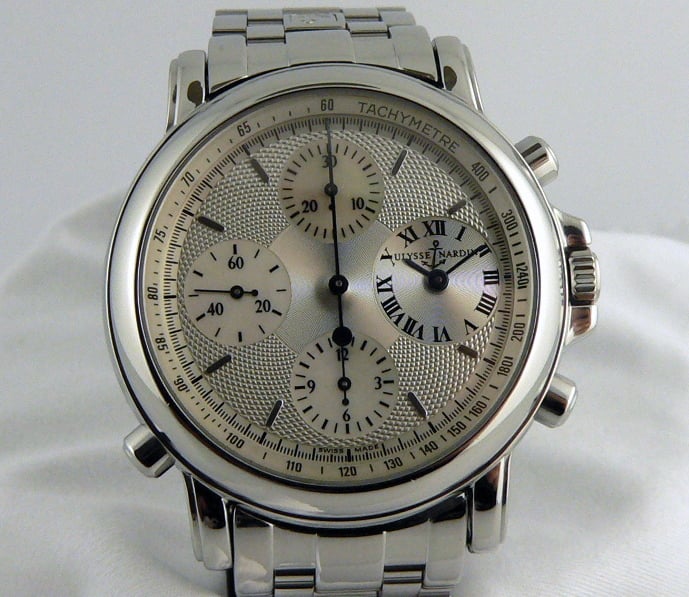
Ulysse Nardin Chronosplit ref. 573.22: The Split-Seconds Sleeper
Some watches announce themselves with a logo, a bezel, or a waiting list. The Ulysse Nardin Chronosplit ref. 573.22 does none of that. It is a late-1990s split-seconds chronograph from a brand whose reputation was built on marine chronometers, not hype drops. That makes it exactly the kind of watch a certain kind of young collector loves: technically serious, visually off the mainstream, and just obscure enough to require actual research. The Chronosplit is not a safe first luxury watch. It is a connoisseur's side door into complicated watchmaking, and it rewards the buyer who does the homework.
The reference 573.22 sits in a fascinating period for Ulysse Nardin. The brand had already been revived by Rolf Schnyder and was beginning to flex its mechanical muscles, but it had not yet become the Freak-led futurist of the 2000s. The Chronosplit belongs to that in-between moment when Ulysse Nardin was making complicated, slightly eccentric watches for people who knew the name but did not need the crowd. Today, it is a sleeper. It is also a watch that demands patience, because public documentation is thinner than it is for a Speedmaster or a Navitimer. That scarcity of information is not a reason to avoid it; it is a reason to buy carefully.
Brand History: From Marine Chronometers to Split-Seconds
Ulysse Nardin was founded in 1846 in Le Locle, Switzerland, and spent its first century building a reputation for precision marine chronometers. That heritage matters here. The brand's modern identity is still anchored in the idea of the ocean, navigation, and measurable accuracy. When Ulysse Nardin returned to the wristwear conversation in the late twentieth century, it carried that instrument credibility into complicated watches. The Chronosplit is not a marine chronometer, but it inherits the same engineering-first attitude. It is a watch about measuring time accurately, just in a more playful format.
The model also reflects the brand's willingness to use supplied movements and modules during the 1990s. Ulysse Nardin was not yet the vertically integrated manufacture it is today, and many of its complicated pieces from this era relied on outside expertise. That is not a criticism. Some of the most interesting watches of the period were collaborations between case designers, dial makers, and movement specialists. The Chronosplit fits that pattern. It is a Ulysse Nardin in style and presentation, but the engine underneath should be verified before purchase. For a collector, that is part of the charm and part of the risk.
Movement: The Split-Seconds Mechanism
The headline complication is the split-seconds chronograph. A standard chronograph lets you start, stop, and reset one timing sequence. A split-seconds, or rattrapante, adds a second central chronograph hand that can be stopped independently while the other hand keeps running. That sounds simple until you see the mechanism. The split-seconds function requires a complex set of levers, cams, and a clamp to isolate the two hands, then let them catch up again. It is one of the most tactile complications in watchmaking, and it remains relatively rare because it is difficult to build, service, and keep reliable.
On the Chronosplit ref. 573.22, the exact caliber is not publicly documented in the sources we could verify. Early Ulysse Nardin complicated watches often used supplied movements or modules, and the brand did not always publish the kind of granular detail collectors expect today. We have therefore left the caliber, power reserve, frequency, and jewel count undocumented rather than guess. What matters is the architecture: this is an automatic split-seconds chronograph with a date. The pushers should feel positive, and the split-seconds function should engage and release cleanly. If you are evaluating one, have a watchmaker confirm the movement, check the split-seconds mechanism, and make sure the chronograph resets to zero properly.
Finishing is likely to be industrial rather than haute horlogerie. This is not a hand-finished Patek Philippe split-seconds. It is a tool-complication from the 1990s, built to be worn and used. That is part of its appeal. The Chronosplit is a watch you can actually wear without feeling like you are carrying a museum piece. The movement is the reason to buy it, but the case and dial are the reason you will keep wearing it.
Case and Design: 1990s Sport-Chic
The ref. 573.22 is cased in stainless steel, which suits the watch's sport-chic personality. The design is unmistakably late-1990s: rounded surfaces, stepped lugs, a dial that prioritizes legibility over minimalism, and a chronograph layout that looks businesslike without being brutal. The sapphire crystal is a practical touch, and the overall presentation is more elegant than a modern tool watch. This is not a chunky dive chronograph. It is a watch that can slide under a shirt cuff with the right strap, but it still has enough wrist presence to feel like a proper mechanical object.
The dial is where the Chronosplit earns its keep. The chronograph registers give it a technical look, while the split-seconds hand adds a subtle layer of complexity. From a distance, it reads like a classic chronograph. Up close, the extra hand and the pusher layout tell a different story. That is the sweet spot for a sleeper: it does not shout, but it rewards the person who knows what they are looking at. The date function adds daily usability, though collectors should check that the date changes cleanly and that the dial is original. The design is not as aggressively retro as a modern reissue, which is a good thing. It feels like a real watch from its era, not a costume.
Wrist Feel and Presence
The Chronosplit wears like a serious steel chronograph. It is not a featherweight titanium piece, and it does not pretend to be. The case has heft, but the balance should be good on a leather strap. The split-seconds mechanism can add some height to the case, so buyers with smaller wrists should try one on before committing. The pushers are a key part of the experience. A split-seconds chronograph should feel mechanical and deliberate, not mushy. When you stop the split hand, you should feel a distinct engagement. When you release it, the hand should snap back to the running chronograph hand. That tactile feedback is a large part of why people pay for this complication.
On the wrist, the Chronosplit has a presence that is confident without being loud. It reads as a watch for someone who knows watches, not someone who wants to be noticed from across the room. That makes it a great daily wear for a collector who works in a creative field, a studio, or a casual office. It is not a formal dress watch, but with a clean leather strap it can handle a dinner. It is not a gym watch, but it can handle a weekend. The wrist presence is a solid 4 out of 5: substantial, interesting, and just unusual enough to start a conversation with the right person.
Accuracy and Daily Use
Real-world accuracy depends heavily on condition and service history. A well-serviced split-seconds chronograph from a quality Swiss movement should keep time like a good automatic chronograph, but split-seconds mechanisms are more sensitive than standard chronographs. The extra levers and clamps can be affected by wear, shock, and magnetism. If you are buying a Chronosplit, do not rely on the seller's word. Have the watch timed on a timegrapher, check the amplitude and beat error, and test the chronograph and split-seconds functions repeatedly. A watch that runs well on the wrist but has a sticky split-seconds hand is not a bargain.
For daily use, the Chronosplit is perfectly livable. The date is useful, the chronograph is fun, and the automatic movement means you do not have to wind it every morning. The main caveat is service. Complicated chronographs need proper care, and older Ulysse Nardin models can be harder to service than a modern mainstream chronograph. Keep it away from strong magnets, avoid dropping it, and do not let the chronograph run continuously unless you are actually using it. Those small habits will extend the life of the mechanism.
Occasions: Where It Works
The Chronosplit is a sport and daily watch at heart. It works with a casual shirt, a jacket, and a pair of jeans. It can also work in a formal setting if you keep the strap simple and the rest of the outfit understated. It is not a black-tie watch, but it is more versatile than a pure tool chronograph. For travel, the date and chronograph are useful, though it is not a GMT. If you are crossing time zones, you will still need to reset the watch manually. That is a minor inconvenience for a watch with this much character.
The best use case is a collector who wants one watch to do a lot. The Chronosplit can be the weekend watch, the office watch, and the dinner watch. It is not the watch you take to the beach, and it is not the watch you wear with a tuxedo. But it is the watch you wear when you want to feel like you are wearing something with a story. That is the real occasion: the moment when someone asks what it is, and you get to explain what a split-seconds chronograph does.
Reference Variants and Family
The ref. 573.22 is the reference covered here, and it is the one we can identify with confidence. Other dial and strap combinations may exist, but public documentation is not reliable enough to list them as definitive variants. Buyers should verify the reference number on the caseback, check the dial for originality, and ask for service records. The Chronosplit family sits between Ulysse Nardin's dressier San Marco chronographs and the more overtly marine-focused Marine Chronograph line. It shares the brand's instrument DNA but presents it in a more urban, 1990s package.
If you are comparing family references, look at the San Marco chronographs and the early Marine chronographs. The San Marco line is more classical, often with Roman numerals and a dressier attitude. The Marine line is more nautical and robust. The Chronosplit is the odd one out: a split-seconds complication in a case that feels like it belongs to the sport-chic era. That is exactly why it is interesting. It does not fit neatly into a single collection, which means it has its own identity.
Similar Watches
The obvious alternatives are not direct split-seconds competitors at the same price. The Omega Speedmaster Professional is the default chronograph for collectors who want history and serviceability. The Breitling Navitimer offers a pilot-chronograph look with a slide rule and a lot of wrist presence. The Zenith El Primero is a high-frequency automatic chronograph with a racing pedigree and a more modern service network. The TAG Heuer Carrera is a 1990s sport-chic alternative with similar proportions and chronograph utility. None of these watches gives you the same split-seconds party trick, but they are the watches you will cross-shop if you are looking for a mechanical chronograph with character.
The Chronosplit's advantage is rarity and complication. Its disadvantage is support and documentation. A Speedmaster is easier to buy, easier to service, and easier to sell. The Chronosplit is a watch for someone who is willing to trade some convenience for a more unusual experience. That is a fair trade for the right collector.
Investment Value and Market
This is not an investment watch. The Ulysse Nardin Chronosplit ref. 573.22 has a thin secondary market, and public auction history is not reliably documented. We have not listed an MSRP or current retail price because those figures are not consistently verifiable for this reference. Pre-owned pricing depends on condition, completeness, service history, and the willingness of the buyer to take on a niche complication. The trend is best described as stable but illiquid. That means you should not buy it expecting to flip it quickly. You should buy it because you want to own a split-seconds chronograph from a brand with genuine marine-chronometer heritage.
The hold recommendation is simple: buy on condition and completeness, not on hype. A full set with service records is worth a premium over a loose watch with an unknown history. If you find a good one, keep it. The market for niche 1990s complicated watches is not efficient, which means there are deals to be found, but it also means exits can be slow. That is the price of admission for a sleeper.
Service and Ownership
The service interval for this reference is not publicly documented, but any split-seconds chronograph should be serviced by a specialist. Use an authorized Ulysse Nardin service center or a watchmaker with proven experience on split-seconds mechanisms. Parts for older complications can be scarce, and the cost of service can be significant. Before you buy, ask for service records and budget for a full overhaul if the watch has been sitting. The good news is that a properly serviced Chronosplit should be reliable for years of normal wear. The bad news is that shortcuts will cost you more in the long run. Authorized service is not cheap, but it is the right call for a watch with this much mechanical complexity.
Final Verdict
The Ulysse Nardin Chronosplit ref. 573.22 is a connoisseur's chronograph. It pairs a rare split-seconds complication with a wearable 1990s case and a brand history that goes back to marine chronometers. It is not a mainstream flex, and its documentation is thin, but that is part of the appeal. Buy it for the mechanism and the hunt, not for a quick flip. If you do the research and find a well-preserved example, you will own a watch that is far more interesting than its price suggests.
Pros and Cons
- Pros: Rare split-seconds complication, strong Ulysse Nardin heritage, distinctive 1990s design, wearable sport-chic case.
- Cons: Sparse public documentation, specialized and potentially costly service, thin secondary market, limited parts availability.