The Milanese Proposition
There is a particular discipline to the way Unimatic builds a watch. The Milanese studio, founded in 2015 by Giovanni Moro and Simone Nunziato, arrived with a design vocabulary borrowed from industrial equipment and military issue rather than from the Swiss luxury canon. Where most young brands reach for vintage pastiche — gilt dials, fauxtina, tropic straps — Unimatic reached for subtraction. The Modello Uno, the brand's flagship dive watch, is a study in what can be removed while the object remains legible, robust and unmistakably itself.
The U1-GMT-NRD applies that same discipline to a travel watch. At first glance it is a Modello Uno with an extra hand; at second glance that is exactly the point. There is no bi-colour bezel, no polished centre links, no globe engraving on the caseback. The GMT function is expressed through a red-tipped 24-hour hand and nothing else. Whether that reads as confident or austere depends entirely on what you want from a watch.
What follows is an assessment of the NRD on its own terms — architecture, finishing, movement, and the practical question of whether a tool watch at this price still makes sense in a market saturated with well-made alternatives.
A Brand Built on Restraint
Unimatic's history is short enough to summarise without footnotes. Moro and Nunziato founded the company in Milan in 2015, launched the Modello Uno, and built a following through limited runs sold directly rather than through dealers. The strategy borrowed from streetwear as much as from horology: small batches, clear design codes, no discounting, and a community that forms around scarcity and consistency rather than around advertising.
That direct model matters when assessing the U1-GMT-NRD, because it explains both the price and the ownership experience. Without a dealer network taking a margin, Unimatic can put a Swiss automatic GMT inside a 300-metre steel case and charge a figure that would be impossible for a brand with a boutique on Bond Street. The trade-off is availability: references appear, sell through, and disappear. There is no guarantee that any given colourway will return.
It also explains the design consistency. Because Unimatic has never needed to fill a display case with forty variations, it has been able to keep a single visual language across the Modello Uno, Due, Tre and Quattro families. The U1-GMT-NRD is recognisably a sibling of the original dive watch, and that continuity is worth more than any individual specification.
Case and Bezel Architecture
The case is stainless steel, 40mm across, with a water resistance rating of 300 metres. Those two figures describe a genuinely useful dive watch, but they do not capture what makes the Unimatic case distinctive. That comes from the absence of crown guards, the flat-topped bezel, the straight brushed flanks and the screw-down crown set almost flush at three o'clock. There are no polished bevels running the length of the lugs, no sculpted transitions between caseband and bezel. The geometry is resolved through planes rather than curves.
This is a deliberate design choice with real consequences. Flat planes catch light differently from polished bevels — they scatter it rather than flare — and the result is a watch that reads as matte even when it is not. On the wrist it makes the case look smaller and flatter than the diameter suggests. The bezel, unidirectional and coin-edged, is easy to grip with wet fingers and carries a luminous marker at twelve. It is a working bezel, not a decorative one.
The crystal is sapphire, which is the correct decision at this price and one that some microbrands still get wrong. The caseback is flat and screwed down; the lugs are drilled, which makes strap changes straightforward and is a small detail that owners of this watch tend to appreciate more than any specification sheet suggests.
Dial and Lume
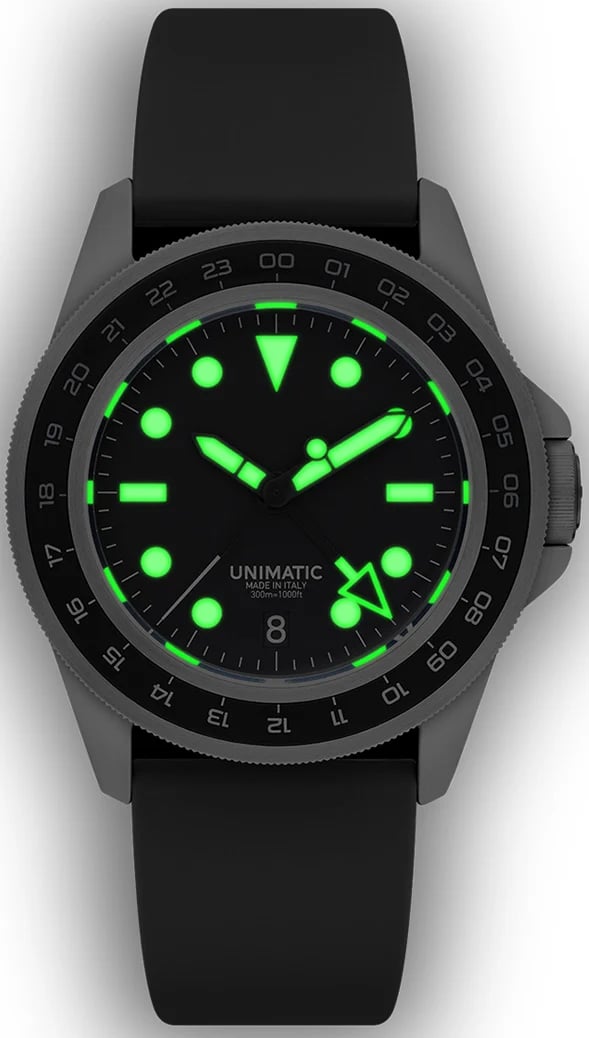
The dial is matte black and, in the NRD configuration, essentially unadorned. Unimatic's design language dispenses with applied indices, framing the hour markers as printed geometric forms that sit flush against the dial surface. The hands are sword-shaped and broad, with the GMT hand distinguished by a red tip that provides the only significant colour on the watch. There is no date window interrupting the layout, which keeps the symmetry intact and removes one of the most common sources of visual clutter in the segment.
Legibility is excellent. The contrast between the printed markers and the matte black ground is high, the hands are wide enough to be read at a glance, and the GMT hand is distinct without dominating. This is a dial designed for a departure board and a taxi window, not for a display case.
Lume is applied in Super-LumiNova and performs to the standard you would expect from a modern dive watch. It is bright on charging, fades predictably, and remains readable through the night at a level sufficient to tell the time without reaching for a phone. It is not a Seiko-diver torch, but it is entirely adequate for the brief.
The Movement
Inside is Sellita's SW330-2, a Swiss automatic GMT with 25 jewels, a frequency of 28,800 vibrations per hour and a power reserve of 56 hours. The architecture is ETA-derived and thoroughly proven; the GMT hand is independently adjustable, and the movement carries a date function that Unimatic leaves unused beneath the dial. That is a sensible decision — a ghost date position is a small compromise in exchange for a cleaner dial.
Finishing is industrial. The bridges are rhodium-plated with straight graining, there is no anglage, and the rotor is functional rather than decorative. None of this is visible through a sapphire caseback, because there isn't one, and none of it matters at this price. What matters is that the SW330-2 is serviceable by any competent watchmaker, that parts are widely available, and that the 56-hour reserve means the watch will still be running on Monday morning after a weekend on the nightstand.
It is worth being clear about what this movement is not. It is not in-house, it is not chronometer-certified, and it does not offer the finishing that collectors of haut de gamme movements travel for. It is a well-engineered, reliable, mass-produced Swiss GMT, and it is the correct choice for a watch built to this brief.
On the Wrist
The U1-GMT-NRD wears better than its specification might suggest, largely because the case is flat and wide rather than tall and domed. The absence of crown guards means the crown sits close to the caseband and does not dig into the back of the hand. The flat caseback distributes weight evenly, and the drilled lugs allow the strap to sit close to the case without the gap that sometimes appears on more sculpted designs.
The supplied NATO-style strap is both the right and the wrong answer. It suits the watch's character — utilitarian, adjustable, forgiving in heat — but it lifts the case off the wrist and adds a visual bulk the design does not need. Many owners move to rubber or a slim leather strap within the first month, and the drilled lugs make that easy. On fabric the watch feels like kit; on rubber it feels like a tool. Both are coherent, but the rubber arguably suits the NRD's blacked-out mood better.
Balance is good. The watch does not feel top-heavy, does not rotate on the wrist, and does not require constant repositioning. It is the sort of watch you put on in the morning and forget about until someone asks what it is.
Accuracy and Daily Use
The SW330-2 is regulated by Unimatic to a reasonable rather than a chronometric standard. Expect something in the region of minus five to plus fifteen seconds per day, with most examples settling into single-digit variance once the movement has bedded in. Positional variation is modest, as is typical of the Sellita architecture. The GMT hand tracks correctly and does not drift against the hour hand.
In daily use the watch does everything asked of it. Three hundred metres of water resistance means swimming and showering are non-issues; the sapphire crystal resists the scratches that acrylic would collect within weeks; and the matte dial does not glare under office lighting. It is not a dress watch and does not pretend to be, but it is perfectly at home under a shirt cuff.
Value and Ownership
At its original retail price the U1-GMT-NRD sits in a competitive but navigable bracket. The Tudor Black Bay GMT costs roughly double and offers an in-house movement and a bracelet; the Longines HydroConquest GMT offers conventional Swiss finishing and broader dealer support; the Christopher Ward C60 Trident Pro 300 GMT undercuts it with a more decorative dial. None of them look like the Unimatic, and that is the argument.
On the secondary market the NRD trades below its original retail, as most Unimatic references do once the initial run sells through. The trend is stable rather than appreciating; these are wearable watches, not speculative assets. Buyers should expect to pay somewhere in the high hundreds to low four figures for a clean example, and should not expect to make money on a resale.
Servicing is straightforward. The SW330-2 is a common movement, parts are available, and any competent independent watchmaker can handle it. A five-year interval and a service cost in the low hundreds of dollars is realistic. Authorised-only servicing is not required, which is one of the quieter advantages of buying a watch with an off-the-shelf Swiss movement.
Alternatives Worth Considering
If the brief is a steel GMT that can survive a swimming pool, the Tudor Black Bay GMT remains the obvious reference point — more watch in every measurable sense, at a price that reflects it. The Longines HydroConquest GMT is the more conventional Swiss alternative, with a dial that will appeal to buyers who find the Unimatic too severe. The Oris Divers Sixty-Five GMT offers a warmer, more vintage-inflected take on the same idea.
If the brief is specifically the Unimatic design language, the alternatives thin out quickly. Few brands in this bracket have committed so completely to a single aesthetic, and fewer still have managed to add a complication without diluting it. That is the NRD's real competitive advantage: not specification, but coherence.
Verdict
The U1-GMT-NRD is not a luxury traveler's GMT and has no interest in becoming one. It takes Unimatic's disciplined case architecture, adds a second time zone through a single red-tipped hand, and leaves everything else alone. The result is legible, robust, genuinely original and honestly priced.
What it will not give you is finishing to admire under a loupe, a bracelet to polish, or a story to tell at a dinner party. What it will give you is a watch that reads clearly in bad light, survives a decade of airports, and looks like nothing else in the room. For a certain kind of collector, that is the whole point.