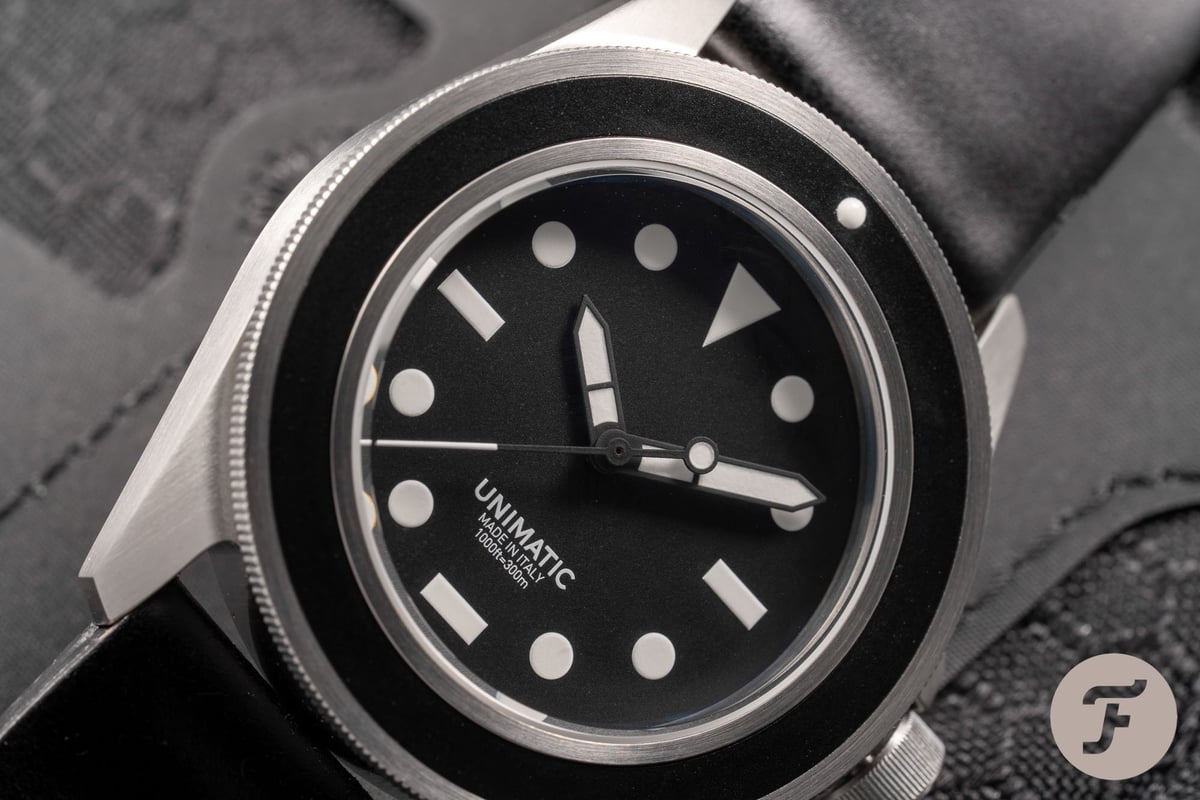
A Tool Watch Stripped to Its Essentials
There is a particular kind of confidence in a watch that refuses to decorate itself. The Unimatic Modello Uno U1-NRD is that watch. Born in Milan in the mid-2010s, Unimatic set out to reduce the dive watch to its functional minimum — a legible dial, a robust case, a reliable automatic movement — and then execute that minimum with enough care that it could sit comfortably alongside watches costing several times more. The U1-NRD is the purest expression of that thesis: a black-dialled diver with no date, no flourish, and no apology.
What makes the Modello Uno interesting to a collector is not its specifications, which are modest by modern standards, but its proportions and its discipline. Unimatic resisted the urge to add a chronograph, a GMT hand, a helium valve, or a ceramic bezel insert. The result is a watch that reads instantly at arm's length and photographs with the graphic clarity of a Bauhaus poster. For a young collector building a first serious collection, that clarity is worth more than a longer feature list.
The microbrand landscape is crowded with watches that promise Swiss finishing at Chinese prices. Most of them are exercises in specification-sheet one-upmanship. Unimatic took the opposite route: fewer features, better resolved. That decision is what separates the Modello Uno from the noise.
Milan, 2015: A Brand Built on Subtraction
Unimatic was founded in Milan in 2015 by Giovanni Moro and Simone Nunziato. Both came from design backgrounds rather than watchmaking dynasties, and that outsider perspective shaped the brand aesthetic. Instead of mining the archives of a century-old maison, they looked to Italian military dive watches and to the industrial design language of postwar Italy — clean lines, honest materials, an indifference to ornament.
The Modello Uno, or U1, was the founding model and remains the brand signature. It established the template: a brushed steel case, a minimalist bezel, a sandwich dial with luminous markers, and a Seiko automatic inside. Over the years Unimatic has released dozens of colourways and collaborations, many in strictly limited runs, which has given the brand a collector culture that punches well above its size. The U1-NRD belongs to that lineage — a black-dialled expression of the core design, sitting squarely in the permanent line rather than in the speculative limited-edition tier.
That distinction matters when you are buying. Limited Unimatic releases sell out in minutes and trade at premiums. Core models like this one are available, wearable, and priced for people who actually intend to put a watch on their wrist. There is no queue, no lottery, and no secondary-market markup. For a young collector, that is a virtue.
Case and Bezel: Brushed Steel, Sharp Intent
The case is stainless steel, brushed on the flanks and the top surfaces, with the kind of crisp edge that suggests CNC machining followed by hand finishing rather than a generic cushion. Unimatic case architecture is deliberately architectural: a stepped bezel sits proud of the mid-case, and the lugs are cut with an angular shoulder that gives the watch a slightly severe profile in three-quarter view. It is not a soft, pebble-like case. It has corners, and it wants you to notice them.
The bezel is the watch quietest statement. Rather than a ceramic insert with a printed dive scale, Unimatic fits a steel bezel with a sparse engraved or printed scale and a single luminous pip at twelve. It functions as a 60-minute elapsed-time bezel, and it turns with a positive, mechanical action. There is no superfluous text, no depth rating on the bezel, and no colour. The bezel is there to be used, not admired.
The crown is screw-down, which is essential given the watch 300-metre water resistance rating. That figure is a serious one for a watch at this price, and it tells you that Unimatic treated the dive-watch brief as a specification rather than a costume. Plenty of watches in this bracket look like divers but would not survive a swim. This one would.
The crystal is sapphire, the right call for a tool watch that will see real use. Sapphire resists the scratches that acrylic collects and keeps the dial legible for decades. The caseback is solid steel, screwed down, engraved with the model details — a practical choice that keeps the watch wearable day to day and protects the movement from shocks that a display back would expose it to. There is no exhibition window here, and there should not be: the movement inside is a workhorse, not a showpiece.
Dial and Lume: Graphic Clarity
The dial is where the Modello Uno earns its reputation. The U1-NRD uses a matte black surface, which absorbs light and makes the luminous elements read with maximum contrast. The layout is a sandwich construction: a large luminous triangle at twelve, round luminous dots at the remaining hours, and a fine printed minute track around the perimeter. There is no date window, no brand slogan, no depth rating cluttering the lower half. Just the markers, the hands, and the name.
The hands are broad and lume-filled, with a shape that prioritises surface area over elegance. They are the kind of hands you can read in the dark at a glance, which is the entire point. Unimatic has always understood that a dive watch first job is legibility, and every decision on this dial serves it. The seconds hand is slim and precise, with a luminous tip that lets you confirm the watch is running without squinting.
The absence of a date is deliberate, and it is the correct choice. A date window at three would break the symmetry of the dial and force a cyclops or a frameless aperture that would look cheap at this price. Omitting it keeps the design pure and removes a setting step from daily life. Collectors who insist on a date will disagree; everyone else will appreciate the restraint.
The luminous compound is Super-LumiNova, applied generously in the markers and hands. In practice the glow is strong and long-lasting — bright enough to read comfortably after hours in darkness, with the even tone that modern lume delivers. It is not the torch-like intensity of a professional instrument with triple-applied compound, but it is more than adequate for a daily wearer and genuinely useful at night.
Movement: The Seiko NH35A Workhorse
Inside the U1-NRD beats the Seiko NH35A, an automatic movement that has become the default heart of the microbrand world for good reason. It is a descendant of the 7S26 family, with the addition of hacking and hand-winding — two features that collectors rightly insist on. The movement runs at 21,600 vibrations per hour, or 3 Hz, and carries 24 jewels. Power reserve is approximately 41 hours, which is unremarkable but entirely sufficient for a watch worn most days.
Architecturally the NH35A is industrial rather than artisanal. There is no Geneva striping, no hand-bevelled bridges, no black-polished screws. What you get instead is robust construction, a proven track record, and serviceability that is unmatched at this price point. Any competent watchmaker can service an NH35A, parts are inexpensive and widely available, and regulation is straightforward. For a tool watch, that is a feature rather than a compromise. The movement is not COSC-certified and it is not made in-house — and neither fact matters in a watch designed to be worn hard and serviced cheaply.
The trade-off is the rotor noise and the slightly utilitarian feel when you wind it. The NH35A is not silky. But it starts reliably, hacks precisely, and keeps time within a range most owners will find acceptable. Given that this is a watch intended for actual diving and actual daily abuse, a more refined movement would be wasted and would only raise the price.
On the Wrist
The Modello Uno wears with an honesty that is increasingly rare. The case sits flat and stable on the wrist, and the angular lugs give it a planted feel rather than a delicate one. Because the design is visually dense — a large dial relative to the case, a prominent bezel, a matte black surface — the watch reads as substantial without feeling oversized. It is the kind of watch that disappears into the day rather than demanding attention, and that is precisely the brief.
The supplied NATO strap suits the watch character. Nylon is light, breathable, and secure, and it keeps the case close to the wrist so the watch does not roll. The pin buckle is simple and reliable. For collectors who prefer leather or rubber, the lug geometry makes strap changes easy, and the watch looks equally at home on a black rubber dive strap or a distressed leather NATO. The balance is good: the watch does not feel top-heavy, and the crown does not dig into the wrist.
One point worth noting for anyone accustomed to dress watches: this is a tool watch with a tool watch presence. It sits tall enough to announce itself under a cuff and it will not slide under a tight shirt sleeve. That is not a flaw. It is a category distinction, and it should inform how you plan to wear it.
Accuracy in Daily Use
Seiko rates the NH35A to roughly -20/+40 seconds per day, a specification that sounds alarming until you live with one. In practice most examples settle into a much tighter band, often between -15 and +20 seconds per day, and many run closer still. Expect to correct the time by a minute or so every few days, or roughly once a week if your example is well regulated. That is not chronometer performance, and nobody should pretend otherwise.
The compensation is that the movement is easy and inexpensive to regulate. A watchmaker can bring a wayward NH35A into single-digit daily deviation for a modest fee, and the watch will then hold that rate for years. For a collector who cares about daily practicality rather than certification, this is a perfectly rational trade. If you need certified precision, buy a chronometer-rated watch and pay for it. If you need a reliable daily companion, the NH35A delivers.
Straps, Versatility, and Daily Life
The U1-NRD is at its best on nylon. A black or grey NATO keeps the watch in its natural habitat and reinforces the tool-watch logic of the design. Swap to rubber and it becomes a genuine swim and beach companion. Put it on a simple leather strap and it crosses into casual office territory — though it will never be a dress watch, and it should not try to be.
This versatility is one of the underrated arguments for a minimal dive watch. A single watch can cover the gym, the commute, the weekend, and the holiday without looking out of place. The U1-NRD does not need a collection around it to make sense. That makes it a strong first serious purchase for a young collector who wants one watch rather than five.
Ownership, Value, and the Secondary Market
Unimatic pricing has always been one of its strongest arguments. The Modello Uno delivers a sapphire crystal, 300-metre water resistance, a screw-down crown, and a proven automatic movement at a figure that would buy only a quartz diver from most established brands. On the secondary market the standard models trade at or slightly below retail, with limited editions and collaborations commanding premiums. The U1-NRD, as a core-line black dial, sits in the stable category rather than the speculative one.
That stability is healthy. Unimatic has built its reputation on making good watches rather than on manufacturing scarcity, and the result is a brand you can buy without fearing instant depreciation. The hold recommendation is straightforward: buy it to wear it. This is not a watch to tuck away in a safe, and it is unlikely to fund a retirement. It is, however, likely to remain desirable among collectors who value design discipline over resale speculation.
Alternatives Worth Considering
If you are shopping in this territory, several watches deserve a look. The Tudor Black Bay 58 offers a vintage-inspired dive watch with an in-house movement and far greater brand recognition, at three to four times the price. The Oris Divers Sixty-Five brings Swiss heritage and a domed sapphire to a similar retro brief. Seiko own Prospex divers, particularly the SPB143, deliver Japanese construction and finishing at a comparable or slightly higher price. And Doxa Sub 200 offers a distinctive cushion case and a genuine dive-watch lineage.
Below the Unimatic, the homage market is crowded. San Martin, Steeldive, and Pagani Design all produce Submariner-adjacent divers for a fraction of the price, and while they cannot match Unimatic design integrity or Italian identity, they are competent watches. The difference is authorship: the Unimatic design is its own, and that matters to collectors who care about originality rather than specification alone.
Service and Long-Term Ownership
The NH35A makes long-term ownership pleasantly uneventful. A service every five to seven years is sensible, and the cost is modest — typically a fraction of what a Swiss in-house movement would demand. Because the movement is so widely used, you are not locked into a single authorised service centre. Any reputable independent watchmaker can handle it. That freedom is a genuine advantage for a young collector who may not want to ship a watch across the world for routine maintenance.
Parts availability is the other quiet benefit. Seiko has produced the NH35A in enormous volumes, and components are inexpensive and easy to source. If something fails, you fix it. You do not wait nine months for a boutique to quote you a four-figure sum for a movement overhaul.
Verdict
The Unimatic Modello Uno U1-NRD is not trying to be everything. It is a dive watch reduced to its essentials and executed with conviction. The case is honest steel, the dial is a lesson in graphic restraint, the movement is a proven workhorse, and the price is sane. It will not impress anyone at a boardroom table, and it will not appreciate like a limited-edition chronograph. What it will do is tell the time accurately, survive real use, and look good doing it — and for a collector who values design over decoration, that is enough.