The Italian Drop Culture Behind Unimatic
Unimatic was founded in Milan in 2015 by Giovanni Moro and Simone Nunziato. The brand built its reputation on limited drops, collaborations, and a design language that sits between Italian industrial design and military tool watch. The U1 is the model that made the name. Its blunt case, stripped-back dial, and refusal to chase conventional luxury cues gave collectors something different from the usual Swiss heritage play.
That matters for the U1 GMT because this is not a heritage brand mining an archive. It is a young brand asking collectors to buy into its taste. The U1 GMT is not a revival of some 1960s reference. It is a modern travel watch with a Seiko movement, a NATO strap, and a design that looks better in a studio or on a train than under a cuff. That is the appeal. You are not buying history. You are buying a point of view.
The brand's drop model also shapes the ownership experience. Unimatic releases tend to move quickly, and collaborations can become collector fodder. The standard U1 GMT is less about auction drama and more about getting a well-designed daily watch before a run sells out. If you miss a drop, the secondary market is usually there, but the premium is rarely extreme unless the reference is a collaboration or a very small run.
Movement: Seiko NH34 Does the Traveling
The U1 GMT runs on the Seiko NH34, an automatic GMT movement with 24 jewels, a 41-hour power reserve, and a frequency of 21,600 vph. It is not in-house, not COSC-certified, and not finished like a Swiss calibre. What it is: a proven, affordable GMT architecture that keeps the U1 GMT at a microbrand price and makes service straightforward.
The NH34 is the reason this watch can exist at its price point. A Swiss GMT movement with comparable utility would push the U1 GMT into a different bracket, and Unimatic would have to compete with Tudor, Longines, and the rest of the established travel-watch crowd. Instead, the brand keeps the movement pragmatic and puts the money into the case, dial, and overall design. That is a trade many collectors will accept.
The movement also explains what the U1 GMT is not. It is not a chronometer. It is not a haute-horology object. It is a tool watch with a second time zone, and the NH34 has enough of a track record to make that a reasonable proposition. The 41-hour reserve is not huge, but it is fine for a watch you wear regularly. The GMT function is the real point, and it works without adding a layer of fragility.
Specs and Build: Tool Watch First
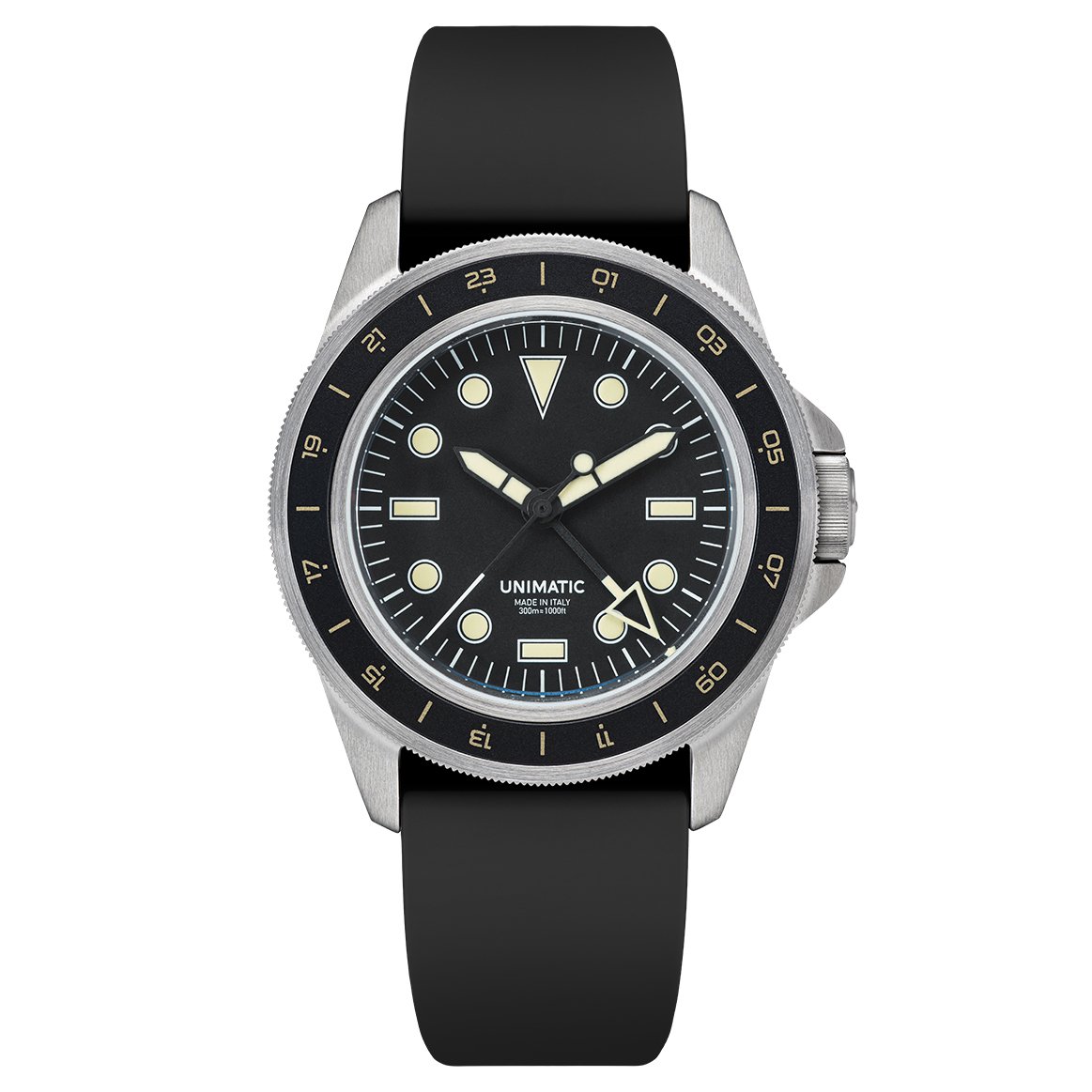
The U1 GMT is a 40mm stainless-steel watch with a sapphire crystal, 300m water resistance, Super-LumiNova, and a NATO strap on a pin buckle. Those are the numbers that matter. The case is not precious. The crystal is not domed acrylic for vintage charm. The water resistance is far beyond what most owners will ever need, and that is exactly the point. This is a watch that can handle rain, swimming, travel, and the general clumsiness of daily life.
Unimatic does not dress this watch up. The dial is matte and legible, the lume is functional, and the NATO strap keeps the whole thing casual. If you want a bracelet-first luxury experience, this is not it. If you want a watch that looks right with a field jacket and a duffel bag, the U1 GMT is in its element. The sapphire crystal is a welcome practical touch, and the 300m rating gives the watch a sense of overbuilt security.
The U1 GMT also benefits from the brand's established case language. Unimatic has spent years refining the U1 silhouette, and the GMT version does not mess with the formula. The result is a watch that feels coherent rather than like a parts-bin special. The GMT hand is integrated into the dial rather than slapped on top, and the overall look is still unmistakably Unimatic.
On the Wrist: The U1 Formula, Now With a Second Time Zone
On the wrist, the U1 GMT reads as a U1 first and a GMT second. The 40mm case has the same blunt, purposeful stance that made the original U1 a microbrand favorite, and the NATO strap keeps the whole package casual and easy to wear. It does not feel like a desk diver or a dress watch trying to cosplay as a tool; it feels like a watch that expects to be worn with a jacket, a backpack, and a boarding pass.
The GMT hand is the tell, but it does not overwhelm the dial. Unimatic has kept the U1's clean, legible layout, so the extra time zone is there when you need it and quiet when you do not. Comfort is good because the watch is not trying to be a bracelet-first luxury object. The NATO distributes weight well, and the pin buckle keeps the profile simple. This is a watch you can wear for a full travel day without thinking about it.
The U1 GMT also works because it does not pretend to be a dress watch. It is at its best with denim, a coach jacket, a hoodie, or a simple button-down. The 40mm size keeps it from feeling bulky on most wrists, and the NATO strap makes it easy to adjust throughout the day. If you have a smaller wrist, the U1 case still works because the design is clean rather than oversized. If you have a larger wrist, it will look purposeful without dominating.
Accuracy: Workhorse, Not Chronometer
Seiko rates the NH34 at roughly -20 to +40 seconds per day. That is the number to expect, not a chronometer spec. Real-world examples often land closer to plus or minus 10 to 20 seconds, but you should not buy a microbrand GMT expecting COSC discipline. The U1 GMT is a workhorse travel watch, and its accuracy story is about reliability and easy service rather than laboratory precision.
For daily wear, that is usually fine. You are not buying this watch to time a race or to satisfy a metrology obsession. You are buying it to track a second time zone, survive a trip, and look good doing it. If you need tighter accuracy, you can have the movement regulated by a watchmaker, but do not expect the U1 GMT to behave like a chronometer out of the box. The NH34 is a known quantity, and that predictability is part of the value.
When to Wear It
This is a sport and travel watch first. It works with denim, a coach jacket, a hoodie, and a carry-on. It can slide into a casual office or a creative studio. It is not a dress watch, and it should not be forced into a black-tie role. The U1 GMT is at its best when the day involves movement: a flight, a train, a gallery visit, a match, a dinner that runs late.
For collectors who like one-watch travel, the U1 GMT makes a strong case. The 300m water resistance means you do not have to worry about the pool. The sapphire crystal means you do not have to baby it. The NATO strap means you can swap it easily and wear it tight or loose. The GMT hand means you can keep home time on the dial without doing mental math. It is not a formal watch, but it is a capable one.
Wrist Presence
Wrist presence: 4/5. It is not loud, but it is legible and confident. The U1 GMT looks like a purpose-built object, and the GMT hand gives it just enough visual difference to start conversations with people who know watches. It does not have the immediate recognition of a Submariner or a Black Bay, but that is part of the appeal. It reads as a design-forward tool watch rather than a flex.
The U1 GMT's presence comes from its proportions and dial clarity rather than shine. The matte finish, the clean markers, and the strap-first setup make it look like something an architect or a creative director would wear. It is the kind of watch that looks better after a few years of use, when the strap has softened and the case has picked up a little character.
Variants and Family Ties
The core reference is the U1-GMT, with a matte black dial and black NATO. That is the version most buyers will encounter. The U1 GMT sits in the U1 family alongside the U1 Classic, U1S, U2, U3, and U4. The U1 is the original 40mm tool-watch shape, while the U2, U3, and U4 explore different case sizes and design briefs. The U1 GMT is the travel-focused member of that family.
Unimatic's broader catalog includes the Modello Uno U1, Modello Due U2, Modello Tre U3, and Modello Quattro U4. Collectors who like the brand's design language often move between these families, but the U1 GMT is the most obvious choice for someone who wants a second time zone without leaving the U1 aesthetic. It is a niche within a niche, and that is what makes it interesting.
Similar Watches and Homages
If you want the same brief from a bigger brand, the Tudor Black Bay GMT and Longines Spirit Zulu Time are the obvious upscale answers. Both offer more heritage, stronger movements, and a more conventional luxury experience. The Seiko 5 Sports GMT SSK001 is the budget answer, with the same NH34 movement and a more mass-market feel. The Baltic Aquascaphe GMT and Christopher Ward C63 GMT are the indie and value alternatives, each with its own take on the travel-watch formula.
Homage territory is trickier with Unimatic because the brand's design is so specific. The Pagani Design PD-1662 GMT and San Martin SN0055-GMT give you NH34 GMT utility for a few hundred dollars, but they do not capture the U1's industrial minimalism. They are affordable ways to scratch the GMT itch, not substitutes for the Unimatic design language. If you want the U1 GMT look, save for the Unimatic.
Investment Value and Service
At an MSRP around $1,050, the U1 GMT is priced like a serious microbrand, not a disposable fashion watch. Pre-owned examples trade roughly $750 to $950. The trend is stable rather than explosive. Standard U1 GMTs do not have the auction heat of Unimatic's limited collaborations, so you should not buy one expecting it to appreciate like a limited-edition Speedmaster or a Rolex GMT-Master.
That does not make it a bad buy. It makes it a watch you buy to wear. The value is in the design, the 300m water resistance, the sapphire crystal, and the easy ownership experience. If you keep it for years, the cost per wear is reasonable. If you flip it after a season, you will likely take a small hit. Service is the good news: the NH34 is widely serviceable, and authorized-only service is not required. Any competent watchmaker can work on it, which keeps long-term ownership simple.
Auction history is essentially nonexistent for the standard U1 GMT. That is not a criticism. It is a reality of the microbrand market. The U1 GMT is not an auction watch. It is a daily-wear watch with a strong design point of view. If you want auction drama, look at vintage GMT-Masters. If you want a wearable travel watch with Milanese attitude, keep reading.
Pros and Cons
- Pros: Seiko NH34 GMT adds real travel utility.
- Pros: The 40mm U1 case is clean and wearable.
- Pros: 300m water resistance is overbuilt for daily life.
- Pros: Sapphire crystal and NATO strap suit hard wear.
- Pros: Microbrand design without a luxury markup.
- Cons: Basic NH34 finishing and accuracy.
- Cons: No COSC or in-house credibility.
- Cons: Standard references depreciate after retail.
- Cons: Limited service network compared with legacy brands.
Final Verdict
The U1 GMT is not trying to be a Tudor or a Grand Seiko. It is a sharply designed, easy-to-service travel watch from a brand that understands drop culture, and that is exactly the point. If you want one watch that moves from airport to studio to dinner without preciousness, it earns a spot.
Buy it because you like the way it looks and because you actually use a GMT. Do not buy it because you think it is the next great auction lot. The U1 GMT is a tool watch with taste, and that is a better reason to wear a watch than most.