Milan doesn't make watches the way Switzerland does
Milan's watch scene has never behaved. Where Swiss houses build catalogues that stretch across decades, Unimatic builds drops — tight, numbered, announced with the urgency of a sneaker release and gone before the forums finish arguing about them. The U4 DRD belongs to that rhythm. It sits inside the brand's Modello Quattro line, and if you weren't watching the right channel when it landed, you probably met it secondhand, in a photograph, on someone else's wrist.
That scarcity is part of the point, but it isn't the interesting part. What makes the U4 DRD worth a serious look is that Unimatic has spent more than a decade making a single, consistent argument: a tool watch doesn't need a hundred-year backstory to be taken seriously. It needs a clear idea, executed without decoration, at a price that doesn't require a relationship with an authorised dealer. The U4 DRD is that argument in its most stripped-down form.
This review covers where the reference sits in the Unimatic family, how the design language holds up in daily wear, what the movement actually delivers, and whether the secondary market treats these watches as collectibles or as tools. Where Unimatic hasn't published a figure, we say so rather than filling the gap with an invented one.
Unimatic, briefly
Giovanni Moro and Simone Nunziata founded Unimatic in Milan in 2011. Both came out of design backgrounds rather than watchmaking dynasties, and that shows in the output. The brand's early references were exercises in subtraction: matte cases, oversized markers, no applied logos fighting for space, no decorative flourishes that would look dated in five years.
The distribution model mattered as much as the design. Unimatic sold direct, in small batches, without a dealer network. That kept margins workable for a young brand, kept the community close, and — crucially — kept resale chatter loud. Every release became a small event. Collectors learned to set alarms.
The Modello Quattro arrived as the fourth pillar of the family, after the Modello Uno, Modello Due and Modello Tre. Where the Uno established the dive-watch template, the Quattro refined it into something cleaner: a case that reads as architecture first and instrument second, with a dial pared back to hour, minute and second.
What the U4 DRD actually is
Unimatic's reference codes are functional, not poetic. The letters after the dash denote a colourway or treatment, and the DRD designation points to a dial built around red accents against a matte black ground. That's the entire concept. There is no commemorative plaque, no engraved caseback essay, no anniversary narrative.
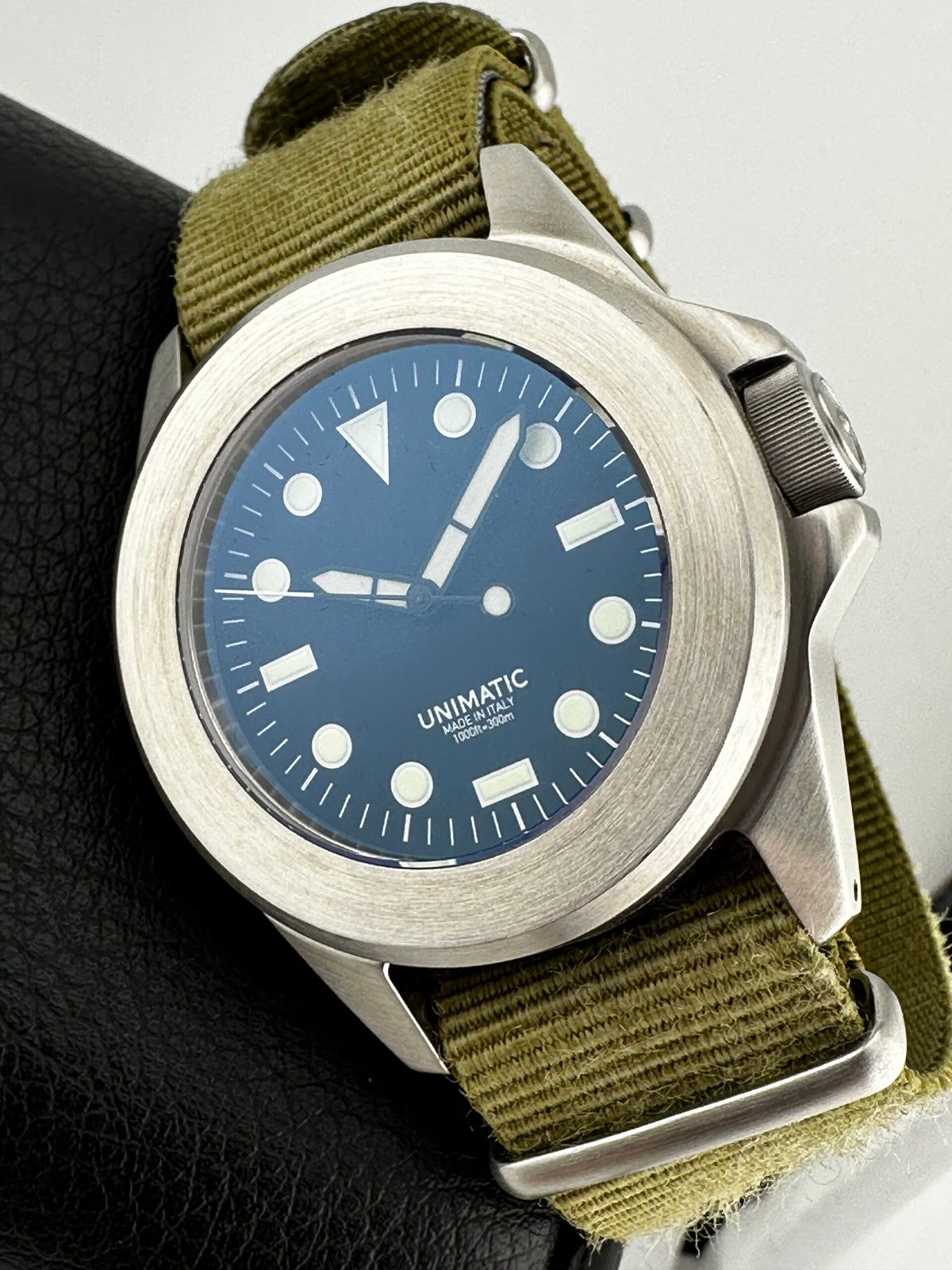
What you get instead is Unimatic's design language at its most confident. The dial is dominated by large, high-contrast markers and hands designed for instant reading in bad light. Branding is minimal — the Unimatic wordmark and the country of origin, nothing else competing for attention. The red accents do the work that a rotating bezel or a busy chapter ring might do on a more conventional dive watch: they give the eye an anchor and a sense of direction.
It's a look that photographs well and wears even better, because it doesn't rely on detail to hold your interest. There is nothing on this dial to get bored of, which is a compliment that far more expensive watches can't claim.
Case, crystal and the small things
The case is stainless steel, brushed rather than polished, with the kind of flat-sided geometry that has become Unimatic's signature. It's a shape designed to be machined cleanly and worn without fuss. The crystal is sapphire, which has become table stakes at this price but is still worth noting on a watch built to be knocked around.
Lume is Super-LumiNova, applied generously to the markers and hands. In practice, this is the part of the watch that justifies the tool-watch framing most clearly: charge it under a lamp for thirty seconds and it stays legible through a dark room, a cinema, a tent. Unimatic doesn't chase the brightest lume on the market, but the application here is even and the hands remain distinguishable from the dial at three in the morning, which is the only test that matters.
Unimatic's published technical data varies by release, and the brand has historically been leaner with specification sheets than its Swiss competition. We've deliberately left case diameter, thickness, lug-to-lug and water resistance unstated here rather than repeating figures that circulate on forums without a primary source. If those numbers matter to you — and for a tool watch they reasonably might — confirm them with the brand or the retailer before you buy.
On the wrist
The Modello Quattro case is the most disciplined shape Unimatic makes, and it wears accordingly: flat against the wrist, low drama, no bezel edge digging into a shirt cuff. Because the case is brushed and largely unadorned, the visual weight sits in the dial, which is exactly where a tool watch wants it. On the supplied fabric strap the whole thing disappears into the wrist in the best sense — you notice it when you check the time and forget it otherwise.
The trade-off is presence. This is not a watch that announces itself across a dinner table. Collectors who like a slab of polished steel catching light will find the U4 DRD austere, even a little cold. The drilled-lug, strap-first approach does make it unusually adaptable, though: swap the NATO for rubber and it becomes a genuine weekend beater; swap it for a slim leather and it dresses up more than its brief suggests. Very few watches in this bracket move that easily between contexts.
Balance is good. The case sits centred rather than flopping forward, and the strap-supplied configuration keeps the whole assembly light enough to forget. Anyone who has worn a heavy steel diver on a bracelet knows how much that matters by hour six of a long day.
The movement
Unimatic's automatic references have long relied on the Sellita SW200-1 family — a Swiss workhorse chosen for serviceability rather than spectacle. It runs at 28,800 vibrations per hour with a power reserve in the region of 38 hours, hacks, hand-winds, and hides behind a solid caseback. There is no display back here, and no finishing to admire. That's consistent with the philosophy: the caseback is a sealed lid, not a window.
Buyers chasing a specific limited run should confirm the exact grade with the brand. Unimatic has used multiple tiers of the same base calibre across its releases, and the difference between an elaboré and a top-grade example shows up in regulation and long-term stability rather than in the spec sheet headline. The architecture itself is well understood by every competent watchmaker on the planet, which is a genuine practical advantage for a watch designed to be used.
One note on transparency: Unimatic doesn't publish jewel counts or decorative details for every release, so we haven't stated them here. The useful takeaway is simpler — this is a movement you can trust, service and replace, not one you buy for the view.
Accuracy, day to day
A Sellita SW200-1 in standard grades typically runs within roughly ±15 seconds per day out of the box, with most examples settling considerably tighter after a few weeks of wear and a proper regulation. Expect something in the ±5 to ±10 second range in normal use. That's good enough that you'll never think about it, and not tight enough to satisfy someone who times their watch against a reference clock every morning.
Positional variation is normal at this tier. If you wear the watch on the same wrist daily and take it off at night, you'll learn its habits within a month — dial up versus crown down will differ, as it does on almost every mechanical watch at this price. There is no chronometer certification, no METAS-style testing, and Unimatic doesn't pretend otherwise. The honest framing is that accuracy is a non-issue in practice and a hobby in itself if you want it to be.
Service and ownership
Because the movement is a Swiss commodity calibre, service is genuinely easy. Any competent independent watchmaker can handle it, and parts availability is about as good as it gets outside the in-house world. Unimatic's direct-sales model means factory service runs through the brand rather than a dealer network, so log your purchase documentation carefully.
We haven't quoted service intervals or costs here, because those depend on the specific calibre grade, your region and the current terms from the brand. The practical advice is standard for a mechanical tool watch: service it when it starts drifting or when the amplitude drops, not on a rigid calendar.
The market
Unimatic's pricing sits in the low four figures depending on the release, with limited editions occasionally commanding more at launch. The secondary market behaves the way microbrand secondaries usually do: a spike of demand immediately after a drop sells out, followed by a gradual softening as attention moves to the next release.
That pattern means the U4 DRD is a stable rather than appreciating asset. You are not buying a commodity here; you are buying design authorship and scarcity. The premium over a comparable Seiko or Hamilton buys you a watch that almost nobody else at your table is wearing, produced in numbers small enough to keep it that way. Whether that's worth the delta is a personal calculation, but it's an honest one — nobody is pretending this is a Daytona.
There's no meaningful auction history for references like this, and there likely never will be. Treat that as a feature. Watches that live outside the auction ecosystem tend to be the ones people actually wear.
What it competes with
The obvious alternative is a Seiko Prospex — the SPB143 and its siblings deliver the same high-legibility diver brief from a brand with a bottomless service network and wider availability. A Hamilton Khaki Navy offers military-adjacent tool styling at a similar price. Christopher Ward's C60 Trident Pro 300 will out-specify the Unimatic on paper for similar money.
None of them will feel like the Unimatic. That's the whole game. The U4 DRD competes on design authorship and the particular pleasure of wearing something that wasn't chosen for you by a marketing department's focus group. Buyers who want maximum specification per dollar should go elsewhere and will be well served. Buyers who want a watch that looks like nothing else in the room will find the calculus obvious.
The verdict
The U4 DRD is the clearest expression of what Unimatic does well: a tool watch with real design conviction, sold without heritage theatre and priced where it can actually be worn hard. It isn't the most specified watch at its price, and it won't reward anyone treating it as an investment.
What it will do is sit on your wrist for a decade without asking for attention. For a growing number of young collectors who have grown tired of buying the same heritage reissue everyone else owns, that's not a compromise — it's the entire appeal.