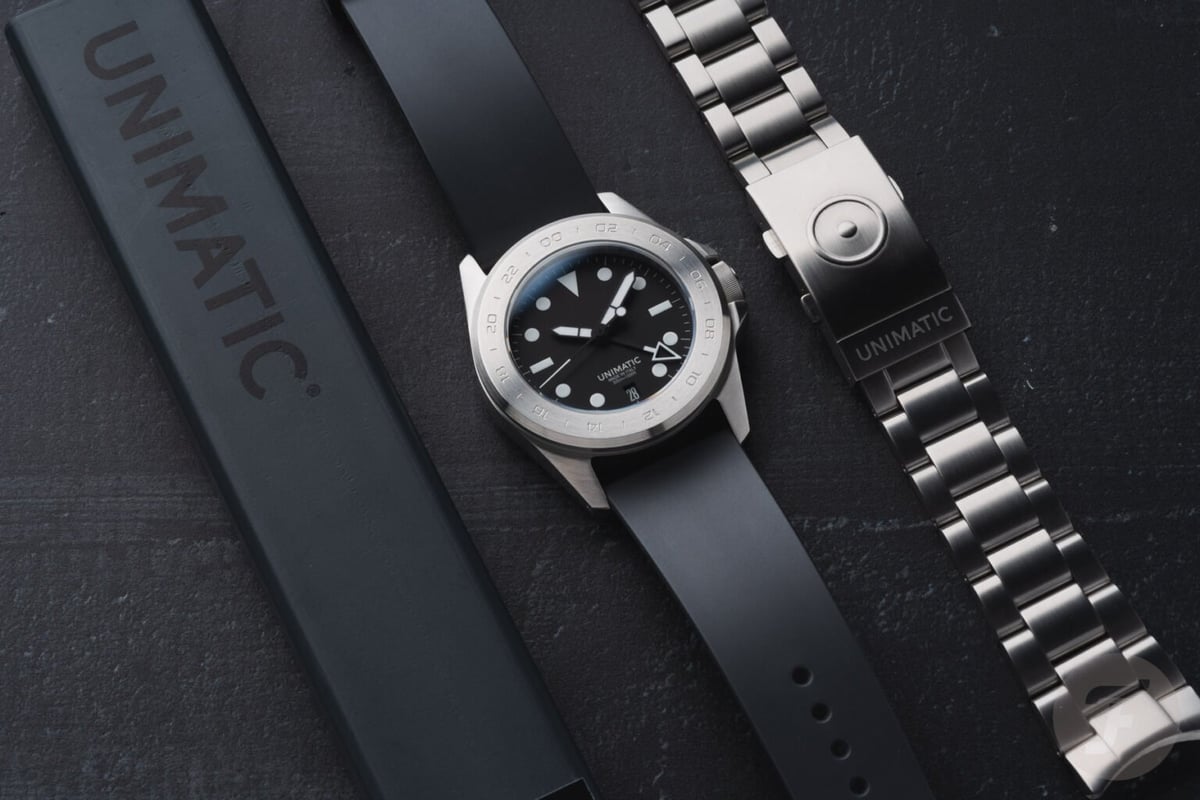
The Quiet Case for a Minimalist GMT
Unimatic has spent a decade proving that restraint is a design position rather than an absence of ideas. Founded in Milan in 2015, the brand arrived with a thesis: that a watch could be severe, industrial, and quietly beautiful at once, and that limited production was a feature rather than a compromise. In an era when microbrands compete on novelty — louder dials, stranger cases, more elaborate collaborations — Unimatic has done the opposite, refining a narrow vocabulary until it reads as unmistakably its own.
The U4 GMT is the clearest expression of that thesis yet in a travel watch. It takes the Modello Quattro case, strips the dial to its functional essentials, and adds a complication that genuinely earns its place on a busy wrist. There is no rotating bezel, no two-tone colourway, no attempt to evoke the golden age of jet travel. What remains is a watch that does one additional thing — track a second time zone — without letting that ability dominate its personality.
Most GMTs are extroverts. They arrive with ceramic bezels, oversized arrow hands, and a colour story borrowed from mid-century airline lounges. The U4 GMT goes the other way. Its 24-hour indication is worked into the dial rather than shouted from the case, and the overall effect is closer to a field instrument than a jet-set accessory. That will disappoint anyone hunting for a statement piece. It will delight anyone who has ever wanted a GMT they could wear without thinking about it.
What follows is a close look at how the U4 GMT is built, how it wears, what the Sellita movement delivers day to day, and where it sits in a market crowded with microbrand travel watches. The short version: this is one of the more coherent tool watches at its price, provided you value discipline over decoration.
Unimatic: A Short History of Discipline
Giovanni Moro and Simone Nunziata founded Unimatic in 2015, working from Milan and building on a simple premise: make fewer watches, make them honestly, and let the design do the talking. Early models such as the Modello Uno established the house codes — matte dials, high-contrast markers, brushed steel, and a refusal to clutter the case with decoration that serves no purpose.
The brand has always leaned on Swiss ébauches rather than chasing an in-house movement, a decision that keeps prices within reach of younger collectors and makes servicing straightforward. Movement choice is treated as an engineering matter rather than a marketing one: Unimatic specifies a calibre, builds the watch around it, and does not pretend the result is something it is not. That pragmatism has become part of the brand's appeal.
Production runs are small and frequently sell out, which has given Unimatic an outsized reputation relative to its output. The Modello Quattro family, of which the U4 GMT is a member, extends those codes into a slightly more refined case shape while keeping the tool-watch ethos intact. Importantly, the brand does not pretend to be a heritage maison. It is a young company with a clear point of view, and the U4 GMT should be judged on that basis — as a contemporary tool watch, not as a successor to anything in particular.
Case and Construction: Industrial Logic
The first thing you notice about the U4 GMT is how deliberate the case feels. It is built from brushed stainless steel, and the finishing is consistent across the surfaces: no stray polish, no decorative bevels that exist only to catch light. The lugs are angular and short in profile, which contributes to the watch's compact stance on the wrist, and the case sides are flat enough to read as machined rather than sculpted.
Unimatic's cases have always been designed around legibility and durability rather than elegance, and the U4 GMT is no exception. The crown is protected and easy to grip, the caseback closes the watch cleanly, and the overall construction feels solid without feeling heavy. There is no display back here, which is the right call: the Sellita inside is a working movement, not an exhibition piece. The absence of a rotating bezel is equally deliberate — it keeps the case profile low, removes a potential point of failure, and leaves the dial to do the work of the 24-hour indication.
The sapphire crystal is flat and clear, with no distracting dome or tinted anti-reflective coating that would undermine the matte dial. It is the sort of detail that is easy to overlook and hard to get right, and Unimatic gets it right by leaving it alone. The same can be said for the case finishing: it is not luxurious, but it is honest, and it holds up well to daily wear.
There is also a coherence to the way the parts relate. The crown, the lugs, the case sides, and the crystal all share a common design language, and nothing looks borrowed from a different watch. That may sound like a low bar, but in a segment where many brands assemble a case from a parts catalogue, coherence is a genuine differentiator.
The Dial: Legibility as Doctrine
The dial is where the U4 GMT makes its case. It is matte, dark, and almost aggressively plain, with printed indices that sit flat against the surface rather than applied markers that add depth but also visual noise. The result is a dial that reads instantly in almost any light, which is precisely the point. At a glance, at an angle, in low light — the information is there, and it does not require effort to extract.
The GMT indication is handled with unusual restraint. A slim 24-hour hand points to a discreet track around the dial's edge, and the hand is finished in a contrasting tone so it can be located at a glance without dominating the design. It is a caller-style GMT, meaning the 24-hour hand is set independently, which is the practical arrangement for most travellers: keep the main hands on local time, set the arrow to home, and read both without mental arithmetic.
Super-LumiNova is applied generously to the hour markers and hands, and it charges quickly and reads clearly in the dark. There is no rotating 24-hour bezel, which simplifies the case and reduces the number of things that can go wrong. Text on the dial is kept to a minimum — a brand mark, a depth-related line, and little else. For collectors used to a paragraph of specifications printed at six o'clock, the emptiness takes adjustment. After a few days, though, it reads as confidence. The U4 GMT does not need to explain itself.
There is a subtle pleasure in a dial this disciplined. It rewards repeated wear rather than first impressions, and it never becomes busy. Even after weeks on the wrist, the eye still finds the hours first and the GMT hand second, which is exactly the hierarchy the design intends.
Movement: The Sellita SW330-2
Inside the U4 GMT is Sellita's SW330-2, a Swiss automatic GMT calibre that has become the default choice for independent brands that want a reliable travel complication without an in-house price tag. It runs at 28,800 vibrations per hour, carries 25 jewels, and delivers a power reserve of around 56 hours — enough to set the watch down on Friday evening and pick it up on Monday morning without resetting.
The architecture is conventional and proven: an independently adjustable 24-hour hand, a hacking seconds function, and a robust gear train that has been refined over years of service in the field. Finishing is industrial rather than decorative, which is entirely appropriate here. You are not buying the U4 GMT for anglage and Geneva stripes; you are buying it for a movement that will start, run, and keep time without drama.
The SW330-2 is not chronometer-certified, and Unimatic does not market it as such. That honesty is refreshing. What you get is a well-understood calibre that any competent watchmaker can service, with parts availability that is far better than most in-house alternatives at this price. For a tool watch, that is a feature, not a compromise: it means the watch can be maintained for decades without a specialist pilgrimage.
The power reserve deserves particular mention. Fifty-six hours is enough to make the GMT function genuinely useful for travel: set the 24-hour hand to home time, adjust the main hands to local time, and the watch becomes a practical companion rather than a complication you have to think about. It also means the watch is not constantly running down between wears, which is more than can be said for many automatics in this segment.
On the Wrist
The U4 GMT wears like a tool watch should: close to the wrist, balanced, and free of the top-heaviness that afflicts thicker GMTs. The short, angular lugs mean the case sits flat rather than perched, and the brushed steel keeps the visual weight low. On the supplied rubber strap it feels secure and unobtrusive, the kind of watch you forget you are wearing until you need to read the time in another time zone.
Comfort is assisted by the strap choices. Unimatic ships the U4 GMT on a rubber strap that suits the case's utilitarian character, and the pin buckle is simple and reliable. Swapping to a NATO or a leather strap is straightforward, and the watch takes on a different character depending on what you choose — more field watch on nylon, slightly more refined on leather. The lug arrangement makes strap changes quick rather than a chore, which matters for a watch likely to be worn in varied settings.
It is not a small watch in the abstract, but it reads modestly on the wrist. That is a function of proportion rather than measurement: the dial is uncluttered, the case is brushed rather than polished, and the absence of a rotating bezel keeps the profile slim. Collectors who prefer their watches to announce themselves may find it understated to a fault. Collectors who value discretion will find it just right.
Wrist presence, then, is a matter of intent. This is not a watch that draws comments from strangers. It is a watch that draws comments from people who know what they are looking at, and that is a narrower — and in some ways more satisfying — kind of attention.
Accuracy and Daily Ownership
In daily use, the SW330-2 is a dependable performer. Expect accuracy in the range of a few seconds per day either side of zero, which is typical for a well-regulated Sellita and more than adequate for a watch of this type. It is not a chronometer, and it does not pretend to be, but it is consistent — and consistency matters more than a single impressive timing result. Positional variation is present, as with any mechanical movement, but it is modest enough that most owners will never notice.
Ownership is uncomplicated. There is no proprietary service ecosystem to navigate, no unusual strap integration to work around, and no fragile finishing to worry about. The U4 GMT is designed to be worn, and it behaves accordingly. It shrugs off knocks, resists the kind of light scratches that accumulate on any daily watch, and does not demand babying.
That matters more than spec-sheet bragging rights for a watch in this category. A tool watch should be the one you reach for without hesitation, and the U4 GMT earns that role through competence rather than charisma. It is, in the best sense, a watch you can forget about.
Variants and the Wider Unimatic Family
Unimatic releases the U4 GMT in small runs, and the core variants differ mainly in case finish and dial treatment. The standard stainless steel version is the purest expression of the design, while the black-coated variant leans further into the tactical aesthetic that the brand has cultivated. Both share the same movement, the same dial architecture, and the same strap system, so the choice comes down to taste rather than capability.
The U4 GMT sits within the broader Modello Quattro family, alongside the brand's other U4 references. It also shares DNA with the Modello Uno dive watches and the Modello Due field watches — the same commitment to legibility, the same brushed cases, the same refusal to decorate for decoration's sake. Collectors who already own an Uno will recognise the design language immediately, and the transition between them feels natural.
Because runs are limited, availability is the real variable. Unimatic tends to sell through its releases quickly, and the secondary market fills the gap. If a particular variant speaks to you, it is worth setting an alert rather than waiting for a restock that may not come. The good news is that the differences between variants are largely cosmetic, so there is no wrong choice — only a question of which finish suits your collection.
Value, Service, and the Long View
At its retail price, the U4 GMT sits in a crowded but appealing segment. You are paying for design discipline, a proven Swiss GMT calibre, and the kind of small-batch production that gives a watch a sense of identity. You are not paying for hand finishing, chronometer certification, or heritage. Judged on those terms, the value is strong. Few watches at this level offer a genuine GMT complication, a coherent design, and a movement that can be serviced anywhere.
On the secondary market, prices tend to settle below retail for standard variants, with limited or sold-out references holding closer to their original asking price. This is not a watch to buy as an investment; it is a watch to buy because you want to wear it. Unimatic's enthusiast base is loyal, which supports resale, but the brand is young and the long-term market is unproven. Buy it for the wrist, not the safe.
Servicing is straightforward. The SW330-2 is a common calibre, and any competent watchmaker can handle routine maintenance. Unimatic also offers factory service through its network, which is the safer route if the watch is still under warranty or if you want to preserve originality. There is no proprietary tooling to worry about, and no reason to fear long-term ownership. For a first GMT, or for a travel watch that will see real use, that peace of mind is worth a great deal.
Who It's For
The U4 GMT is not a universal recommendation. It rewards a specific kind of buyer: someone who travels often enough to use a GMT function honestly, who prefers a watch that reads as a tool rather than a trophy, and who is comfortable buying from a young brand with a limited track record. It is also a strong choice for collectors who already own the obvious GMTs and want something quieter — a watch that fills the same functional role without repeating the same visual language.
It is less persuasive for buyers who want a single do-everything watch on a bracelet, or who value finishing above design. Those buyers have excellent alternatives and should probably take them. But for the collector who understands what Unimatic is doing, the U4 GMT makes a persuasive case.
Verdict
The Unimatic U4 GMT is a travel watch for people who do not want a travel watch to look like a travel watch. Its restraint is the point: a matte dial, a discreet 24-hour hand, a brushed case, and a movement that simply works. It will not impress anyone across a dinner table, and it is not trying to. What it will do is tell the time, track a second time zone, and disappear into your daily rotation without complaint.
If you want a GMT with colour, heritage, and a bezel that rotates with a satisfying click, there are excellent options elsewhere — and they will cost more, or weigh more, or both. If you want a tool watch with a clear design philosophy and a proven Swiss heart, the U4 GMT is one of the more convincing arguments in its price range. Buy it to wear, not to flip, and it will reward you with years of quiet competence.