That sounds like a recipe for a boring watch. It isn't. The U4S lands in the sweet spot Italian industrial design has owned since the postwar years: objects that look inevitable rather than designed. Where most microbrands compete on spec-sheet one-upmanship, Unimatic competes on restraint. And in a market where every new release seems to arrive with a paragraph of dial text and three color accents nobody asked for, restraint turns out to be a genuine differentiator.
This is a watch that gets worn with a waxed jacket, a hoodie, or a suit sleeve pushed up at a gallery opening, and never looks like it's trying. It's also a watch with real trade-offs. Here's what living with it actually feels like.
Milan, Not Switzerland
Unimatic was founded by Giovanni Moro and Simone Nunziata, two designers working out of Milan rather than a Vallée de Joux atelier, and that origin explains almost everything about the product. Milanese design culture is about reduction and material honesty — Castiglioni's lamps, Magistretti's chairs, the entire postwar argument that an object should reveal how it works rather than conceal it behind ornament.
That is precisely the U4S's thesis. The Modello Uno dive watch established the house language in the early 2010s: matte dials, high-contrast markers, no decorative flourishes, produced in small runs. The Modello Quattro line took that language and pushed it toward the utility end of the spectrum — a leaner silhouette, a cleaner dial, less to look at and more to read.
Unimatic has grown through limited drops and collaborations rather than a sprawling fixed catalog, which has two consequences for a buyer. The good news: you're wearing something with a genuinely small footprint on the street. The less good news: the exact configuration you fall in love with online may already be gone by the time you decide, and Unimatic's drop cadence rewards people who pay attention.
Design: Subtraction as a Feature
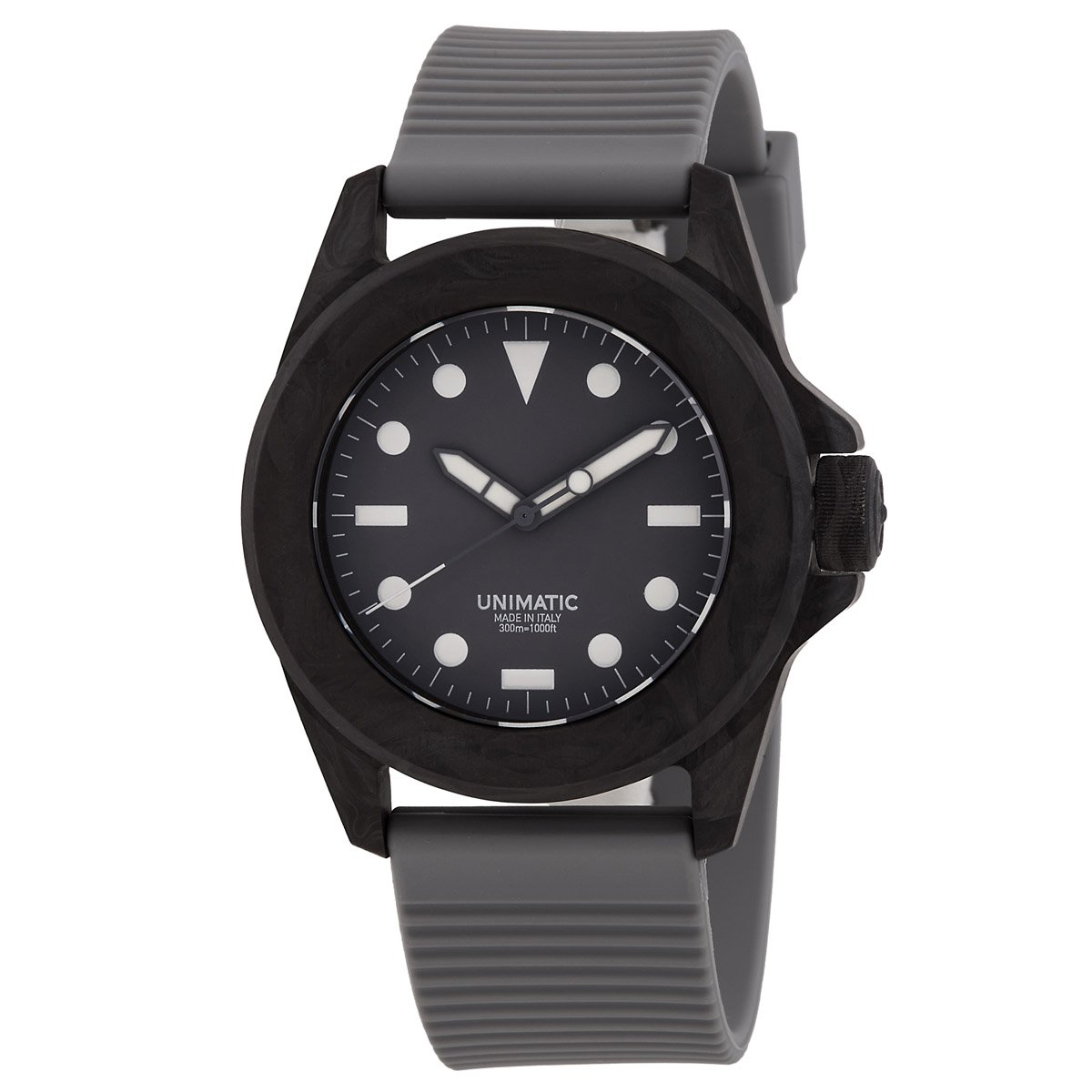
Look at the U4S dial and count the elements. You'll run out of fingers fast. There's a set of hour markers, a set of hands, and the minimum of text required to identify the thing. The lume plots are large and set against a matte black ground, which is why legibility in low light is so unusually good — the design isn't fighting itself for attention.
The hands deserve specific mention. Unimatic's signature is a broad, sword-adjacent hour hand paired with a slim minutes hand, and the differentiation is immediate at a glance. So many minimalist watches fail precisely here: they clean up the dial and then leave you squinting to tell the hour hand from the minute hand. The U4S doesn't make that mistake. Under a jacket cuff, in a car at dusk, in a dim restaurant, it reads instantly.
The case is brushed stainless steel with an almost architectural flatness to the flanks and a clean transition into the lugs. There's no polished bevel to catch light and no chamfer competing for attention. That's a deliberate choice, and it means the watch looks essentially the same after three years of daily wear as it does on day one — brushed steel hides the micro-scratches that polished surfaces collect like a diary.
The sapphire crystal is the right call at this price. Acrylic would have been more period-correct and would have warmed up the look, but sapphire means you stop thinking about the crystal entirely, which is the correct outcome for a tool watch.
The Movement: Workhorse Economics
Under the hood, the U4S runs on Seiko's NH35A — the Japanese automatic that has quietly become the default engine of the entire accessible-watch world. Approximately 41 hours of power reserve, 21,600 vibrations per hour, hacking seconds, bidirectional winding. Nothing exotic, nothing decorated, nothing you'd want to look at through a display caseback.
And that's fine, because Unimatic doesn't fit one. The caseback stays solid, which is honest: a display back on an undecorated NH35A is a marketing decision, not a horological one.
What the NH35A buys you is a specific kind of freedom. It's cheap to replace, easy to regulate, and understood by essentially every watchmaker on earth. You can walk into a repair shop in almost any city and find someone who has serviced a thousand of them. Compare that to a small-batch in-house movement where a single part can mean a six-month wait and a plane ticket to the manufacturer.
What it doesn't buy you is romance. If you want a movement that's a conversation piece — a micro-rotor, a high-beat column wheel, something with hand-finished bridges — this is not that watch, and Unimatic has never pretended otherwise. The brand's argument is that the money went into the case, dial, and design instead. Whether you accept that trade is the whole question of the U4S.
On the Wrist
The U4S wears like a watch that was drawn around a wrist rather than around a spec sheet. It's light — genuinely light, the kind of light that makes you check your wrist for the first hour — and it sits close rather than floating. The case flanks are clean enough that there's nothing to snag on a knit sleeve, and the crown sits flush enough that you forget it's there.
Balance is the standout quality. There's no bezel to catch on a doorframe, no thick caseback pushing the watch off-center, no heft pulling it toward the outside of the wrist. It locates itself and stays put. If you've spent years in chunky dive watches, the first few days will feel almost alarmingly insubstantial. By the end of the week, everything else in the box feels like a paperweight.
Part of this is the strap-first philosophy. The U4S arrives on a nylon NATO, and NATO straps are the great equalizer of watch comfort — they distribute load across the whole wrist, they breathe, and they let the case sit low. Swap to a two-piece leather strap and the same watch sharpens up considerably, reading almost dressy under a cuff. That versatility is worth more than any single spec on the sheet.
Accuracy and Daily Life
The NH35A is not a chronometer, and Unimatic doesn't market it as one. Expect something in the region of minus ten to plus twenty seconds per day out of the box, with most examples settling into a tighter band after a few weeks of running in. Positional variation is real: resting the watch crown-up overnight versus flat will shift the rate by a few seconds, and if you're the type who logs it, you can game the average down.
In practice, this is a watch you set once a week or once a fortnight, not one you sync against a time server every morning. And if the rate bothers you, any competent watchmaker can regulate an NH35A into single digits for very little money — the movement is forgiving in a way that high-end calibers often aren't.
Day to day, the U4S asks nothing of you. No winding ritual, no date to reset after a weekend in the drawer, no quickset to fumble. You pick it up, it's running, you put it on. For a watch pitched as a daily wearer, that frictionlessness matters more than a certificate.
The Modello Quattro Family
The U4S is the most reductive expression of the Modello Quattro case, and it's the reference most people should start with. Unimatic's catalog practice is to iterate rather than expand: dial text, lume tone, and strap kits shift across small production runs, so the family tree looks less like a conventional model range and more like a series of editions.
The broader Unimatic ecosystem runs from the Modello Uno dive watch through the Modello Due and the Modello Tre chronograph, with the Quattro sitting at the utility-focused end. If you like the U4S but want more visual presence, the Uno is the obvious sibling. If you want a complication, the Tre is where you go. But if what appeals is the silence — the sense of a watch that's been edited down until only the necessary remains — the Quattro is the purest hit in the lineup.
What It's Up Against
The obvious comparison is Sinn's 556 A, the German answer to the same question. Sinn brings more industrial credibility, a harder-edged case, and a much longer track record; Unimatic brings a stronger design identity and a lower entry point. Both are legible steel tool watches with no interest in being jewelry, and choosing between them is largely a question of whether you want German engineering or Italian editing.
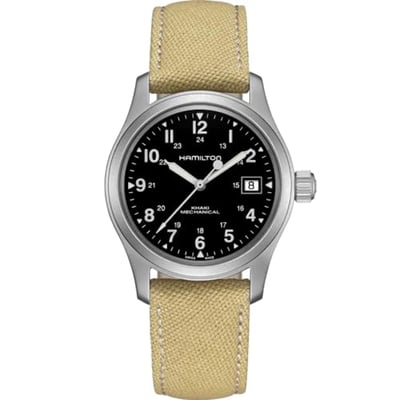
Hamilton's Khaki Field is the volume answer — softer-edged, far more common on wrists, and a perfectly good watch. But it's also the watch everyone's cousin owns, and the U4S exists precisely because some people want the same functional brief without the ubiquity.
Serica's 4512 out of Paris is the closest spiritual competitor: another microbrand with obsessive proportions and a mid-century utility brief. Tudor's Ranger occupies the same conceptual territory at four times the money with a fraction of the design nerve. Nivada Grenchen's Antarctic rounds out the set with a lighter touch of archive-driven nostalgia.
The honest read is that the U4S doesn't beat these watches on any measurable spec. It beats them on coherence — the sense that every decision was made by the same person with the same intent.
The Homage Question
As with every successful microbrand design, a small industry has grown up around reproducing the look. San Martin's field automatics deliver a comparable silhouette and a similar movement philosophy for roughly a quarter of the price, and they're not bad watches — the finishing is better than the price suggests.
Baltany sits below that, with vintage-styled field watches that get the proportions close but never quite resolve the dial. Pagani Design occupies the floor: functional, cheap, and entirely without design intent.
What none of them replicate is the editing. A homage copies the visible outcome of design decisions without the reasoning behind them, and it shows in the details — hand shapes that don't differentiate properly, lume plots sized for the render rather than for the wrist, cases that don't sit right. The U4S is not a complicated watch. But it is a watch where every element was argued over, and you can feel that on the wrist in a way you can't in a spec sheet.
What It Costs and What It Holds
The U4S sits in the mid-hundreds at retail, which puts it in the same bracket as a Hamilton Khaki Field Automatic or an entry-level Seiko diver. What you're paying for at that price isn't materials — it's design discipline and small-run production. Unimatic doesn't make watches by the tens of thousands, and the cost of that shows up in the number.
Secondhand, these trade at a modest discount to retail. The standard black dial is not a scarcity play, and Unimatic is far too young a brand to have meaningful auction history. There is no realistic investment thesis here, and anyone telling you otherwise is selling something.
What the U4S does hold is relevance. It's the kind of watch that stays in the rotation for years rather than getting flipped in six months, because it doesn't depend on novelty to be interesting. The scarcer colorways from past drops hold firmer than the standard reference — that's simple supply mechanics, not appreciation.
Service and Longevity
Unimatic maintains its own service channel, but the real advantage of the NH35A is that you're not locked into it. Any watchmaker who has handled Seiko's NH series can service, regulate, or outright replace this movement, and the parts are cheap and everywhere. That's a meaningful difference from a watch with a proprietary caliber, where a single failure can mean months off the wrist.
The rest of the watch is similarly low-maintenance. Brushed steel hides wear. Sapphire resists scratching. The NATO strap is a consumable you replace for the price of a nice lunch. There's no reason this shouldn't run for a decade with nothing more than routine attention.
Verdict
The U4S is the rare microbrand watch that justifies itself on design rather than novelty. It won't impress anyone at a dinner party who doesn't already know what Unimatic is, and that's the entire point — this is a watch for the person who has stopped needing the wrist equivalent of a loud voice.
Buy it if you want a daily wearer that looks inevitable rather than engineered, one that works as well with a nylon strap and a rain shell as it does on leather under a jacket. Skip it if the movement needs to be a conversation piece, or if you need a bracelet — this is a strap watch through and through, and no integrated bracelet option exists.
What you're left with is a Milanese design object disguised as a field watch: quiet, legible, and quietly relentless about not being anything it doesn't need to be.