What the Urwerk AMC actually is
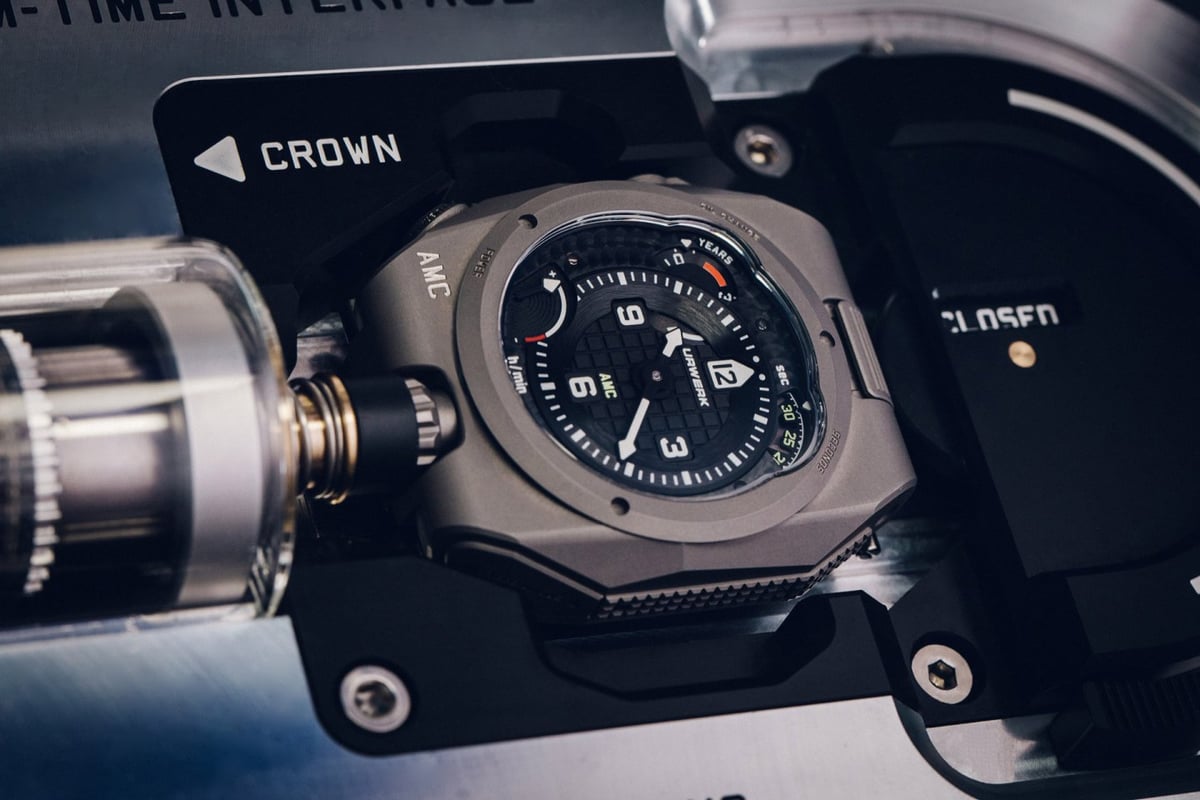
The AMC is often described as an atomic watch, but that shorthand is misleading. The wristwatch itself is a mechanical watch. It has a mainspring, a gear train, an escapement, and a balance wheel. The atomic part lives in the base station. When the watch is docked, the base can measure its rate against an atomic reference and provide the information needed to regulate it. This is the key distinction: the AMC is not a quartz watch with an atomic receiver on the wrist. It is a mechanical watch with an atomic reference in its home base.
That makes the AMC a curious object for daily wear. The watch is the part you wear, but the base is the part that gives the watch its meaning. If you ignore the base, you still have a very interesting Urwerk mechanical watch. If you use the base, you have a precision system that lets you see and correct rate in a way that ordinary mechanical watches cannot. The owner is therefore not just wearing a watch; the owner is participating in a ritual of measurement and correction.
Urwerk has always been interested in the relationship between the wearer and the mechanism. The brand's satellite displays and wandering-hour indications are not designed to be passively read; they are designed to be watched. The AMC takes that idea and applies it to timekeeping itself. You do not just check the time. You check how the watch is performing against an atomic reference. That is a very different kind of horological pleasure.
Brand context: Urwerk's scientific streak
Urwerk was founded in 1997 by Felix Baumgartner and Martin Frei, and it quickly became known for watches that looked like they had escaped from a laboratory or a spacecraft. The UR-103 established the brand's satellite-hour language, and later models like the UR-202, UR-210, and UR-220 pushed the idea of mechanical theatre further. These are not watches for people who want a classic three-hander with a discreet logo. They are watches for people who want to feel the mechanism thinking.
The AMC fits into that lineage, but it also stands apart. It is not just a new way to display time; it is a new way to think about rate. Urwerk's other watches are about unconventional displays. The AMC is about unconventional precision. It takes the brand's scientific streak and applies it to the oldest problem in mechanical watchmaking: how do you know the watch is running well? The AMC's answer is to give you an atomic reference and a base station that lets you do something about it.
For a young collector, this is an important distinction. Many high-horology pieces are about craftsmanship, finishing, and tradition. The AMC is about instrumentation, measurement, and feedback. It is a very modern kind of luxury, and it will appeal most to collectors who enjoy the idea of a watch as a system rather than a solitary object.
Movement and the atomic master clock
The wristwatch is powered by a manual-wind mechanical movement, the UR-AMC. It has a power reserve of around 100 hours, which is generous for a watch of this type and gives the owner some flexibility between wears. The movement is in-house and designed with the docking system in mind. This is not a movement that was simply borrowed from another Urwerk model and dropped into a new case. It is part of a larger system, and that shows in the way the watch is meant to be used.
The base station is the atomic master clock. It provides a stable reference against which the wristwatch's rate can be measured. The exact correction process is best demonstrated by Urwerk or an authorized retailer, but the principle is clear: the mechanical watch is not left to drift unobserved. The owner can dock the watch, let the system do its work, and then wear the watch with a renewed sense of confidence. That is the AMC's party trick, and it is a very good one.
From a finishing perspective, the AMC is more scientific instrument than traditional haute horlogerie. You will find the expected quality of execution, but the visual language is industrial, technical, and purposeful. This is not a movement designed to be admired through a sapphire caseback in the traditional sense. It is a movement designed to perform a specific task, and the aesthetics follow that task. Collectors who love traditional Geneva stripes and hand-engraved bridges may find the AMC cold. Collectors who love the idea of a mechanical watch as a measurable system will find it thrilling.
The 28,800 vph frequency is a sensible choice for a watch that is meant to be measured and regulated. It gives the movement a stable base rate and is consistent with Urwerk's broader approach to mechanical performance. The power reserve indicator is a useful complication because it tells you when the watch is ready for another round of measurement. In a system like this, the power reserve is not just a convenience; it is part of the user experience.
On the wrist: comfort, balance, and presence
On the wrist, the AMC is less a conventional round watch and more a precision instrument with a strap. The titanium case gives it a purposeful, technical presence without the dead weight some large high-horology pieces carry. The leather strap is supple enough for a full day of desk work, and the pin buckle keeps the package visually honest: this is not a watch trying to be a sports bracelet. The balance is good, but the AMC is not invisible. It sits tall enough in the mind that you are always aware of it, partly because the dial is unusual and partly because you know what the watch is meant to do when it goes back into its base.
For a real week on the wrist, the AMC works best as a rotation piece rather than a one-watch solution. The strap breaks in nicely, the case does not feel fragile in normal office life, and the watch head is comfortable enough for long meetings. But it is not a watch for gym sessions, beach days, or careless travel. The lack of lume also means it is a daylight and indoor-lighting watch; after dark, you are relying on ambient light and the glow of your own satisfaction. That is acceptable for a collector's instrument, but it is a real limitation for anyone hoping to make the AMC a daily default.
The AMC's wrist presence is enormous, but not in the way a flashy gold chronograph is enormous. It is enormous because it is strange. People notice it, but they do not always know what they are looking at. That is part of the appeal. The watch starts conversations, and the base station finishes them. If you are the kind of collector who enjoys explaining your watch, the AMC is a gift. If you prefer to fly under the radar, it is the wrong choice.
Legibility and daily wear
Urwerk watches are not always easy to read, but the AMC is more legible than many of the brand's satellite-display pieces. The dial is designed around a scientific layout, with clear indications and a power reserve display that makes sense once you understand the system. In good light, reading the time is straightforward. The contrast between the hands and the dial is strong enough for everyday use, and the overall layout is less chaotic than the brand's more theatrical models.
The lack of lume is the biggest daily-wear compromise. This is not a watch for late-night movie sessions or early-morning runs. It is a watch for daylight, offices, restaurants, and collectors' gatherings. If you need a watch that glows, the AMC is not it. That is a deliberate choice, not an oversight. Urwerk built a scientific instrument, not a field watch, and the dial reflects that priority.
The leather strap and pin buckle also set the AMC's daily-wear boundaries. The strap is comfortable and appropriate for formal and business-casual settings, but it is not a swimming or hiking strap. The pin buckle is traditional and secure enough for normal wear, but it does not offer the micro-adjustment of a modern folding clasp. For a watch at this price, that is a small but noticeable old-school detail. It fits the AMC's character, but it is not the most convenient daily-wear setup.
Accuracy in the real world
When used as intended, the AMC's accuracy story is exceptional for a mechanical watch. The atomic master clock provides a stable reference, and the base measures the wristwatch's rate so that its performance can be assessed and corrected rather than simply tolerated. That does not turn the wristwatch into an atomic watch; it remains a mechanical movement with mechanical variation. But it does mean the owner can chase precision in a way that ordinary mechanical watch owners cannot. Off the dock, expect normal positional variation and drift. The difference is that the AMC gives you the tools to understand and address it.
In practical terms, the AMC encourages a different relationship with accuracy. Most mechanical watch owners accept a certain amount of drift as part of the charm. The AMC owner is invited to measure, compare, and correct. That is a more active form of ownership, and it suits collectors who enjoy data. If you are the kind of person who checks your watch against a radio-controlled clock every few days, the AMC is made for you. If you prefer to set your watch once a month and forget it, the AMC's system may feel like overkill.
Occasions and ownership
The AMC is at its best in formal and dressy settings, where its technical presence reads as sophisticated rather than sporty. It works well with a suit, a jacket, or a smart-casual outfit. It can be worn daily in an office environment, provided you are careful with it and do not need lume or water resistance. It is also a travel watch in the sense that the wristwatch can travel with you, but the base station is not something you toss into a carry-on without thought. The AMC is a system, and systems prefer to stay home.
For collectors, the AMC is a special-occasion piece. It is the watch you wear when you want to talk about watches. It is the watch you bring to a collector's dinner, not the watch you wear to the gym. That is not a criticism; it is simply the truth of the object. The AMC is not trying to be all things to all people. It is trying to be the most interesting thing on your wrist, and it succeeds.
Investment and service
The AMC was originally positioned as a very high-end collector's set, with an original price around the mid-six-figure dollar mark depending on market and taxes. Current retail availability is limited because the AMC is a niche system rather than a regular production watch. Pre-owned data is thin, which is typical for ultra-limited high horology. The trend is best described as stable rather than aggressively appreciating. Buyers should treat the AMC as a passion asset, not a liquidity play.
Service is another consideration. The AMC involves both a mechanical watch and an atomic master clock base, so servicing is not a simple watchmaker task. Authorized service through Urwerk or a qualified specialist is essential. There is no published standard service interval for the complete system, and costs will depend on what the watch and base need. For a collector, this is part of the cost of ownership. For a first-time high-horology buyer, it is a reason to ask detailed questions before committing.
Competitors and alternatives
The AMC does not have many direct competitors because few brands combine a wearable mechanical watch with an atomic reference base. The closest comparisons are avant-garde mechanical objects from MB&F, precision-focused pieces from F.P. Journe, and ultra-high-end craft from Greubel Forsey. Each of those offers a different kind of collector experience. MB&F offers sculpture and theatre. F.P. Journe offers classical precision and resonance. Greubel Forsey offers artisanal complexity. The AMC offers a system: a mechanical watch plus an atomic master clock.
For buyers who want the practical version of atomic-adjacent timekeeping, a GPS solar watch from Seiko or Citizen makes far more sense. But that is not the point. The AMC is not competing with practical quartz. It is competing with other high-horology experiences. On that stage, its uniqueness is its greatest strength. There is no credible homage to the AMC because the concept is too complex, too expensive, and too closely tied to Urwerk's specific design language. That rarity is part of what you are buying.
Pros and cons
The AMC's pros are obvious: it is a unique atomic-assisted mechanical concept, the wristwatch half has strong presence, the rate-correction potential is exceptional when docked, and the production is extremely limited. It is a collector's piece that will stand out in any collection.
The cons are equally clear: the base-dependent party trick means the watch is less impressive without its home station; the lack of lume limits everyday practicality; service and calibration are complex; and the entry price is very high. These are not flaws in the abstract. They are the trade-offs that define the AMC. If you cannot live with them, the watch is not for you.
Final verdict
The Urwerk AMC is a brilliant collector's instrument that happens to be wearable. It is not the one watch for a young collector building a daily rotation, but it is a memorable statement about what mechanical watchmaking can become when it borrows tools from atomic timekeeping. Buy it for the concept, the rarity, and the theatre; wear it when you want your wrist to start a conversation.
As a daily-wear reviewer, I would not recommend the AMC as an only watch. I would recommend it as a special-occasion piece for a collector who already understands mechanical watches and wants to experience something genuinely different. The AMC is not about convenience. It is about the pleasure of measurement, the ritual of docking, and the knowledge that your mechanical watch is being judged against an atomic reference. That is a very specific pleasure, but for the right collector, it is enough.