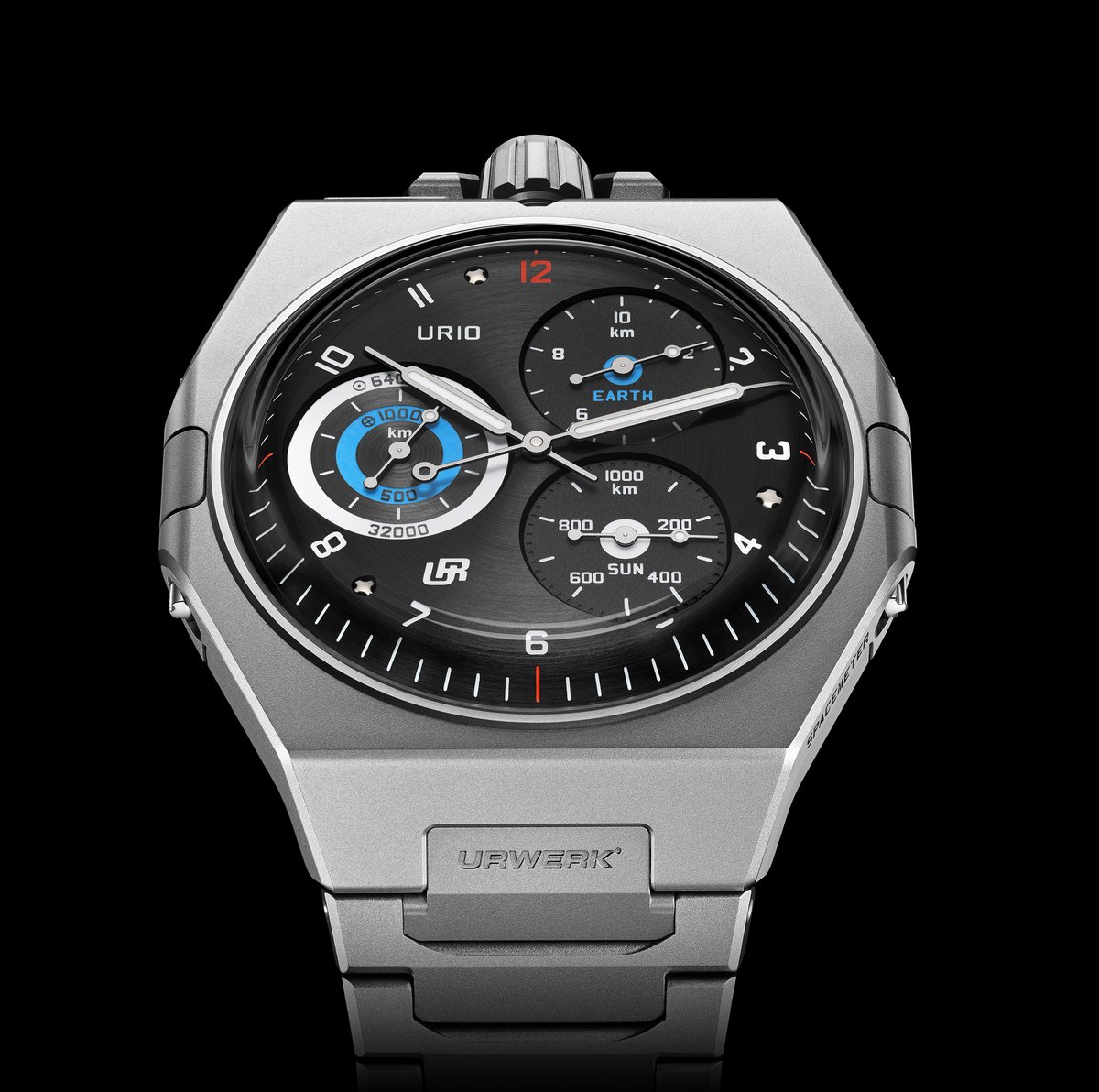
The Urwerk Story Behind the Spacemeter
Urwerk was founded in 1997 by watchmaker Felix Baumgartner and designer Martin Frei. From the start, the brand treated watchmaking as a design problem as much as a technical one. The satellite-hour display became its signature: instead of a conventional hand sweeping around a dial, the hour rides on a rotating carousel, and the minute is read against that moving architecture. It is a system that makes time feel spatial.
The UR-100 SpaceTime, launched in 2019, pushed Urwerk into a new phase. It added indicators that translate Earth's rotation and orbit into wrist-scale readouts, turning the watch into a small dashboard for the fact that we are all moving through space. The UR-10 Spacemeter continues that thread. The name is not decorative. It tells you that the watch is less about telling time on a grid and more about time as a physical event.
That matters for collectors because Urwerk is one of the few independents with a recognizable visual language that does not depend on a heritage catalog. You do not buy a UR-10 because it looks like a vintage watch. You buy it because it looks like nothing else in the room, and because the brand has spent decades refining that difference.
Design and Display: A Dashboard for the Wrist
The UR-10 Spacemeter is built around its satellite carousel. Rotating cubes carry the hour, while minute pointers track across them. The space-meter readouts give the dial a second layer of information, and that is where the watch becomes an instrument cluster rather than a simple display. The layout is not instantly readable in the way a three-hand watch is. It requires a moment of orientation, a small act of learning. Once you have it, the payoff is a display that feels alive.
The case is titanium, with a sapphire crystal and a rubber strap. That combination tells you a lot about the brief. Titanium keeps the object from feeling like a paperweight, while the rubber strap gives it a more daily-friendly attitude than a leather strap would. The sapphire crystal protects the dial without adding unnecessary visual noise. The overall effect is technical, modern and deliberately not precious.
Urwerk's design language is polarizing, and the UR-10 does not soften it. The watch has a strong three-dimensional quality. The satellite cubes, the readouts and the case architecture all compete for attention, but they are composed rather than chaotic. This is not minimalism. It is mechanical theatre with a purpose.
Movement and Mechanics
The UR-10 uses an in-house automatic movement. Urwerk does not publish every figure in the same way a mainstream Swiss brand does, and the caliber designation for this reference is not publicly confirmed in the material available. What matters more is the architecture: the satellite carousel is the centerpiece, and the space-meter indicators are integrated into the same mechanical narrative. This is not a conventional movement with an avant-garde dial stuck on top. The display is the movement's reason for being.
The finishing is intended to be viewed. Urwerk movements are not hidden behind a closed caseback or a solid dial. The mechanics are part of the appeal, and the UR-10 is no exception. The automatic winding system keeps the watch practical for daily wear, while the satellite system gives it the kind of mechanical distinctiveness that collectors associate with independent watchmaking.
The watch is not COSC-certified. That is not the point. Urwerk builds mechanical experiences, not lab certificates. If you need a chronometer rating to feel comfortable, this is the wrong watch. If you want a display that makes you think about how time is constructed, the UR-10 delivers.
On the Wrist: Wearability and Presence
The UR-10 is not a subtle watch, but it is not a clumsy one either. Urwerk's case architecture is sculptural, with a curved profile and a strap that tucks the watch toward the wrist rather than letting it sit like a puck. The titanium case keeps the mass in check, which matters because the design is deliberately three-dimensional. On the wrist, the sensation is less luxury dress watch and more precision instrument that happens to be wearable.
The rubber strap is the right call. It gives the UR-10 a sportier, more daily-friendly attitude than a leather strap would, and it keeps the focus on the case and dial. The clasp is secure and unobtrusive. This is a watch you notice on your own wrist, and one that people across a table notice too. It is not a stealth piece, but it is also not a brick.
Wrist presence is a five out of five. The UR-10 is a conversation starter with genuine three-dimensional presence. It reads as an object from a future watch fair, and that is exactly the point. If you want a watch that disappears under a cuff, this is not it. If you want a watch that makes a statement without relying on a logo, it is hard to beat.
Accuracy and Daily Use
Urwerk does not position the UR-10 as a chronometer-certified daily beater. The satellite display makes conventional seconds-watching less relevant; you read the hour and minute as a mechanical event, not a sweeping hand. Expect stable automatic-watch accuracy and check it against a phone or time signal when you care about being exact. The real-world appeal is the display and the engineering, not a lab certificate.
Daily use is more practical than the design suggests. The automatic movement means you do not have to wind it every morning, and the rubber strap makes it easy to wear in warm weather or during travel. It is not a dive watch, so treat water exposure with care. But for office days, dinners, gallery openings and airport lounges, the UR-10 has the right mix of durability and drama.
The occasions list is broader than you might expect. This is a daily watch for someone with a certain kind of wardrobe, a formal watch for someone who does not want a conventional dress watch, a travel watch for people who like a mechanical companion, and a dress watch for collectors who treat avant-garde design as formalwear. It is not a sport watch in the traditional sense, but it has the attitude of one.
Reference Variants and Family Context
At the time of writing, the UR-10 Spacemeter is best understood as a single launch reference, with the black dial and rubber strap configuration doing the heavy lifting. Urwerk has not disclosed a broad catalog of variants for this exact model, so collectors should confirm later editions directly with the brand. The reference number is UR-10 Spacemeter.
In the wider Urwerk family, the UR-100 SpaceTime is the closest sibling. The UR-105 CT Streamliner, UR-110 Torpedo and UR-220 Falcon Project are other notable models that share the brand's satellite-display DNA and independent spirit. If you are comparing the UR-10 to other Urwerk pieces, the question is not which one is more conventional. It is which one best matches your tolerance for mechanical theatre.
Other notable models by Urwerk include the UR-100 SpaceTime, UR-105 CT Streamliner, UR-110 Torpedo and UR-230 Eagle. Each one takes a different angle on the same core idea: time as a mechanical system rather than a flat dial. The UR-10 Spacemeter sits in that lineage as a more wearable expression of the space-time theme.
Similar Watches and Homages
If you like the UR-10 but want to compare it to other independent watches, the MB&F HM10 Bulldog is a natural reference point. It shares the same sculptural, mechanically theatrical approach to telling time, even though the display is completely different. The De Bethune DB28 is another independent Swiss alternative with cosmic design language and high horology credibility. The Richard Mille RM 67-02 offers avant-garde lightweight luxury with strong wrist presence, though it is a very different wearability brief.
There is no direct homage to the UR-10 Spacemeter at an accessible price. Urwerk's satellite carousel is not replicated at affordable price points, and buyers who want the look usually settle for space-themed curiosities instead. That is worth knowing if you are shopping on a budget: the UR-10 is not a watch you can approximate with a cheap alternative. You either buy into the real thing or you choose a different design language.
Investment Value and Service
Urwerk does not publish a consistent public USD MSRP for every reference, and the UR-10 Spacemeter is typically quoted on request. That makes precise value comparisons difficult. Independent Urwerk pieces have a collector base, but this is a wear-and-enjoy purchase first. Do not underwrite a flip. The trend is best described as stable rather than explosive, and there is no major auction history for this reference at the time of writing.
Service should go through Urwerk's authorized network. The satellite carousel is not a movement for a generalist watchmaker, and the brand's service requirements are specific. Urwerk does not publish a fixed service interval or approximate cost in the material available for this reference, so collectors should confirm those details directly with the brand or an authorized partner.
The price buys an independent satellite-display sculpture with real collector cachet. Value retention is likely stable rather than explosive, so buy it because you want the object. If you are looking for a safe, liquid asset, this is not the watch. If you are looking for a mechanical experience that holds its own in a collection, it is a strong candidate.
Pros and Cons
The pros are clear. The satellite display is genuinely legible once learned. The independent Urwerk design language gives it strong wrist presence. The titanium case and rubber strap make it more wearable than the sculpture suggests. It is a watch that rewards attention and starts conversations.
The cons are equally clear. Price on request keeps comparison shopping difficult. It is not a chronometer-certified daily beater. Service must go through Urwerk's network. And it is not a subtle watch, so it will not suit every wardrobe or every occasion. Those are not flaws in the design; they are part of the brief. The question is whether that brief matches your life.
Final Verdict
The UR-10 Spacemeter is not the Urwerk you buy to pass unnoticed, and that is its strength. It delivers the brand's satellite-hour theatre in a package that feels more wearable and more daily-ready than a pure concept piece. If you want a mechanical object that starts conversations and rewards a little study, it is a compelling independent buy; if you need a safe, liquid asset, keep looking.
For young collectors who follow independent watchmaking, the UR-10 sits in a sweet spot between sculpture and daily wear. It is expensive, specific and unapologetic. That is exactly what Urwerk does best, and it is why the Spacemeter deserves a place on the shortlist for anyone who wants a watch that feels like an event every time you look down.