Urwerk’s pocket-watch manifesto
Urwerk was founded in 1997 by Felix Baumgartner and Martin Frei, and its identity was never built on tradition for its own sake. The brand made its name with satellite hour displays: rotating carousels that carry the hours past a minute track, turning the act of reading time into a mechanical performance. The UR-1001 extends that language into a pocket-watch format, but it does more than enlarge a wristwatch. It treats the pocket watch as a platform for a different kind of complication set, one that includes a calendar scale measured in centuries rather than months.
That is the essential context for the UR-1001. It is not a nostalgia piece, and it is not a pocket watch in the nineteenth-century sense. It is an independent horological object with a technical brief that could only come from a brand willing to abandon the familiar dial. The case is a housing for a movement architecture, not a frame for a conventional face.
Movement architecture: UR-10.01
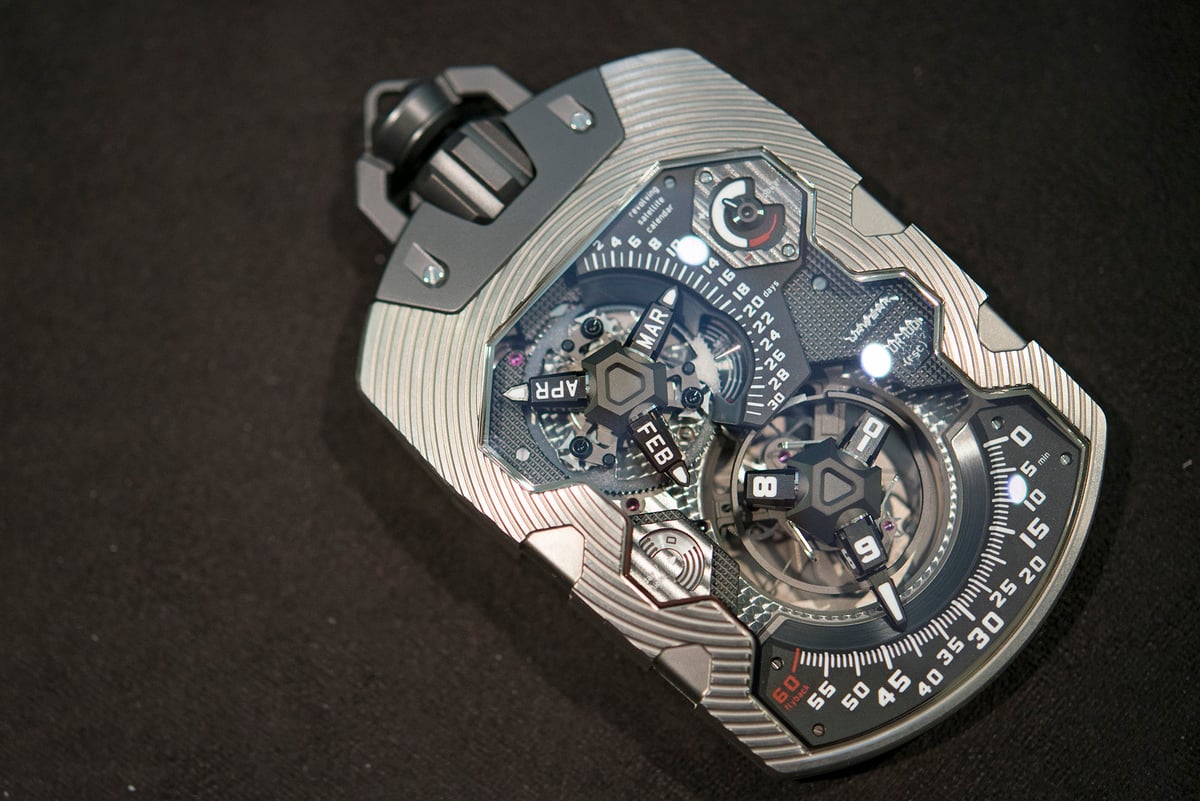
The UR-10.01 is a hand-wound, in-house calibre built around Urwerk’s orbital satellite system. It runs at 28,800 vph and carries a 39-hour power reserve, which is enough for a pocket watch that is likely to be wound on a regular ritual basis rather than worn continuously. The movement is not a modular afterthought. The satellite hours, orbital minutes, day-night indication, power reserve, and millennium calendar are integrated into the same technical architecture, which is why the UR-1001 feels like a single instrument rather than a collection of displays.
The 1,000-year calendar is the detail that separates the UR-1001 from every other Urwerk. It is important to be precise here: this is a millennium-scale calendar display, not a conventional perpetual calendar with a date window. It tracks the passage of years on a very long scale, which gives the owner a mechanical relationship with time that is almost philosophical. The satellite hours and orbital minutes remain the primary time display, but the calendar gives the object a second horizon.
Finishing follows Urwerk’s instrument-like language. The movement is not decorated in the soft, old-world manner of a Geneva dress watch. It uses bead-blasted plates, polished bevels, and a dark, technical palette that makes the architecture legible. The surfaces are meant to look engineered rather than jewel-like, and the contrast between matte structure and polished edges is part of the appeal. This is finishing as clarity: every bridge and lever reads as part of a system.
The case and the object
The UR-1001 is housed in a titanium and steel case with a sapphire crystal. It is a pocket-watch format, supplied with a chain and designed to be carried or placed on a stand. There is no lume, no conventional water-resistance claim in the sports-watch sense, and no pretense that this is a daily wrist companion. The case is there to protect the movement and to frame the displays, but it also establishes the object’s presence. It feels like a piece of equipment from an alternate history of horology.
That is not an accident. Urwerk’s design language has always leaned toward the mechanical and the aeronautical, and the UR-1001 pushes that language into a larger format. The displays are arranged for inspection rather than for a quick glance. The owner is expected to handle the watch, turn it over, and read the movement as part of the experience. This is a timepiece that rewards attention, not one that disappears under a cuff.
How it wears and carries
The UR-1001 is not a wristwatch, so wrist feel is not the right measure. It is a pocket watch and desk object: substantial in the hand, deliberately top-heavy in character, and meant to be carried in a jacket pocket or rested on its stand. The chain and case finish make it an object you notice every time you handle it, not a daily beater you forget you are wearing.
Its comfort is the comfort of a well-made instrument. The case is designed to be read and handled, with the displays arranged for inspection rather than for a casual glance at a wrist. Collectors who are used to lightweight titanium sports watches will find the UR-1001 more ceremonial, more deliberate, and entirely unapologetic about it. It is the kind of object that changes the way you think about a jacket pocket: not as storage, but as a display case.
Accuracy and daily expectations
Urwerk does not submit the UR-1001 for COSC certification, and that is not the point of the piece. Expect a well-regulated independent mechanical movement, with day-to-day variance dependent on position, winding state, and temperature. For a watch with this many displays, the more important discipline is synchronization: the calendar and orbital indications should be checked and reset by a trained watchmaker during service.
In practice, the UR-1001 is a piece for the collector who understands that mechanical accuracy is a relationship rather than a specification. It will keep time well enough for daily use if you choose to carry it, but it is not a chronometer-certified tool watch. The pleasure comes from the movement’s architecture and the way the displays interact, not from a lab sheet.
Occasions and presence
The UR-1001 is at its best in formal and dress contexts, where a pocket watch still has a place, and in travel, where a distinctive object can become part of the ritual of a trip. It is not a sport watch and not a daily wristwatch. Its natural companions are a suit, a jacket, a desk, and a collector’s cabinet.
Its wrist presence, if we can use the term at all, is 5/5 as a pocket-watch object. As a wristwatch it is not applicable. The UR-1001 is meant to be seen and handled, and it has the kind of physical authority that makes other watches feel conventionally small. That is the point: it is a statement piece in the most literal sense, a mechanical object that occupies space and demands attention.
Reference variants and family context
The UR-1001 Zeit Device is the reference in question, and it is not a conventional model line with dozens of dial and bracelet combinations. It is a pocket-watch and desk-clock format with satellite hours, orbital minutes, and millennium calendar displays, supplied with a pocket-watch chain. There is no conventional dial and no bracelet option in the usual sense. Collectors should think of it as a standalone object rather than a base model waiting for variants.
Within Urwerk’s wider family, the UR-103, UR-202, UR-210, and UR-220 are the closest siblings in spirit. They share the satellite-hour philosophy and the brand’s commitment to unconventional displays, but none of them is a pocket watch with a 1,000-year calendar. Other notable Urwerk models include the UR-112 Aggregat, UR-120, UR-150, and UR-230, each of which extends the brand’s architectural approach in a different direction.
Similar watches and alternatives
There is no direct competitor to the UR-1001, because no other brand combines satellite hours, orbital minutes, and a millennium calendar in a pocket-watch format. The closest alternatives are object watches from other independent houses. The MB&F Horological Machine No. 9 is another architecture-first object with a sculptural case and a non-traditional display. The Greubel Forsey Hand Made 1 is a hand-finished independent showpiece for collectors who value movement architecture over convention. The Jacob & Co. Astronomia is a theatrically engineered object watch with astronomical displays and a similarly uncompromising presence.
None of these is a substitute for the UR-1001. They share a collector profile rather than a specification sheet. The Urwerk is more focused on time display and calendar scale; the others lean toward sculpture, astronomy, or extreme hand-finishing. The choice comes down to which mechanical narrative the collector wants to live with.
Homages and affordable alternatives
There is no credible direct homage to the UR-1001. The satellite-hour system and millennium calendar are not replicated at lower price points, and the pocket-watch format is too niche for the usual homage market. Collectors who want the Urwerk experience should look to the brand’s own wristwatches rather than to imitation pieces. The UR-1001 is a singular object, and that singularity is part of its value.
Investment and market position
The UR-1001 is a limited-production collector piece, and its market is correspondingly narrow. Public pricing is not always disclosed, and pre-owned examples are rarely listed in the same way as mainstream luxury watches. The trend is best described as stable: the piece is rare, technically distinctive, and supported by a dedicated collector base, but it is not a liquid asset in the manner of a steel sports watch. There is no major public auction history to point to, which is typical for a niche independent object of this kind.
The hold recommendation is straightforward. Buy the UR-1001 for the architecture, the rarity, and the experience of owning a mechanical object that does not resemble anything else. Do not buy it as a short-term trade. Its value is held in collector demand and scarcity rather than in mass-market visibility, and the right owner is someone who will actually handle and enjoy it.
Service and ownership
Service should be arranged through Urwerk or an authorized specialist. The movement’s calendar and orbital displays require factory-trained care, and the pocket-watch format adds handling considerations that a conventional wristwatch does not. Service intervals and costs are not publicly standardized in the way they are for mass-produced movements, so owners should expect a specialized, relationship-based service experience. That is normal for independent horology at this level, but it is worth planning for.
Pros and cons
The UR-1001’s strengths are obvious to anyone who values independent movement architecture. The satellite hours and orbital minutes are a genuinely different way to read time, and the 1,000-year calendar gives the piece a conceptual depth that few watches can match. The pocket-watch format is a bold choice, and it makes the UR-1001 a true collector’s object rather than another wristwatch in a safe.
The cons are equally clear. It is not a wristwatch, so it will not suit collectors who want daily wrist wear. It has no COSC certification, no conventional accuracy benchmark, and no lume or sports-watch water resistance. Service is specialized and costly. These are not flaws in the design; they are the terms of the object. The UR-1001 asks the owner to accept a different set of priorities.
Final verdict
The Urwerk UR-1001 Zeit Device is Urwerk at its most uncompromising: a pocket watch that treats time as an instrument and a millennium as a scale. It is not for every collector, but for the collector who wants a mechanical object with no true peer, it is compelling. The movement architecture is radical, the finishing is deliberately industrial, and the ownership experience is ceremonial in the best sense.
If you are looking for a watch to wear every day, this is not it. If you are looking for a piece that expands what a mechanical timepiece can be, the UR-1001 belongs on the short list. It is a time capsule, a desk companion, and a pocket-sized argument for independent watchmaking, all in one.