Introduction: The Watch That Refuses to Be a Watch
In the rarefied world of independent horology, Urwerk doesn't just make watches—it makes statements. The UR-111C is the brand at its most uncompromising: a timepiece that abandons the circular dial entirely in favor of a linear, almost industrial display that looks like it was ripped from a sci-fi prop department. This is not a watch for the faint of heart, nor for the traditionalist who still believes a watch should tell time at a glance. It's for the collector who wants to wear a conversation piece, a mechanical sculpture that happens to keep time.
Since its debut in 2019, the UR-111C has become a grail for a very specific kind of buyer: the tech entrepreneur who sold a startup, the rapper who wants something no one else in the room has, the athlete whose wrist already carries a Richard Mille but craves something even more esoteric. It's a watch that signals not just wealth, but a deep, almost obsessive engagement with the bleeding edge of watchmaking. And in a market flooded with vintage reissues and safe designs, that kind of audacity is worth its weight in titanium.
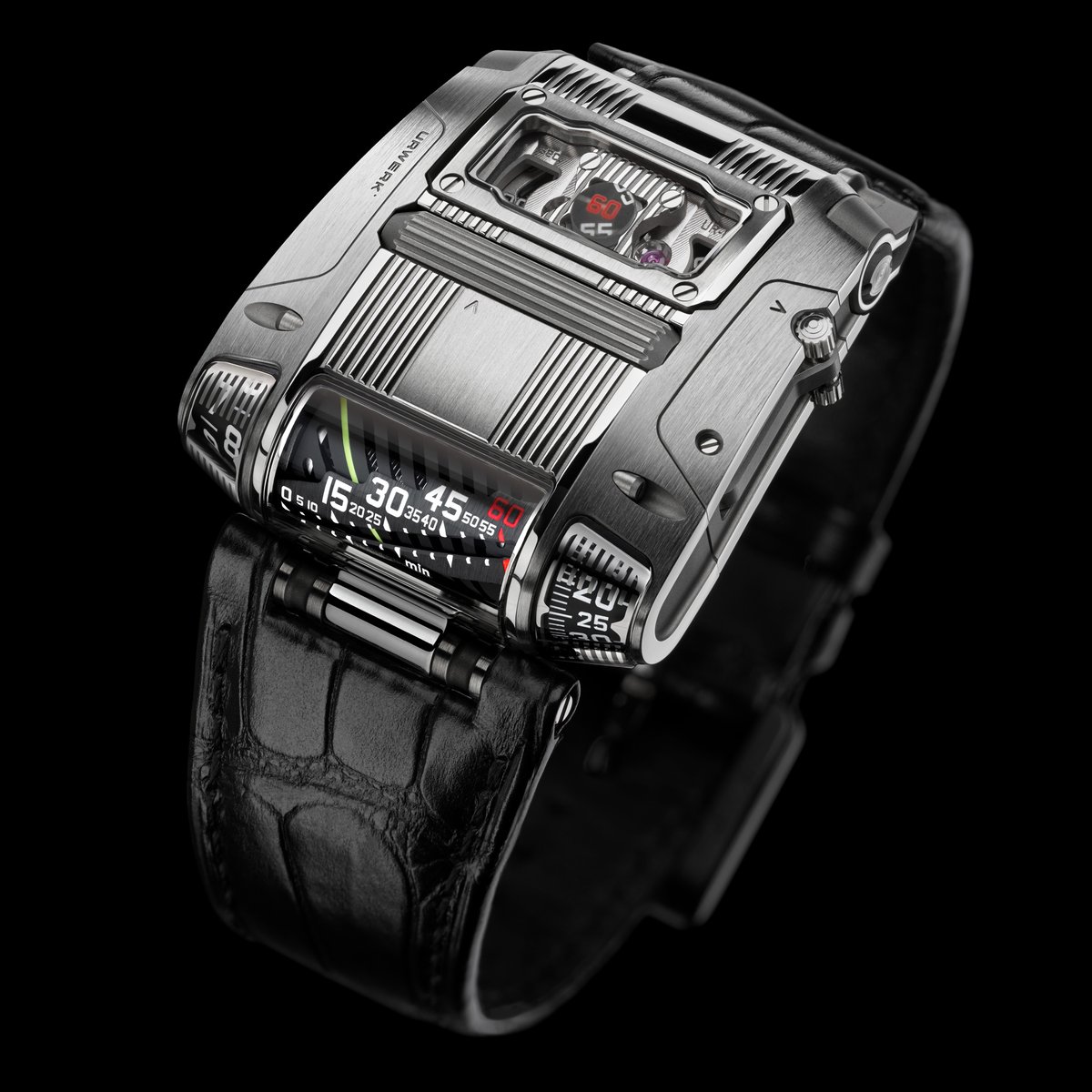
What makes the UR-111C so radical is its display. Instead of hands sweeping around a dial, the hours are shown on a rotating cylinder that clicks into place, while the minutes are indicated by a red pointer that travels along a linear track before snapping back to zero. It's a system that demands you recalibrate how you read time—and that's exactly the point. Urwerk isn't interested in making watches that are easy; they're interested in making watches that are unforgettable.
Brand History: Two Decades of Defiance
Urwerk was founded in 1997 by Felix Baumgartner, a master watchmaker, and Martin Frei, an artist and designer. The name itself is a nod to the ancient city of Ur, where timekeeping began, and the German word "Werk," meaning work or mechanism. From the very first model, the UR-101, the brand set out to challenge every assumption about how a watch should look and function. Their signature satellite time display—rotating cubes or cylinders that carry the hours—has become a hallmark of avant-garde horology, copied by none and admired by many.
The UR-111C continues that legacy by pushing the concept of linear time into new territory. While previous Urwerk models like the UR-110 and UR-105 used rotating satellite cubes, the UR-111C strips the display down to its most elemental form: a horizontal cylinder for hours and a straight line for minutes. It's a bold move that proves Urwerk remains the most fearless innovator in independent watchmaking, unafraid to alienate traditionalists in pursuit of pure mechanical expression.
Movement: The Engine Behind the Theater
Powering the UR-111C is the in-house automatic caliber UR-111C, a movement developed specifically for this model. It features a micro-rotor, a rarity in high-end watchmaking that allows for a slimmer profile while still providing efficient winding. The movement beats at 28,800 vibrations per hour and offers a 48-hour power reserve, which is respectable for a watch with such a complex display mechanism. The jewel count is 39, and while it is not COSC-certified, Urwerk regulates each movement to perform within a tight tolerance of about -5 to +7 seconds per day in real-world conditions.
The architecture of the movement is as visually striking as the display itself. Visible through the sapphire caseback, the bridges are sandblasted and finished with circular graining, giving the movement an industrial, almost brutalist aesthetic that matches the case design. The linear retrograde minute mechanism is a marvel of engineering: a cam and lever system drives the red pointer along its track, then releases it to snap back to zero at the end of each hour. It's a mechanical ballet that you can watch happen in real time, and it never gets old.
Specifications: The Numbers That Matter
The UR-111C's case is made of lightweight titanium, measuring 42mm wide, 46mm long, and 15mm thick. It's not a round watch, so the traditional diameter measurement is less relevant—what matters is how it sits on the wrist, and the tonneau shape with its curved caseback ensures a comfortable fit. The crystal is sapphire, scratch-resistant and slightly domed to protect the display. Water resistance is a modest 30 meters, which means you should keep it away from anything more than a splash. The strap is black rubber with a titanium deployant clasp, and the minute pointer and hour numerals are treated with Super-LumiNova for low-light legibility.
Wrist Feel: Surprisingly Wearable, Delightfully Weird
Despite its imposing dimensions, the UR-111C wears surprisingly well thanks to its lightweight titanium case and ergonomic tonneau shape. The curved caseback hugs the wrist, and the rubber strap is supple enough to keep the watch from sliding around. At 42mm wide and 46mm long, it's not a small watch, but the lack of a traditional round dial means it doesn't feel bulky. The weight is negligible—around 80 grams on the strap—so you can wear it all day without fatigue. The only real adjustment is mental: you'll find yourself staring at the linear display, trying to decode the time, which is part of the charm.
The watch sits high on the wrist due to its 15mm thickness, but the curved caseback mitigates the visual heft. It's not a watch you'll forget you're wearing, but it's also not uncomfortable. The rubber strap is well-made and doesn't attract dust or lint, and the deployant clasp is secure and easy to operate. Overall, the UR-111C is far more wearable than its radical design would suggest, and that's a testament to Urwerk's attention to ergonomics.
Accuracy: Good Enough for a Mechanical Sculpture
Urwerk doesn't chase chronometer certification, but the UR-111C's movement is regulated to perform within a respectable range of about -5 to +7 seconds per day in real-world wear. That's more than acceptable for a watch whose primary purpose is mechanical theater, not split-second precision. Expect to reset the time every few days if you're obsessive about accuracy, but most owners will be too busy showing off the display to care. The micro-rotor winding is efficient, so the watch will stay running as long as you wear it regularly, and the 48-hour power reserve means you can take it off for a weekend without it stopping.
Occasions: Where to Wear the UR-111C
The UR-111C is not a dress watch, but it's also not a tool watch. It occupies a unique space: a daily-wear statement piece that works best in casual or smart-casual settings. Pair it with a hoodie and sneakers for a tech-bro vibe, or with a tailored blazer and dark jeans for a gallery opening. It's too bold for a black-tie event, but it will absolutely dominate a boardroom or a private club. Travel is a natural fit—the lightweight titanium and rubber strap make it comfortable for long flights, and the conversation-starting display will make you friends at the airport lounge. Sport is a stretch given the 30m water resistance, but it can handle a light workout or a round of golf without issue.
Wrist Presence: 5/5 - Impossible to Ignore
The UR-111C is impossible to ignore. The linear minute track and rotating hour cylinder draw eyes from across the room, and the titanium case has a stealthy, industrial cool that works with everything from a hoodie to a tailored suit. It's not a dress watch, but it's a statement piece that elevates any casual or smart-casual outfit. When you wear this watch, you will be asked about it—constantly. Be prepared to explain how to read the time, and enjoy the look of bewilderment followed by admiration.
Reference Variants: One Configuration, No Compromises
The UR-111C is offered in a single configuration: a black linear minute track with a red pointer, a rotating hour cylinder with white numerals, and a black rubber strap with a titanium deployant clasp. There are no dial color options, no strap alternatives, and no limited edition variations. Urwerk has chosen to keep the UR-111C pure, and that's a good thing—any deviation would dilute the design's impact. Production is limited to small batches, though not a numbered limited edition, so availability is scarce but not impossible to find.
Family References: The Urwerk Lineage
The UR-111C sits alongside other Urwerk models that share its avant-garde DNA. The UR-110, with its satellite cubes and rotating hour display, is a direct predecessor in spirit. The UR-105 CT, with its hooded case and wandering hour, is another sibling that explores unconventional time display. The UR-210, with its retrograde minutes and power reserve indicator, is a more complex cousin. All of these watches share the same philosophy: time should be experienced, not just read.
Other Models by Urwerk: The Wider Universe
Beyond the UR-111C, Urwerk offers a range of equally radical timepieces. The UR-100, with its satellite hours and orbital minutes, is a more accessible entry point. The UR-120, with its rotating satellite cubes, is a modern classic. The UR-220, with its oil-filled case and fluid time display, pushes the boundaries even further. And the UR-230, with its turbine-like winding system, is a mechanical marvel. Each model is a statement, but the UR-111C stands out for its pure linearity—a concept so simple yet so rarely executed.
Similar Watches: The Avant-Garde Competition
If you're drawn to the UR-111C, you're likely also considering other independent heavyweights. MB&F's Horological Machine No. 9 features a radical case shape and unconventional time display, though it's more sculptural than linear. HYT's H1 uses fluid to indicate time, similarly abandoning traditional hands for a circular fluid track. Ressence's Type 3 has a dial filled with oil and rotating discs, offering a completely different way to read time. All of these watches share the same spirit of rebellion, but the UR-111C is the only one that commits fully to a linear display.
Homages: Rare, But Not Impossible
Because the UR-111C's display is so unique, direct homages are rare. However, a few microbrands have taken inspiration from its linear approach. The Xeric Halograph II features a wandering hour and linear minute track, though far less complex and at a fraction of the price. The Dietrich Time Companion also uses a linear retrograde minute display, clearly influenced by Urwerk's approach. These are not exact copies, but they offer a taste of the linear aesthetic for those who can't stomach the six-figure price tag.
Investment Value: A Stable Asset for the Right Buyer
The UR-111C has an MSRP of approximately $130,000 USD, and current retail remains at that level. Pre-owned examples typically trade between $100,000 and $150,000, depending on condition and completeness. The trend is stable—Urwerk pieces hold value well due to limited production and a dedicated collector base, but they are not speculative assets. The UR-111C is unlikely to depreciate significantly, but it's also unlikely to double in value overnight. Buy it because you love it, not as an investment. There is no major auction history publicly recorded, but private sales and dealer listings indicate strong demand at or above retail for well-maintained examples.
Service: Specialized Care Required
Service intervals for the UR-111C are recommended every five years, with an approximate cost of $1,500 USD. Service must be performed by Urwerk or an authorized independent specialist due to the proprietary movement and display mechanism. Expect a lead time of several months, as the watch must be sent to Switzerland for most repairs. This is not a watch you can take to your local watchmaker, so factor in the logistics and cost of ownership.
Pros and Cons: The Honest Assessment
Pros: Radical linear time display unlike anything else on the market; lightweight titanium case with excellent ergonomics; in-house automatic movement with micro-rotor; limited production ensures exclusivity; strong brand cachet among collectors and celebrities.
Cons: Extremely expensive for a time-only watch; not legible at a glance—requires a learning curve; low water resistance (30m) limits practical use; service costs and wait times are significant; no strap or dial customization options.
Final Verdict: A Mechanical Manifesto
The Urwerk UR-111C is not a watch for everyone, and that's precisely the point. It's a mechanical manifesto, a middle finger to convention, and a wearable piece of kinetic art. If you have the means and the nerve, it will reward you with a daily dose of wonder every time you glance at your wrist—just don't expect to tell the time in under five seconds. For the collector who wants the most radical statement in independent horology, this is it.