The New Era of Independent Dominance
For the modern collector, the landscape of luxury horology has shifted. The days of being satisfied with a 'standard' Nautilus or Royal Oak are over. We are living in the age of the Independent, where brands like Urwerk, MB&F, and De Bethune are the new benchmarks of status. Within this ecosystem, the Urwerk UR-120, known by the cognoscenti as the 'Spock,' has emerged as a definitive piece of contemporary engineering. It is a watch that doesn't just tell time; it performs it.
As an investment analyst, I look for three things: mechanical innovation, ergonomic evolution, and scarcity. The UR-120 hits a trifecta. It succeeds the UR-110, a watch that won the Design Watch Prize at the GPHG in 2011, but it does so with a level of sophistication that makes its predecessor look like a prototype. This is the 'grown-up' Urwerk, designed for the collector who spends as much time in a boardroom as they do at a supercar rally.
Mechanical Theater: The 'Spock' Gesture
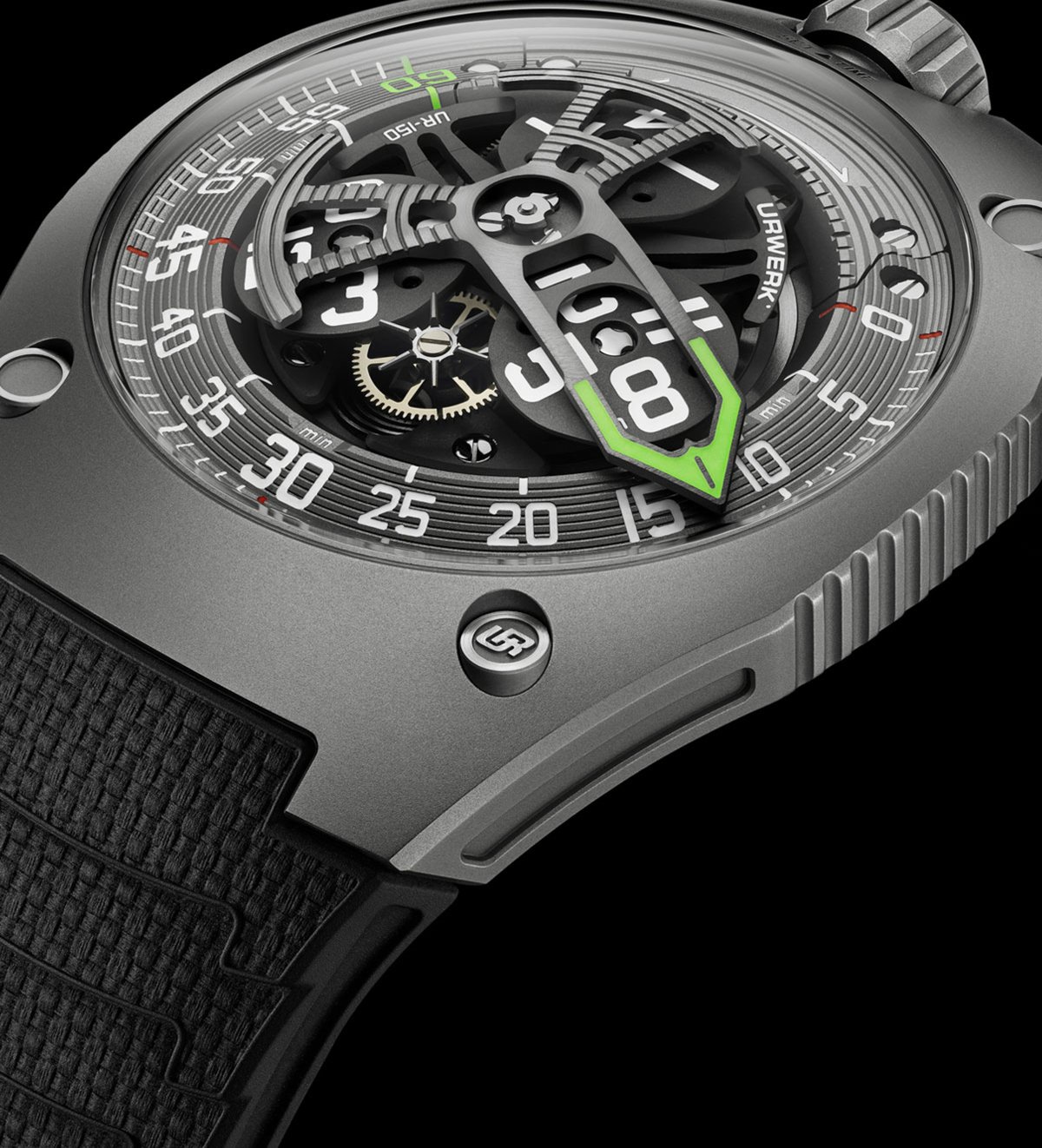
The heart of the UR-120 is the Caliber UR-20.01. To the uninitiated, the dial looks like a chaotic dance of metal. To the expert, it is a masterclass in kinematic engineering. The central carousel carries three satellites, each bearing four hour numerals. As the satellite reaches the end of the minute track (0-60 at the right of the case), it must rotate to display the next hour. In previous models, this was a simple rotation. In the UR-120, the satellite splits into two distinct parts—forming a 'V' shape reminiscent of the Vulcan salute—before rotating and merging back together.
This isn't just for show. By splitting the satellite, Urwerk's engineers reduced the height required for the rotation, allowing for a slimmer case profile. It is a functional innovation masquerading as a visual flourish. The complexity of this movement cannot be overstated. Each component is finished to an exacting standard, with the sandblasted surfaces providing a matte, industrial contrast to the high-polish elements of the carousel. This is the ultimate 'macro-lens' watch—the more you look, the more you find.
The Investment Thesis: Why the UR-120?
Let’s talk numbers. The UR-120 carries an MSRP of approximately $110,000. In the current market, 'Indies' are seeing a massive influx of capital from collectors who are exiting the over-saturated Rolex and Patek markets. The secondary market for Urwerk has remained remarkably stable, with the UR-120 specifically holding its value due to its limited annual production. Unlike mass-produced luxury watches, Urwerk only produces about 150 pieces a year across their entire catalog. The allocation for the UR-120 is likely fewer than 50 units annually.
This scarcity creates a floor for the price. When you buy a UR-120, you aren't just buying a timepiece; you are buying a ticket into an exclusive club. On the secondary market, we are seeing 'Space Black' variants and early production models trade at a premium, often reaching $125,000 to $130,000 depending on the provenance. If you can secure an allocation at retail, you are effectively entering a 'positive equity' position from day one. This is the 'hold and appreciate' play that savvy young collectors are looking for.
Ergonomics for the Elite
One of the historical critiques of Urwerk was that their watches were 'wrist-monsters'—imposing, heavy, and often uncomfortable for those with smaller wrists. The UR-120 solves this with its articulated lug system. The lugs are not fixed; they are hinged at the case, allowing them to pivot and conform to the wearer's wrist. This makes the 44mm width feel significantly more manageable.
The case material choice is also strategic. By utilizing a stainless steel upper bezel for durability and a titanium mid-case and caseback for lightness, the watch achieves a weight that feels substantial but not burdensome. It is a piece you can wear for a full day of meetings followed by a dinner at Carbone without feeling the need to take it off. The strap, a calf leather with a cordura-style embossing, adds to this rugged yet refined aesthetic. It is the horological equivalent of a bespoke tactical suit.
The Competitive Landscape
When comparing the UR-120 to its peers, the closest rival is the MB&F HM10 Bulldog. While the Bulldog is a triumph of whimsical design, it lacks the sleek, 'integrated' feel of the UR-120. The Urwerk feels like a piece of technology from the year 2050, whereas the MB&F feels like a piece of art from an alternate Victorian past. For the collector who values a futuristic, 'cyberpunk' aesthetic, Urwerk wins every time.
Another competitor is Ressence, specifically the Type 3. While Ressence offers a unique oil-filled display, it lacks the aggressive presence and mechanical 'chunkiness' of the Urwerk. The UR-120 is for the person who wants people to notice their watch from across the room, while the Ressence is for the person who wants to explain their watch to the person sitting next to them.
Service and Longevity
Owning a UR-120 is like owning a Ferrari. You cannot take it to your local watchmaker. It requires specialized service every five years to ensure the lubricants in the satellite carousel haven't degraded. The cost is high—expect to pay around $2,500 for a full service—but this is the price of admission for high-complication horology. Urwerk's service department in Geneva is world-class, and they provide a full digital passport for the watch, which is essential for maintaining resale value.
Final Verdict: The Exit Watch
The Urwerk UR-120 is what we call an 'exit watch.' It is the piece you buy when you have reached the pinnacle of your collecting journey and no longer feel the need to prove yourself with 'hype' brands. It is technically fascinating, ergonomically perfect, and financially sound. In the world of luxury horology, it is the ultimate alpha move. If your dealer offers you an allocation, do not hesitate. Buy it, wear it, and watch the market move in your favor.