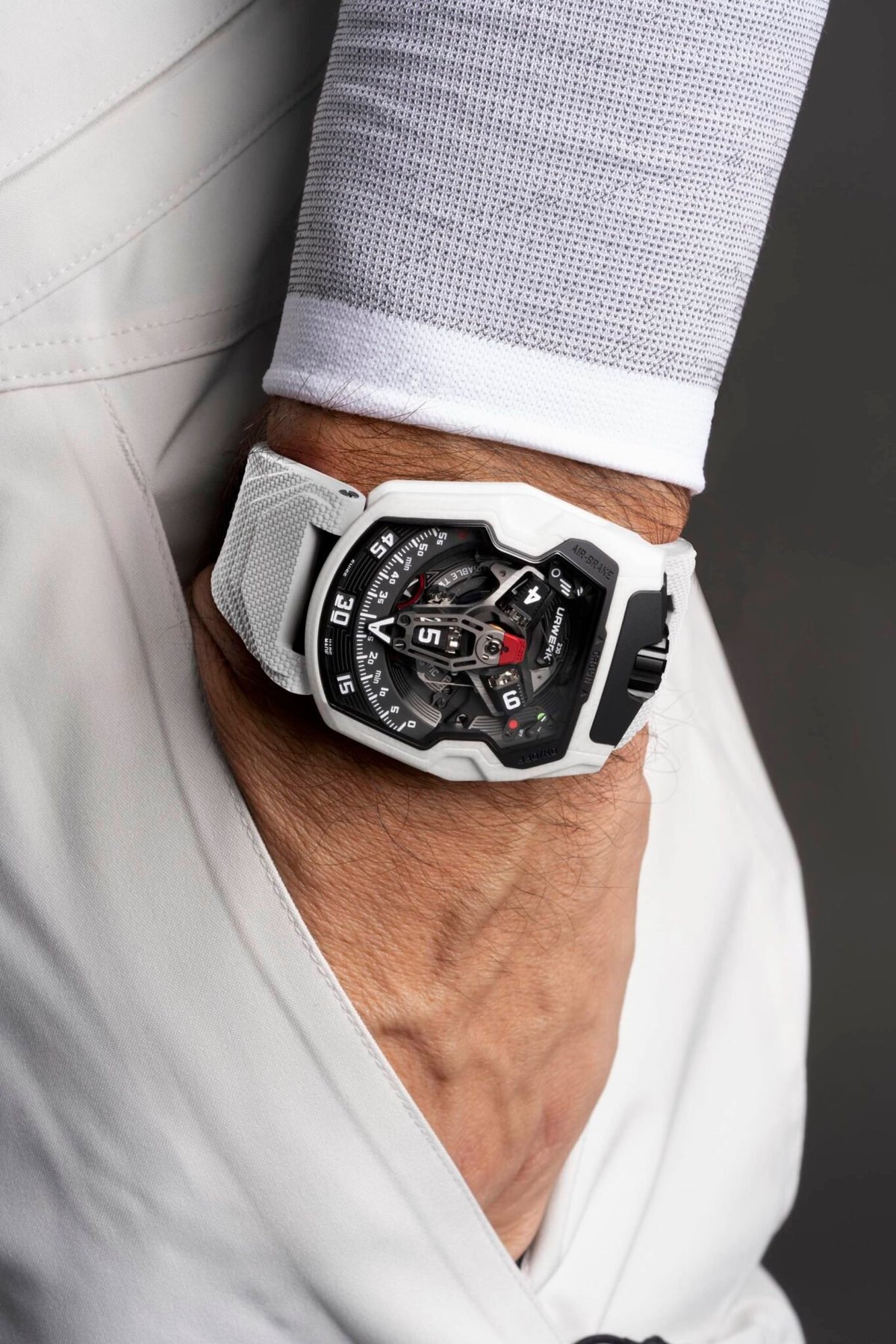
First impressions
The first thing that strikes you about the UR-230 is how much of the watch is devoted to the act of reading time. The satellite hours are not tucked into a corner or treated as a novelty; they are the central event. Three rotating arms carry the hour numerals, and as each arm sweeps into position, the current hour is presented at the top of the display while the minutes are tracked separately. It is a system that requires a few days of familiarity, but once learned it becomes intuitive. The pleasure is not in instant legibility but in the deliberate, mechanical way the watch presents information.
The second impression is one of density. The UR-230 is not a minimal object. Its case is layered with surfaces, recesses, and controls that suggest a cockpit instrument rather than a piece of jewelry. Urwerk has always been interested in the language of aviation and instrumentation, and the UR-230 continues that conversation without turning into costume. The design feels purposeful. Every element appears to have a job, even when that job is simply to remind you that this is a machine.
Manufacture history and context
Urwerk was founded in 1997 by watchmaker Felix Baumgartner and designer Martin Frei. From the beginning, the brand was less interested in traditional dial layouts than in rethinking how time could be shown. The early Urwerk pieces established the satellite-hour concept as a signature, and subsequent models pushed the idea into more complex, more architectural territory. The UR-230 belongs to that lineage, but it also represents a maturing of the brand's approach: the display is still radical, yet the movement and case feel more integrated than ever.
This matters because independent watchmaking is often sold on novelty alone. Urwerk has survived and thrived because its novelties are backed by real mechanical engineering. The UR-230 is not a concept watch. It is a production piece designed to be worn, serviced, and lived with. That distinction is important for collectors who want something unusual without sacrificing the fundamentals of ownership.
Movement and architecture
The UR-230 is powered by the in-house UR-7.30 automatic caliber. It runs at 28,800 vibrations per hour and offers a power reserve of 48 hours. Those figures are respectable rather than spectacular, but they are appropriate for a watch whose primary spectacle is the display module rather than raw chronometric performance. The movement is not COSC-certified, and Urwerk does not position it as a precision instrument in the traditional sense. It is an engineering platform built around the satellite-hour complication.
The architecture is where the UR-7.30 earns its keep. The automatic winding system is regulated to avoid unnecessary stress on the movement, and the finishing is architectural rather than decorative in the conventional Swiss sense. You will find brushed and sandblasted surfaces, clean geometry, and a deliberate absence of the ornamental flourishes that define more traditional high horology. This is finishing as engineering: it is there to make the mechanism legible and durable, not to imitate a nineteenth-century pocket watch.
The caseback is part of the experience. Urwerk has long treated the back of the watch as a control surface, and the UR-230 continues that idea with a layout that invites handling. It is not a display back in the usual sense. It is a place where the owner can interact with the watch, check its state, and appreciate the mechanical logic behind the display. That tactile relationship is one of the UR-230's most distinctive qualities.
Case, dial, and controls
The case is rendered in titanium in the launch configuration, with a dark treatment that gives it a technical, almost stealthy character. Sapphire crystal protects the display, and the rubber strap is integrated into the case design rather than simply attached to it. The overall effect is coherent: the case, dial, and strap feel like they were designed together rather than assembled from a parts bin.
The dial is best understood as a stage. The satellite hours rotate into view, the minutes are tracked separately, and a day/night indicator adds a useful layer of information without cluttering the display. Super-LumiNova is applied where it matters, though this is not a watch that relies on lume for its personality. The real visual drama comes from the movement of the hour satellites and the way the dial architecture frames them.
The controls are intentionally tactile. The crown and the caseback elements give the watch a mechanical ritual that many owners will appreciate. Setting the time requires a little attention, but it is not difficult once you understand the logic. The pin buckle is secure and appropriate for the rubber strap, and the whole package feels robust enough for regular wear. What it is not is discreet. The UR-230 announces itself, and no amount of dark finishing changes that.
On the wrist
The UR-230 wears like a piece of engineered equipment that has been carefully adapted to the wrist. It is not a subtle watch, but it is not clumsy either. The case is sculpted to sit against the arm rather than perch above it, and the rubber strap integrates with the case in a way that keeps the mass centered. The strap does most of the stabilizing work, which matters because the watch has a strong visual presence and a tactile caseback that invites handling.
The crown and the caseback controls give the watch a ritualistic quality. Winding and setting feel deliberate, and the satellite-hour display rewards a little practice. It is not a watch you put on absentmindedly and forget about; it is one you notice every time you move your arm. That is either the point or the problem, depending on the collector. For someone who wants a daily wearer with a conventional silhouette, the UR-230 will feel excessive. For someone who wants a mechanical object with a distinct personality, it feels surprisingly comfortable once the strap is adjusted correctly.
Accuracy and daily use
Urwerk does not submit the UR-230 for COSC certification, and that is consistent with the brand's priorities. Expect a well-regulated automatic that keeps time within roughly a minute a week in regular wear, though individual results will vary with activity and winding. The minute hand is the precise reference; the satellite hours jump in a way that makes the display more about reading the time in a deliberate, almost ceremonial manner than about split-second precision.
For daily use, the movement is dependable and the 48-hour power reserve is sufficient for a normal rotation, provided the watch is worn regularly or wound by hand when it sits. The automatic winding system is designed to cope with the energy demands of the satellite-hour module, and in practice the watch feels consistent. It is not a watch for someone who demands chronometer certification, but it is a watch for someone who values mechanical character over lab-bench bragging rights.
Occasions and wrist presence
The UR-230 is at its best in situations where its personality can be part of the conversation. It works with formal wear when the outfit is deliberately modern, and it works with daily casual wear because the rubber strap and titanium case keep it from feeling precious. Travel is also a natural fit: the display is easy to read once learned, and the robust construction gives it a practical edge that many haute horlogerie pieces lack.
Wrist presence is a five out of five. This is not a watch that whispers. The sculptural case, the moving satellites, and the dark technical finish make it unmistakable from across a room. That is a strength for collectors who want a signature piece, and a liability for anyone who prefers their watches to recede. The UR-230 is a commitment to visibility.
Variants and family context
The UR-230 is offered in a single launch configuration, with a black dial featuring green accents and a black rubber strap. Urwerk has not announced other standard variants, which is typical for a brand that prefers focused releases over endless dial options. The reference sits within a broader family of Urwerk satellite-hour watches, including the UR-220, UR-210, UR-110, and UR-100. Each of those models explored a different facet of the wandering-hour concept, and the UR-230 benefits from that accumulated experience.
Compared with its predecessors, the UR-230 feels more integrated and more wearable. The display is still radical, but the case and strap work together more cohesively. It is also a clearer statement of intent: this is what Urwerk believes a modern mechanical watch should be. Collectors who already own an earlier Urwerk will recognize the DNA, while newcomers will find the UR-230 a coherent entry point into the brand's philosophy.
Alternatives
There is no direct competitor to the UR-230, because no one else makes quite the same combination of satellite hours, in-house automatic movement, and architectural case. The closest alternatives are other independent statement pieces. The MB&F HM11 Architect offers a similarly unconventional display and a highly engineered case. The Greubel Forsey Tourbillon 24 Secondes Architecture shares the sculptural, multi-level movement aesthetic. The Hublot MP-09 Tourbillon Bi-Axis is a bolder, more extroverted take on technical watchmaking. Each of these watches asks the owner to engage with the mechanism rather than simply read the time, and each occupies a similar psychological territory.
For collectors who want the satellite-hour idea at a much lower price, the Xeric Halograph II Automatic offers an orbiting-hours display with a fraction of the engineering. It is not a substitute for the Urwerk, but it is a useful reminder that the underlying concept can be adapted. The difference is in the execution: the Urwerk's movement, finishing, and case architecture operate at a completely different level.
Value and investment
The UR-230 sits in the low six figures, with an MSRP of roughly $180,000 and a current retail figure closer to $190,000. Pre-owned examples trade in a broad band below retail, typically between $150,000 and $190,000 depending on condition, completeness, and timing. The trend is stable rather than appreciating. This is not a watch to buy as a short-term flip. It is a collector's object, and its value depends on finding the right buyer when the time comes to sell.
That said, the UR-230 has several factors working in its favor. Urwerk is a respected independent with a clear identity, and the UR-230 is a distinctive model within its catalog. Limited production and strong brand recognition help support values, even if the market for six-figure independent watches is inherently narrower than the market for mainstream luxury sports watches. The price buys a singular mechanism, a well-executed case, and the credibility of a brand that has been refining this idea for decades. Whether that holds value is a question of patience and buyer appetite, not just specification.
Service and ownership
Urwerk does not publish a fixed service interval for the UR-230, so owners should follow the brand's guidance and have the watch inspected if it begins to run inconsistently or if the satellite-hour module feels sluggish. Service should be handled through Urwerk or its authorized partners. The satellite-hour module is specialized, and independent watchmakers are unlikely to have the parts or training to service it correctly. The cost of service is significant, as it is with any high-complication independent watch, but authorized-only care is the right approach for long-term ownership.
Ownership also means accepting that the UR-230 is not a watch for every day of every wardrobe. It is robust enough for regular wear, but it is not invisible. The reward is a mechanical experience that is difficult to replicate elsewhere. The satellite hours, the caseback controls, and the architectural finishing all contribute to a sense of occasion that conventional watches rarely deliver.
Pros and cons
- Pros: singular satellite-hour display with immediate visual identity.
- Pros: in-house automatic with winding regulation and architectural finishing.
- Pros: comfortable, integrated rubber strap and wrist-centered mass.
- Pros: strong independent-brand provenance and collector appeal.
- Cons: no COSC certification; accuracy is good but not chronometric.
- Cons: service is specialized and costly.
- Cons: limited everyday versatility for conservative dress codes.
- Cons: price puts it far beyond most collectors.
Final verdict
The Urwerk UR-230 is a brilliant piece of kinetic horology and a genuinely wearable statement watch. It rewards collectors who value movement architecture, unconventional displays, and independent thinking over conventional luxury cues. It is not for everyone, but for the right wrist it is exceptional. The UR-230 does not ask to be compared with a standard three-hand watch; it asks to be understood as a machine with its own logic. On that terms, it succeeds completely.