Brand history: Urwerk’s satellite-hour lineage
Urwerk was founded in 1997 by Felix Baumgartner and Martin Frei. From the beginning, the brand was less interested in classic dial layouts than in the mechanics of reading time. Wandering hours, rotating satellites, and architectural cases became its signature. The UR-300 sits in that lineage alongside the UR-100, UR-200, UR-220, and UR-230, but it does not read like a retro exercise. It is a modern independent watch with a clear point of view.
That matters for collectors because Urwerk is not a fashion brand borrowing sci-fi language. It is a watchmaker with a long-running technical argument about how time can be displayed. The UR-300 is part of that argument. It is also part of a broader cultural shift: independent watchmaking has moved from the margins of auctions and forums into the center of young collector culture. The UR-300 is a watch for that audience.
Movement and mechanism
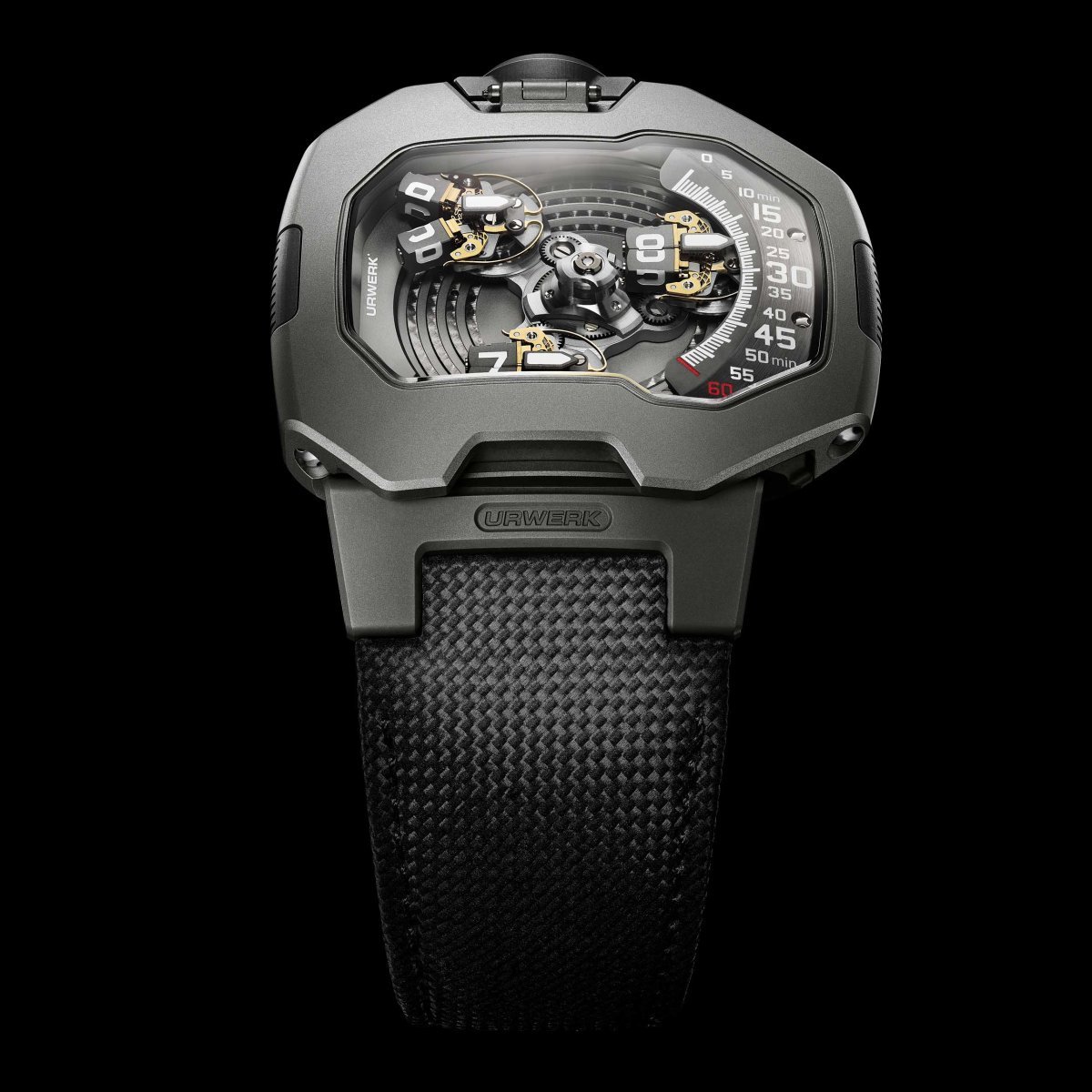
The UR-300 is powered by a proprietary Urwerk automatic movement built around the satellite-hour display. That is the key point: this is not a conventional movement with a wild dial stuck on top. The mechanism and the display are designed together. The hour numerals travel on rotating carriers, and the minutes are read in a way that turns timekeeping into a small mechanical performance.
Urwerk does not position the UR-300 as a chronometer-certified precision instrument. The movement is in-house, automatic, and architecturally finished in a style that suits the watch’s industrial design. Collectors who expect Geneva stripes and classical anglage should look elsewhere. Collectors who want to see the mechanism as part of the object will understand the appeal. Exact frequency, power reserve, and jewel count should be confirmed with Urwerk for a specific delivery, as edition details can vary.
Service is the serious ownership consideration. A satellite-hour mechanism is not a standard ETA service. It should go back to Urwerk or an authorized specialist. That adds cost and time to ownership, but it is part of the deal with independent watchmaking. The UR-300 is not a watch you buy and forget.
Case, crystal, strap, and daily reality
The UR-300 is a sculptural watch. The case is finished in titanium, with sapphire crystal and no lume. That last detail is important: this is not a night-readable tool watch. It is a mechanical object meant to be seen in good light, handled, and admired. The rubber strap suits the industrial design language and makes the watch easier to wear than a fragile leather strap would. The pin buckle keeps the package simple and focused on the case and display.
Urwerk does not publish every specification in a way that matters to mainstream buyers, and the UR-300 should be treated as a lifestyle watch rather than a sports watch. Do not buy it for swimming, diving, or rough daily abuse. Buy it because the satellite display and case architecture make you feel something. The UR-300 is at its best with a jacket, a good shirt, or a collector’s meetup where people actually want to talk about watches.
Wrist feel and presence
The UR-300 wears like a piece of kinetic sculpture rather than a conventional round watch. It has presence, but the weight and strap integration keep it from feeling clumsy on the wrist. The rubber strap suits the industrial design language and makes the watch easier to live with than a leather-strap independent would be. This is not a watch that disappears under a cuff. It is meant to be seen, handled, and discussed.
Comfort depends on how you wear your watches. Collectors who like slim, tucked-in cases will find the UR-300 demanding. Collectors who enjoy MB&F, De Bethune, or early Richard Mille will understand the appeal immediately. The case balances the satellite display well, and the strap helps anchor the watch during daily wear, though owners should still treat it as a special-occasion object rather than a beater.
Wrist presence is a five out of five. The UR-300 is impossible to ignore. Its satellite display and sculptural case create a wrist presence that reads as futuristic, expensive, and deeply collector-oriented. This is not a stealth watch, and it is not trying to be.
Accuracy and real-world timekeeping
The UR-300 is not a chronometer-certified sports watch, and Urwerk does not sell it on split-second precision. Expect stable automatic timekeeping suitable for daily use, but read the satellite display as mechanical theatre first and a precision instrument second. Owners should have the watch timed on a machine at delivery and monitor it over the first few months; any independent satellite mechanism deserves that attention.
Day to day, the UR-300 is easy enough to read once you adapt to the satellite layout. It is not as instant as a conventional three-hander, but it is not meant to be. The pleasure comes from watching the display do its job. If you need a watch that gives you the time in a glance while you are running for a train, this is not the one. If you enjoy the ritual of reading a mechanical object, the UR-300 rewards the attention.
Occasions: where the UR-300 fits
The UR-300 works best as a formal and collecting watch. It can be worn daily by someone who works in a creative field or does not need to hide their personality in a conservative office. It is not a sport watch in the traditional sense, and it should not be treated as a travel beater. The satellite display and case architecture are conversation starters, which makes the UR-300 a natural choice for gallery openings, dinners, auctions, and collector events.
For young collectors building a serious collection, the UR-300 can function as a statement piece alongside a more conventional daily watch. It is not the only watch you need, but it is the one people will remember. That is a specific kind of value, and it matters more than a generic list of occasions.
Reference variants and family context
The UR-300 is the reference to know in this review. Urwerk’s limited editions can vary in finishing and accents, so buyers should confirm the exact edition with the manufacture or dealer. The broader family includes the UR-100, UR-200, UR-220, and UR-230, all of which share Urwerk’s interest in satellite displays and architectural cases. The UR-300 is not a replacement for those watches so much as a new chapter in the same argument.
Other notable Urwerk models include the UR-100V, UR-112 Aggregat, UR-220 Falcon, and UR-230 Eagle. Each has its own collector base. The UR-300 should appeal to buyers who want the satellite-hour experience with a modern independent-watchmaking identity. It is not the entry point to the brand, but it is a strong statement for someone who already understands what Urwerk does.
Similar watches and alternatives
The obvious alternative is MB&F. The HM8 Mark 2 shares the independent, automotive-influenced theatre and the sense that the watch is a machine first and a time-telling tool second. Greubel Forsey offers a more classical independent alternative with the Balancier Convexe, though it appeals to a different collector sensibility. De Bethune’s DB28 is another futuristic case-and-mechanism object for buyers who treat watches as sculpture.
For collectors who want the look without the engineering, the Xeric Soloscope Automatic is an affordable orbiting-hour display that borrows the sci-fi wrist presence, not the engineering. It is not a substitute for an Urwerk, and it should not be treated as one. It is a reminder that the satellite-hour language has spread into the broader watch world, which only makes the original more compelling.
Investment value and secondary market
The UR-300 is a price-on-request watch, and public secondary-market data is thin. That is normal for limited-production independent watchmaking. The trend is best described as stable rather than appreciating, because Urwerk’s market is specialist-led and not driven by mass-market liquidity. Buyers should focus on edition, condition, paperwork, and provenance. Those factors matter more than a generic price chart.
Auction history for this recent reference is not a major factor. There is no deep public auction record to lean on, which means the UR-300 should be bought for the object and the engineering, not for a quick flip. Limited production supports residuals, but the market is not deep enough for casual speculation. The right buyer is someone who wants to own and wear an independent watch with real mechanical character.
Service and ownership
Service should go through Urwerk or an authorized specialist. Independent work on the satellite module is not advisable. Urwerk does not publish a simple service interval that applies to every owner, so buyers should confirm the recommended schedule with the manufacture. The cost will be higher than a mainstream luxury watch service, and the turnaround may be longer. That is part of the ownership reality.
This is not a reason to avoid the UR-300. It is a reason to buy it with clear eyes. Independent watchmaking rewards collectors who value the object, the maker, and the mechanical idea. The UR-300 is exactly that kind of watch.
Final verdict
The Urwerk UR-300 is a collector’s watch in the purest sense: mechanical theatre, independent engineering, and a design language that refuses to blend in. It is not the easiest watch to own, but it is one of the most memorable. For the right collector, that is the entire point.
If you want a conventional daily watch, keep looking. If you want a watch that turns time into a performance and signals a real interest in independent horology, the UR-300 deserves a place on your shortlist. It is expensive, specific, and unapologetic. That is precisely why it works.