Urwerk UR-FREAK: Radical Time, Real Market
The Urwerk UR-FREAK is not a watch that fits neatly into a comparison table. It is an independent statement piece from a brand that has spent decades treating time display as a design problem rather than a tradition to preserve. For a serious collector, that makes it interesting. For a buyer worried about liquidity, it makes it dangerous. The UR-FREAK sits at the intersection of avant-garde engineering and a thin, specialist secondary market, and the correct approach is to understand both before writing a check.
This review is written for collectors who already know what Urwerk is and want to know whether the UR-FREAK deserves a place in a portfolio. It is not a first-watch recommendation. It is a piece that rewards connoisseurship, provenance and a tolerance for ambiguity. Urwerk has not published the full technical sheet for this reference in the same way it does for core models, so where public data is missing, this review says so rather than inventing numbers. That candor matters in a market where speculation often outruns facts.
Brand context: why Urwerk matters
Urwerk was founded in 1997 in Geneva by watchmaker Felix Baumgartner and designer Martin Frei. From the beginning, the brand rejected the conventional central handset and built its identity around wandering hours, satellite displays and carousel-based mechanisms. That is not a gimmick; it is a coherent design philosophy. Urwerk watches are small-series objects, produced in limited numbers and sold to collectors who value mechanical theater over classical restraint.
The UR-FREAK belongs to that lineage. It is not a dress watch with a quirky dial, nor a sports watch with a modified movement. It is an independent horological concept, and its value depends on how much you value that concept relative to more conventional references. Urwerk's core families — the UR-100, UR-105, UR-110, UR-210, UR-220 and UR-230 — have built a dedicated following, but the market is narrow. That is both the risk and the opportunity.
The UR-FREAK concept
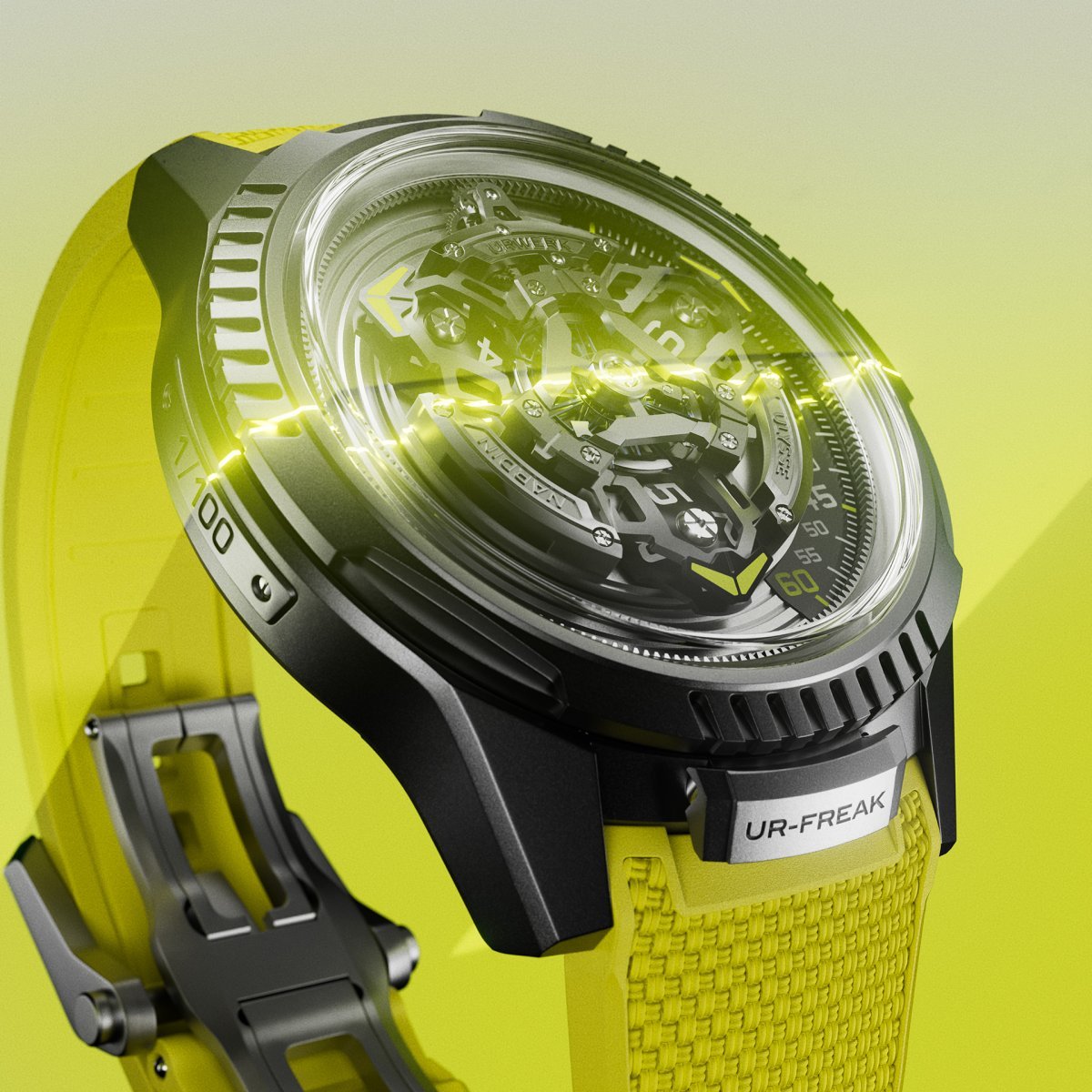
The UR-FREAK is best understood as a collector's object rather than a catalog watch. Its appeal is not measured in water resistance or bracelet options; it is measured in the way it reframes the act of reading time. Urwerk's wandering-hour architecture turns the dial into a stage. The hours move, the minutes are read differently, and the whole experience is deliberately less immediate than a conventional three-hander. That is the point. The UR-FREAK is a watch you look at, not just a watch you glance at.
For collectors, this creates a specific kind of demand. The buyer is not cross-shopping a Submariner or a Royal Oak. The buyer is comparing the UR-FREAK with other independent statements: an MB&F, a Ulysse Nardin Freak, a Richard Mille, or another Urwerk. These are not rational purchases in the traditional sense. They are convictions about design, engineering and the culture of independent watchmaking. The UR-FREAK has to win on that terrain.
Movement and architecture
Urwerk's movements are built around the display, not adapted to it. The brand's carousel-based architecture places the wandering-hour mechanism at the center of the watch, and the finishing is designed to be seen rather than hidden. The UR-FREAK follows that non-traditional layout. Urwerk has not published full calibration figures for this reference, so this review does not invent a caliber designation, power reserve or frequency. What can be said is that the watch is an in-house independent construction, not a modified third-party ébauche, and that matters for long-term collectability.
The movement is automatic in concept, consistent with Urwerk's core production, and it is not submitted for COSC certification. That is not a criticism. Urwerk's clients are buying mechanical invention, not chronometer paperwork. The relevant questions are serviceability, parts availability and whether the carousel display remains stable over time. Those are questions for the brand and for a trusted independent watchmaker, not for a spec sheet alone.
Collectors should also think about what the movement represents. A conventional automatic is a known quantity: service it, regulate it, wear it. A carousel display is a piece of mechanical theater with more points of adjustment and more dependency on correct servicing. That does not make the UR-FREAK fragile, but it does make documentation valuable. A watch with a clear service history is a different asset from one with an unknown past.
On the wrist
The UR-FREAK is not a watch to judge from a spec sheet. Urwerk has not published the full dimensional data for this reference, so the only honest guidance is to treat it as a sculptural object that must be tried on. Urwerk designs typically place the display and carousel architecture at the center of the wrist, which gives a tall, architectural presence rather than a flat, classic profile. The strap and buckle matter enormously: a well-fitted strap can make a radical case feel balanced, while a loose fit exposes the top-heaviness.
Collectors should expect attention, not subtlety. The UR-FREAK is comfortable for short, high-impact wear and for collectors who like a watch that announces itself, but it is not the piece you forget you are wearing. It is best suited to a rotation, not to a single-watch life. If you need a watch that disappears under a cuff, this is not it. If you want a piece that starts conversations and rewards close looking, it is exactly the point.
Accuracy and ownership
Urwerk does not pursue COSC certification for this kind of piece, so owners should expect independent-watchmaking regulation rather than chronometer-grade promises. The wandering-hour display is not a precision timing instrument in the traditional sense; positional variation and service condition matter more than a daily rate claim. A clean, recently serviced example should keep time well enough for daily use, but buyers should ask for timing data and service records. If absolute accuracy is the priority, this is the wrong watch.
Ownership is about more than rate. The UR-FREAK requires a collector who enjoys the ritual of setting and reading a non-standard display. It also requires patience with service. Urwerk's carousel mechanisms are specialist work, and independent servicing is not recommended unless the watchmaker has specific experience with the brand. That does not make the watch fragile; it makes it a commitment.
Market, resale and hold-versus-sell
The secondary market for Urwerk is not deep. It is a specialist market with knowledgeable buyers, limited comparables and a premium on provenance. That means the UR-FREAK should not be treated as a liquid asset. If you need to sell quickly, you will likely accept a discount. If you can wait for the right collector, the result can be much better. The spread between a rushed sale and a patient sale is wider than in mainstream luxury watches.
Demand cycles for independents are driven by brand momentum, auction exposure and the reputation of individual references. Urwerk has a strong core following, but the UR-FREAK is not a mass-market icon. Its value will depend on rarity, condition, original accessories and documentation. A full set with service history is worth materially more than a loose watch. That is true across independent watchmaking, and it is especially true here.
The hold-versus-sell judgment is therefore straightforward. If you bought the UR-FREAK for the concept and you still enjoy wearing it, hold. If you bought it as a short-term trade, sell into strength rather than waiting for a market that may not appear. The watch is a collector's piece, not a momentum stock. There is no major auction history for this specific reference to point to, and that absence of public price discovery is itself a risk. Collectors should price in that opacity.
What the price buys is not a promise of appreciation. It buys access to a small independent manufacture, a radical display and a community of collectors who value both. That can be worth more than a spreadsheet, but only if you are honest about your own time horizon. The UR-FREAK is the kind of watch that can sit in a collection for years without trading, and that is normal in this segment.
Variants, family and alternatives
Urwerk has not published a full variant matrix for the UR-FREAK, so collectors should focus on the individual piece rather than a catalog. The core family references — UR-100, UR-105, UR-110, UR-210, UR-220 and UR-230 — show how the brand has evolved its wandering-hour language. Other notable Urwerk models include the UR-100V, UR-112 Aggregat, UR-220 Falcon Project and UR-230 Polaris. These are the natural siblings for a collector building a serious independent portfolio.
Alternatives outside the brand are equally important. The Ulysse Nardin Freak is the closest conceptual ancestor: a no-hands carousel watch that made radical time display a luxury proposition. MB&F's HM series offers a different kind of independent sculpture, with a strong collector base and a more established auction record. Richard Mille offers high-concept engineering and a very different market profile. None of these is a substitute for the UR-FREAK, but they frame the decision. The UR-FREAK has to be the right kind of radical for you.
Homages and the affordable gap
There is no true affordable equivalent to Urwerk. The engineering, finishing and small-series construction are not replicable at a low price. But collectors who love the wandering-hour idea can find affordable orbital displays that capture the mood. The Xeric Halograph II Automatic is one example: it is not an Urwerk, and it does not pretend to be, but it offers a non-traditional display at a fraction of the cost. For a collector who wants to test whether the format suits their eye, that kind of piece can be a useful first step.
The gap between homage and original is exactly where the UR-FREAK lives. You are not paying for the ability to read time differently; you are paying for the engineering, the independence and the scarcity. That is the honest case for the watch. If that case does not move you, the homage will be enough. If it does, nothing else will satisfy the itch.
Service and long-term ownership
Urwerk service is handled through the brand and authorized partners. Independent servicing is not recommended for carousel-based calibers unless the watchmaker has specific Urwerk experience. The cost and interval for the UR-FREAK are not publicly disclosed, so buyers should budget for specialist care rather than assume a standard luxury-watch service bill. A documented service history is a meaningful value factor at resale.
Long-term ownership also means thinking about parts and provenance. Independent brands can change, and collectors should prefer examples with complete documentation. The UR-FREAK is not a watch you buy anonymously and forget. It is a relationship with a small manufacture. That relationship is part of the pleasure, but it is also part of the risk.
Collector profile and risks
The right owner for the UR-FREAK is a collector who already has conventional pieces and wants a watch that operates by different rules. This is not a one-watch collection. It is a rotation piece, a conversation piece and a statement about what you value in horology. The risk is that the market for that statement is narrow. The reward is that the watch is genuinely different from almost everything else in a safe.
Collectors should also be realistic about public information. Urwerk has not disclosed every specification for this reference, and that is a feature of the independent segment, not a scandal. The answer is not to guess; it is to inspect the watch, ask for documentation and buy from a source that knows the brand. In a market this thin, who you buy from matters as much as what you buy.
Final verdict
The Urwerk UR-FREAK is not a rational first luxury watch. It is a collector's statement from one of independent watchmaking's most consistent radicals. Buy it for the idea, the engineering and the scarcity, not for liquidity. If provenance is clean and the price is right, hold. If you need certainty, pass.