The Pitch
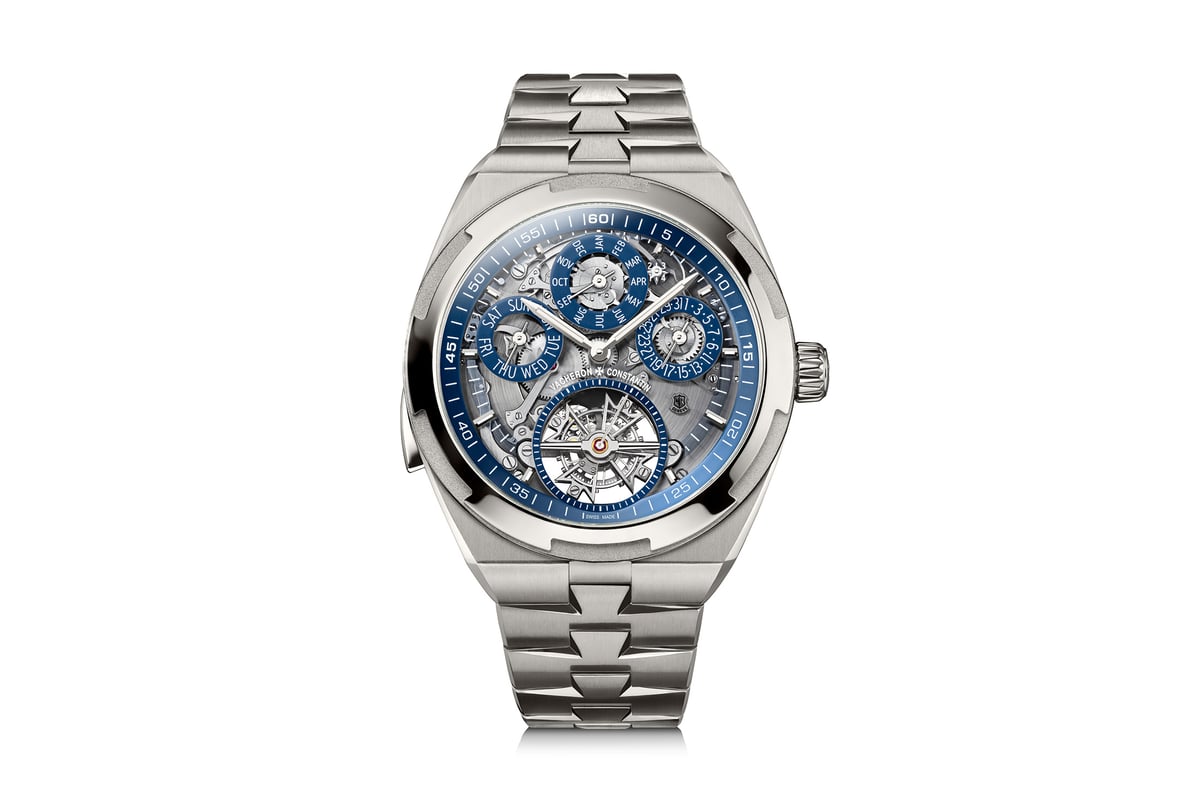
There is a specific kind of collector who walks into a Vacheron Constantin boutique and asks to see the Overseas — not the steel one with the blue dial that everyone photographs — and then asks the question underneath it: what happens if you push this line all the way to its ceiling? The Overseas Grand Complication Openface is the answer. It takes the most democratic case shape in haute horlogerie, a 1970s-bred bracelet-forward sports watch, and drops a tourbillon, a perpetual calendar and a minute repeater inside it, then opens the dial so you can watch all three of them work.
This is not a rational watch, and it does not pretend to be. A perpetual calendar wants to be set once and left alone. A minute repeater wants a quiet room and a patient ear. A tourbillon wants to be looked at. Putting all three into a case with a screw-down architecture and an interchangeable strap system is either the most French thing Vacheron has ever done or the most Geneva thing, depending on your temperament. Either way, it is a statement about what a luxury sports watch is allowed to be.
What the Openface does brilliantly is refuse the usual costume. You do not need black tie to wear a grande complication — you need nerve.
1755 And All That
Vacheron Constantin was founded in Geneva in 1755 by Jean-Marc Vacheron, which makes it the oldest watch manufacture in continuous operation. That is not marketing trivia; it is context. This is a house that was making complicated pocket watches when the wristwatch was a novelty, and its modern range reflects a two-track identity: classical complications under the Patrimony and Traditionnelle banners, and the Overseas, a luxury sports line launched in 1996 and comprehensively rebuilt in 2016.
The 2016 relaunch is the one that matters for anyone under forty. Vacheron took the Overseas and gave it in-house movements, a soft-iron-protected case, and — crucially — a quick-release system that lets the bracelet and strap be swapped without tools. Add the notched bezel inspired by the Maltese cross, the brand's emblem, and you have a watch that reads as heritage without ever looking like costume jewellery. The line's spiritual ancestor is the 222, launched in 1977 for the company's anniversary and now enjoying a serious second life on the secondary market.
The Grand Complication Openface is where those two tracks collide. It has the Overseas silhouette and the Overseas ergonomics, but the engineering underneath is Patrimony-grade. Vacheron has never been a brand that courts hype cycles, and its ambassador strategy — the One of Not Many campaign, photographer and explorer Cory Richards among them — has deliberately framed the Overseas as a traveller's instrument rather than a status symbol. This watch tests the limits of that framing.
What "Openface" Actually Means
Skeletonization in haute horlogerie is usually a marketing exercise dressed up as craft. Remove material, engrave a few bridges, call it architecture. The Openface is the other version: the movement is designed to be seen, and the dial is not so much removed as negotiated down to its structural minimum.
What you get are three complications in one movement, hand-wound, in-house, made under the terms of the Geneva Seal. The tourbillon sits in its own aperture, rotating once a minute, and it is the least subtle thing in the watch — which is fine, because a tourbillon that hides is a tourbillon you paid for and cannot enjoy. The perpetual calendar carries the day, date and month without any of the annual correction a normal calendar demands, which is engineering you feel every time you pick the watch up after a month in the safe and find it still correct.
Then there is the repeater. A minute repeater is the most labour-intensive complication in traditional watchmaking, and the one that survives skeletonization least gracefully — hacks, racks and gongs all need volume to sound well. Vacheron has spent decades on repeaters, and the architecture here is the reason the price is what it is. The chimes are not the loudest in the market; they are the most musical. There is a difference between a hammer hitting a gong and a hammer hitting a gong a master adjuster has tuned by hand in a quiet room.
Finishing is the part you will see and not see. Hand-bevelled bridges, interior angles cut by hand rather than machine, and Geneva Seal-level decoration applied to surfaces that only a loupe and a phone camera will ever examine. Vacheron does not chase COSC certification, and the Geneva Seal governs construction and finishing rather than rate — a distinction that says a great deal about what the house thinks a movement is for.
Specs, Honestly
Vacheron Constantin does not publish every dimension for every high-complication reference, and we are not in the business of inventing numbers to fill a table. The case is gold, the crystal is sapphire, the watch runs on a hand-wound in-house grand complication movement with the three complications described above, and it is delivered on leather with a deployant clasp — though the Overseas interchangeable system means the bracelet is a genuine option rather than an afterthought.
There is no luminous treatment on the dial, and that is not an oversight. Lume on a skeletonized grand complication would be like reflective piping on a dinner jacket. If you are reading this watch at night, you are reading it by the light of a phone screen like everyone else.
On The Wrist
The Overseas case is the secret weapon of the line. The barrel-shaped middle and the notched, Maltese-cross-derived bezel sit closer to the wrist than the architecture suggests, and the Openface inherits that geometry wholesale. The result is a large watch that does not behave like a large watch. It is not discreet — gold and openworked bridges do not do discreet — but it is comfortable.
The real party trick is the strap system. Quick-release changeovers mean the same watch can be a gold-bracelet statement at a gallery opening and an alligator-strap object at a dinner, changed in a hotel room with the television on. It is one of the genuinely useful innovations of the modern luxury sports watch era, and it makes a grand complication feel like part of a wardrobe rather than a locked box.
Weight is the honest caveat. Gold case plus gold bracelet is a physical presence, and if you spend your day at a keyboard you will know about it. On the leather strap, the balance improves noticeably — the case settles down into the wrist instead of floating above it. This is a watch you wear deliberately, not absent-mindedly.
Living With It
A tourbillon-and-repeater movement is not a chronometer racehorse, and expecting quartz-like rate from a hand-wound skeleton is a category error. What you should expect is a well-regulated piece that keeps comfortably acceptable time for a complication of this order, provided you are consistent: wind it at roughly the same hour, keep the perpetual calendar on a winder when it is out of rotation, and do not test it against a radio signal every morning.
Legibility is the real daily compromise. A skeleton dial is a landscape, not a signpost. Reading the date requires attention; reading the time requires more. Owners of openworked grand complications generally acquire the habit within a fortnight and stop noticing, but if you need a watch that tells you the time in a quarter-second glance, this is the wrong object and no amount of money will change that.
Water resistance is the other thing not to test. The Overseas line as a whole is built for real life, but a grande complication with a repeater slider on the case flank is not a swimming companion. Treat it as a watch for rooms with doors.
When You Wear It
Formal and dress occasions are the obvious answer, and the Openface handles them without effort — gold, openworked bridges, and the sound of a repeater in a quiet room is a hell of a way to end a dinner. But the more interesting case is the one Vacheron is actually making: this is a grand complication with a sports watch's shoulders, and there is real pleasure in wearing it with a crewneck and dark trousers to a design fair or a gallery opening where everyone else is in a steel Nautilus.
It is not a daily driver in the sense of a Submariner. It is a daily driver in the sense that the person who owns it probably has other watches for the gym. Occasions list: formal, dress, evening, and the collector's own private category of days when you simply want to hear it chime.
The Lineup Around It
Within the Overseas family, the nearest siblings in spirit are the Perpetual Calendar Ultra-Thin 4300V, which delivers one of the three complications in a wearable, quietly excellent package, and the World Time 7700V, which is the complication most Overseas owners actually use. The Tourbillon 6000V is the purest expression of the line's openworked instinct. Above them all sits the Openface, which is less a product than a position statement.
Step outside the line and the alternatives are specific and serious. Patek Philippe's 5304/301R puts a minute repeater and perpetual calendar under a sapphire dial, and it is the closest philosophical rival — the same idea, different accent. Audemars Piguet's Royal Oak Perpetual Calendar Openworked is the piece that made skeletonization a mainstream flex on an integrated bracelet. And A. Lange & Söhne's Datograph Perpetual Tourbillon is the Saxony answer: three complications, finishing that invites a loupe, and a very different idea of what luxury should look like.
For anyone wanting the silhouette without the invoice, no one makes a budget skeleton grand complication — the honest substitutes are silhouette pieces. Tissot's PRX Powermatic 80 delivers the integrated-bracelet, tapered-case energy for under a thousand dollars. Casio's Edifice Slim EFR-S108D does something similar in steel for a fraction of that. They are not homages and should not be treated as such; they are the silhouette, and the silhouette is most of what you see from across a room.
Money, Service, And The Long Game
Pricing for this reference is on request, which in Vacheron's world is both a discretion play and an acknowledgement that grand complications are negotiated rather than listed. What the money buys is hand-finishing, three complications, a Geneva Seal movement, and rarity — production of pieces like this is measured in dozens, not units per year.
Secondary market reality is less romantic. Gold grand complications from major houses trade in thin, relationship-driven channels where the buyer pool is small and the bid-ask spread is wide. This is not a watch with a chart. Vacheron's auction heat currently lives with the vintage 222 and early Overseas references, not with modern complicated pieces. If you want an appreciating asset, there are better ways to spend seven figures. If you want an object that will be serviced by the manufacture, documented, and passed on with a story, this does that.
Service is authorised-only, and it should be. A hand-finished repeater with a Geneva Seal movement does not go to the local watchmaker; it goes back to Geneva, on a schedule that reflects the complexity rather than the calendar. Budget for it as part of ownership the way you budget for a car's major services — infrequently, and without flinching.
Verdict
The Overseas Grand Complication Openface is Vacheron Constantin at its most confidently unreasonable. It puts a repeater, a tourbillon and a perpetual calendar into the case shape the house uses to sell steel watches to young collectors, then lets you see all of it. It is hard to read, expensive to service, and completely unnecessary.
It is also one of the very few watches in the world that manages to be a grande complication and a mood. Wear it to the opera. Wear it to a gallery opening. Wind it on Sunday and listen to it chime. Fewer than a handful of brands could make that argument and mean it, and this one does.