The Architecture of Utility
When one examines the Vaer Arctic DS2, the first impression is one of stark, uncompromising clarity. In the world of horology, the 'Arctic' designation usually implies a white dial, a choice that historically served explorers in high-glare environments. Vaer has embraced this tradition, but they have executed it with a level of technical precision that warrants a deep dive into the watch's construction.
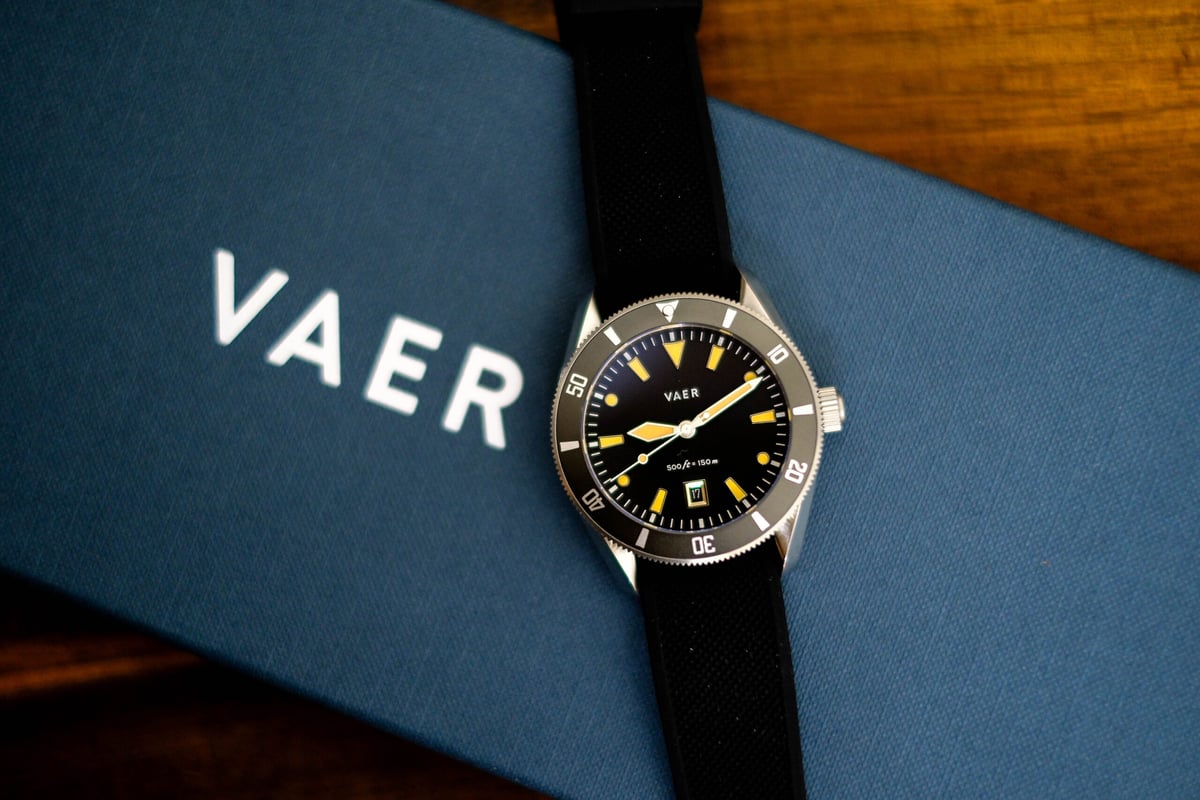
The case of the DS2 is a study in modern machining. Crafted from 316L stainless steel, the 42mm chassis features a dual-finish approach. The top surfaces of the lugs are finely brushed, a practical choice for a tool watch as it hides the inevitable micro-abrasions of daily wear. However, it is the polished chamfer—a thin, mirrored bevel running along the outer edge of the case—that elevates the DS2 from a mere instrument to a piece of jewelry. This chamfer requires a steady hand and high-speed polishing wheels to achieve the crisp transition seen here, and its presence is a hallmark of Vaer's attention to detail.
Movement: The Swiss Heartbeat
At the center of the DS2 beats the Sellita SW200-1. For the uninitiated, the Sellita SW200-1 is often dismissed as a 'clone' of the ETA 2824-2. While historically accurate, this description fails to capture the evolution of the movement. The SW200-1 is a 26-jewel workhorse that has become the backbone of the independent Swiss watch industry. Vaer’s decision to use the 'Swiss Made' version of this movement ensures that the assembly and regulation meet stringent legal requirements.
Technically, the movement operates at 28,800 vibrations per hour (4Hz), which translates to eight ticks per second. This high frequency is not just for visual smoothness; it provides a more stable rate against external shocks. The movement features a hacking seconds function, allowing the wearer to stop the seconds hand for precise synchronization—a necessity for any mission-critical timepiece. The inclusion of the Incabloc shock protection system ensures that the delicate pivots of the balance wheel remain intact even if the watch is dropped or subjected to heavy vibration.
Dial Legibility and the Arctic Aesthetic
The 'Arctic' dial is the soul of this reference. Unlike many white dials that can appear flat or 'plasticky,' Vaer has opted for a matte finish that absorbs light, preventing glare. The indices are applied, rather than printed, providing a sense of depth. Each index is bordered in black, creating a high-contrast boundary that is essential for legibility against the white background. This is a subtle but vital design choice; without the black surrounds, the white-on-white effect would render the watch unreadable in bright sunlight.
The lume performance is equally impressive. Vaer utilizes Grade A Super-LumiNova BGW9. Unlike the more common C3 lume, which has a greenish tint in daylight, BGW9 is stark white in the sun and glows a cool, electric blue in the dark. This choice maintains the 'Arctic' color palette throughout the day and night. The lume is applied generously to the hands, indices, and the zero-marker on the ceramic bezel insert, ensuring that the watch meets ISO 6425 standards for dive watch legibility.
The Engineering of the Bezel and Crystal
A diver's watch is only as good as its bezel, and the DS2 features a 120-click unidirectional rotating bezel. The action is firm, with distinct detents and no perceptible back-play. This level of mechanical tolerance is difficult to achieve at this price point. The insert is made of ceramic, a material favored for its near-diamond hardness and resistance to fading under UV exposure. In an 'Arctic' environment, where sun reflection off snow can be intense, a ceramic bezel is a logical, high-performance choice.
Protecting the dial is a scratch-resistant sapphire crystal. Vaer has specified a double-domed sapphire, which minimizes the visual distortion often seen at extreme viewing angles on flat crystals. Furthermore, the underside is treated with several layers of anti-reflective (AR) coating. This ensures that the time is visible even when light hits the crystal directly, a technical detail that Marcus Aldridge advocates for in any serious tool watch.
Wrist Experience and Ergonomics
On the wrist, the DS2 Arctic defies its 42mm dimensions. The secret lies in the 'skin diver' influence—a design ethos from the 1960s that prioritized a slim profile and curved lugs. At 11.6mm thick, the DS2 is significantly thinner than a Rolex Submariner (12.5mm) or a Tudor Black Bay 41 (14.4mm). This allows the watch to slide effortlessly under a shirt cuff, making it a viable option for more formal settings despite its tool-watch DNA.
The bracelet is a three-link 'Oyster' style, featuring solid end links and screw-in pins for resizing. The use of screws rather than friction pins is a nod to the luxury segment, offering greater security and ease of adjustment for the owner. The clasp is a double-locking deployment style, providing peace of mind during vigorous activity. While I would have preferred to see a tool-less micro-adjustment system, the provided four micro-adjustment holes allow for a reasonably precise fit.
Conclusion: The Vivir Verdict
The Vaer Arctic DS2 represents the pinnacle of what an independent American brand can achieve when they leverage Swiss manufacturing. It does not attempt to reinvent the dive watch; instead, it refines it. By focusing on the fundamentals—movement reliability, case finishing, and legibility—Vaer has produced a timepiece that commands respect from seasoned collectors and novices alike.
The DS2 offers a refreshing alternative to the 'hype' pieces that dominate social media. It is a watch for those who understand that true luxury lies in the integrity of the object itself, not the logo on the dial. The DS2 Arctic is a testament to the fact that a world-class mechanical watch can be both accessible and exceptional.