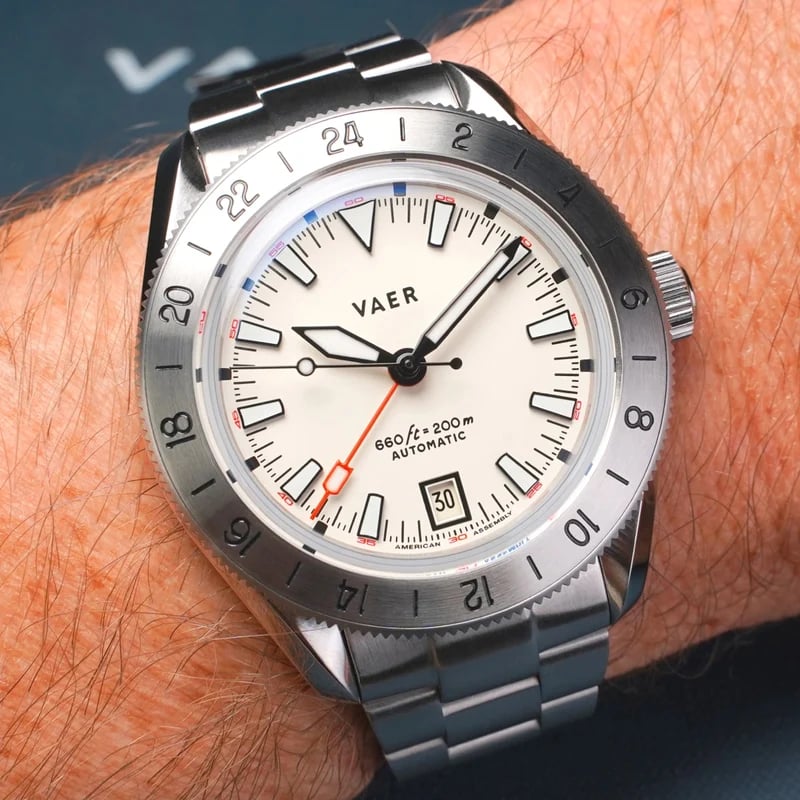
Introduction: The Democratization of the Flyer GMT
For decades, the 'True GMT' or 'Flyer GMT'—a watch where the local hour hand can be jumped independently without stopping the movement—was the exclusive province of high-end Swiss manufactures. If you wanted the convenience of adjusting your watch as you crossed time zones without losing your synchronization to the second, you were looking at a Rolex, an Omega, or perhaps a Grand Seiko. The rest of the market was left with 'Caller GMTs,' where the GMT hand is adjusted, a process far less intuitive for the frequent flier.
Enter the Vaer G5 Pacific Polar GMT. Powered by the Miyota 9075, this watch represents a seismic shift in the industry. It brings the functionality of a professional pilot’s tool to a price point accessible to the burgeoning collector. But as I often remind my readers at Vivir, a movement alone does not make a masterpiece. A watch must be lived with. It must survive the rigors of the daily commute, the accidental knock against a doorframe, and the long-term fatigue of the wrist. The G5 isn't just a vehicle for a movement; it is a carefully considered piece of industrial design.
Case Ergonomics and the 48mm Rule
When assessing a watch for daily wear, the first thing I look at is the lug-to-lug measurement. At 48mm, the Vaer G5 sits in the 'Goldilocks zone.' It is large enough to provide modern presence but compact enough to avoid the dreaded lug-overhang on wrists as small as 6.25 inches. During my week with the G5, I found that the downward turn of the lugs allowed the watch to hug the wrist, creating a sense of security that is often missing in more slab-sided designs.
The thickness—or lack thereof—is the G5’s secret weapon. At 11.6mm for the case walls, it is remarkably slim for a watch boasting 200 meters of water resistance. Most GMTs in this price bracket tend to be chunky, often exceeding 14mm due to the added height of the GMT complication and the desire for high WR. Vaer has managed to keep the profile sleek, allowing the G5 to slide effortlessly under the cuff of a bespoke shirt or a technical shell jacket. This versatility is essential for the modern traveler who might move from a morning hike to a formal dinner without a change of timepiece.
The Polar Dial: Legibility in Every Light
The 'Polar' aesthetic—a crisp white dial with high-contrast markings—is more than just a stylistic choice; it is a functional one. In low-light environments, such as a dimmed aircraft cabin, the white dial provides a reflective surface that makes the black-surround indices pop. The use of Super-LumiNova BGW9 ensures a long-lasting blue glow that, while not as initially blinding as C3, maintains its visibility throughout a red-eye flight.
The GMT hand is rendered in a vibrant orange, providing an immediate visual distinction from the local time. This is a critical detail. When you are jet-lagged and squinting at your wrist at 3:00 AM, you don't want to spend three seconds deciphering which hand is which. The bi-directional ceramic bezel further aids this, with a 24-hour scale that allows for the tracking of a third time zone if one is so inclined. The bezel action is firm, with enough resistance to prevent accidental shifts, though it lacks the buttery clicks of a high-end Swiss diver—a fair trade-off given the price point.
The Miyota 9075: A Technical Deep Dive
The heart of the G5 is the Miyota 9075. To understand why this movement matters, one must understand the mechanics of travel. Most affordable GMTs use the Seiko NH34 or the ETA 2893, where the 24-hour hand is adjusted. In contrast, the 9075 allows you to pull the crown to the first position and 'jump' the local hour hand. This moves the date forward or backward and leaves the GMT hand pointing at your 'home' time. It is the gold standard for travel complications.
On the wrist, the movement is a high-beat (4Hz) performer, providing a smooth eight-ticks-per-second sweep of the seconds hand. The only drawback common to the Miyota 9000 series is the uni-directional winding rotor. On a quiet night, you can feel and hear the rotor spinning freely when it’s not engaging the mainspring. For some, this adds character—a reminder of the mechanical heart beating within. For others, it may feel less 'refined' than the silent winding of a Rolex Calibre 3285. In my experience, the noise is a non-issue once you are out in the world.
The Bracelet: Taper and Tension
Vaer offers the G5 on a variety of straps, but for the daily-wear collector, the premium oyster-style bracelet is the only logical choice. The 20mm to 16mm taper is aggressive and welcome. It lightens the overall package and gives the watch a more elegant silhouette. The links are solid steel with screw pins, a significant upgrade over the friction pins found on many entry-level pieces.
The clasp is a standard folding unit with four holes for micro-adjustment. While it is secure and well-finished, this is perhaps the one area where Vaer could improve. In an era where 'on-the-fly' adjustment systems are becoming common, having to use a tool to adjust for wrist swelling during a flight feels slightly dated. However, the sheer comfort of the bracelet links themselves goes a long way in compensating for this.
The Vivir Verdict: Who is the G5 For?
The Vaer G5 Pacific Polar GMT is a watch for the person who cares about what a watch *does* more than what it *signifies* to others. It is a sophisticated choice for the young collector who understands the technical merit of a flyer GMT and wants a piece that can handle a 200m dive just as easily as a trans-Atlantic flight. It is a tool that feels 'correct' on the wrist—balanced, legible, and remarkably thin.
In the week I spent with the G5, it never felt out of place. It survived the mundane (washing dishes, typing reports) and the adventurous (a weekend coastal hike). It is a testament to what a small, focused brand can achieve when they prioritize ergonomics and movement technology. For under $1,000, you are not just buying a watch; you are buying a reliable companion for the next decade of travel.