Ibach, 1884: knives first, watches much later
Victorinox was founded in 1884 by Karl Elsener in Ibach, in the canton of Schwyz, and spent its first century making cutlery and the pocketknife that would eventually become the Swiss Army Knife. After Elsener's death in 1918, the company took the name it still carries — a compression of Victoria, his mother's name, and inox, for the stainless steel that made the knives possible.
Watches arrived much later, in 1989, and Victorinox has built them in Bienne ever since, in the same Jura arc where most of the Swiss industry does its work. That timing matters. By the late 1980s the Swiss watch industry had already been through the quartz crisis, and the brands that survived had learned to sell identity as much as mechanics. Victorinox arrived with an identity already banked: durability, utility, a certain sober Swissness.
Two decisions shaped the Ambassador's fate. The first was co-branding. For two decades the dials read Swiss Army, a name Victorinox licensed and eventually retired from its watches in the early 2010s, when the products became simply Victorinox. The second was the I.N.O.X., launched in 2014 for the company's 130th anniversary, which reset the brand's public identity around indestructibility — a watch you could run over with a truck and then photograph for a campaign.
Between a borrowed military name and a piece of wearable armor, the Ambassador had no obvious home. It was a dress watch from a knife company, in a catalog that sold toughness, at a price where buyers expected either heritage or flash. Victorinox gave them neither. It gave them restraint, which is the hardest thing to market and the easiest thing to undervalue on the secondary market.
The design brief: don't get noticed
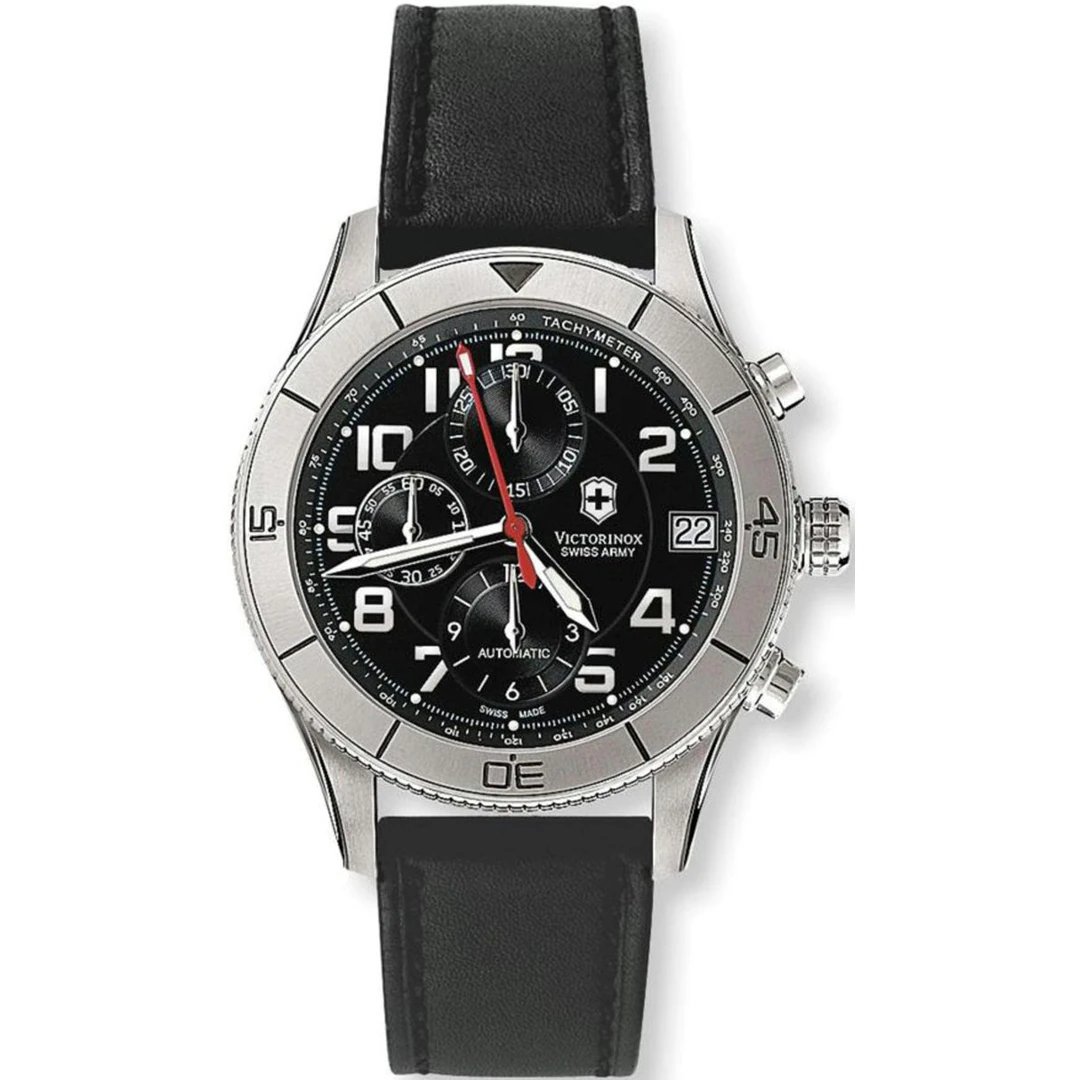
Look at the rest of the Victorinox line and the Ambassador's design decisions read as a series of refusals. No bezel stack. No crown guards. No pushers, no red accents, no depth text. The case is the entire story, and the case is deliberately boring in the way that good dress watches are boring: a clean caseband, lugs that taper into the strap, and a crown small enough that it never catches on a cuff.
The dial follows the same logic. Applied indices rather than printed ones, which is a small luxury tell at this price and gives the surface a bit of depth when it catches window light. Hands that are long enough to reach their respective tracks, a sweep seconds hand that does its job without drawing attention, and a date window cut cleanly enough that it does not look like an afterthought. Nothing on the dial is trying to be a logo.
The finishing is the standard alternation of brushed and polished surfaces you would expect from a Swiss watch of this class — enough contrast at the caseband to keep the profile from flattening out, not so much that the watch reads as flash. The crystal is sapphire, which matters more than most buyers realize: on a dress watch that will spend years in a drawer between wears, an acrylic crystal scratches and a mineral crystal hazes, and either one will make a clean dial look tired.
The strap is leather, tapering toward a pin buckle. That is the right call. Deployant clasps add bulk under a shirt cuff and are one more thing to break on a watch that gets worn eight times a year. A pin buckle is honest, replaceable, and cheap to swap when the leather gives out.
The movement question
Here is where the Ambassador gets awkward, and where an honest review has to stop pretending. Victorinox did not publish a caliber designation alongside this reference, and the automatic dress line of the period ran on outsourced Swiss ébauches rather than anything the company developed itself. There is no chronometer certificate, no in-house architecture, no decorated bridges to admire through a display back that does not exist.
What that means in practice is both a limitation and a relief. The limitation is obvious: you cannot buy this watch for the movement, and nobody is going to be impressed by it at a dinner party. The relief is that an outsourced Swiss ébauche is the most serviceable object in horology. Parts are generic, tolerances are known, and any competent independent watchmaker can strip, clean, and regulate it without needing a factory account or a three-month wait.
That last point is more important than it sounds on a discontinued reference. When a brand's proprietary calibre goes out of production, service becomes an act of institutional goodwill. When a watch runs on a Swiss ébauche, service becomes an errand. The Ambassador will still be repairable in twenty years, which is more than can be said for a lot of watches at this price.
On the wrist
The Ambassador's whole argument is one of proportion, and proportion is the one thing a spec sheet cannot tell you. A dress watch lives or dies on where the lugs meet the strap, how the caseband catches light when you turn your wrist, and whether the whole assembly slides under a shirt cuff instead of fighting it. On those terms the Ambassador behaves like a watch from a more expensive shelf: the caseband reads slim from the side, the strap tapers hard toward the buckle, and the head stays planted instead of rolling around the wrist.
Balance is the other thing. A dress watch with a heavy case and a flimsy strap feels like a coin on a string, and a dress watch with a light case and a thick strap feels like a toy. The Ambassador avoids both by keeping the leather substantial at the lugs and letting it narrow gradually, so the visual weight stays where the eye expects it — at the dial.
It is not a watch you will notice on your own wrist at hour nine of a long day. That is the highest compliment available to a dress watch. The ones that fail are the ones you keep adjusting because something about the fit keeps demanding attention. The Ambassador does not demand anything.
Accuracy and ownership reality
There is no chronometer certificate here and no promise of tight daily deviation. What you should expect from a Swiss ébauche automatic of this generation is a watch that runs within roughly ten seconds a day when it has been properly regulated and freshly serviced, and drifts wider as the oil film ages. Real-world examples that have sat in drawers for years will usually want a service before they behave, and a watch that has not been serviced in a decade is not a bargain at any price.
Because the movement is outsourced, service is not a crisis. Any competent watchmaker can handle it, and the cost sits in the ordinary range for a three-hand Swiss automatic rather than the punitive range reserved for proprietary calibres. The variable is parts: confirm availability with the service center before you buy a watch that has clearly been sitting.
Then there is the practical question of what happens to a dress automatic you wear eight times a year. It will stop. You will reset it. That is the deal with any non-quartz dress watch, and it is not a reason to avoid this one — but it is a reason not to pay a premium for a watch you will mostly look at.
What it is actually for
The Ambassador is a formal watch first and a daily watch second. Its best setting is a suit, a wedding, a dinner where you would rather not be asked what you are wearing. The restrained dial and the leather strap do exactly what they should in those rooms, and the absence of lume, depth rating, or any tool-watch signaling keeps it from looking like a compromise.
It also works as a daily for people who dress in a way that tolerates it — tailoring, knitwear, a shirt with a collar. Where it struggles is at the beach and in the gym, and not only because it has no lume. This is a watch with no sporting aspirations. Do not take it hiking and expect the Victorinox name to protect it.
For travel it is a reasonable companion: no GMT, no second time zone, nothing clever, just a three-hander that looks appropriate in any city where you might be meeting someone. If you want a single watch that covers a wedding and a hike, this is not it. If you want a single watch that covers a wedding and a business trip, it is.
The market: nobody is fighting you for one
Here is the part collectors do not like to hear about watches like this. The Ambassador has no auction history worth citing, no collector community organized around it, and no scarcity narrative. It is a discontinued mid-tier Swiss dress watch from a brand whose equity lives in knives and tool watches, and it is priced accordingly — examples turn up in the low hundreds with some regularity.
That is not a flaw. It is the entire proposition. Compare what the same money buys across the Swiss dress category and the Ambassador's argument becomes clear: a restrained, sapphire-crystal, leather-strap automatic with no marketing premium baked in. The Tissot and Hamilton equivalents carry more recognition and more supply; the Longines and Baume & Mercier equivalents carry more finishing and roughly double the outlay.
What you are not buying is liquidity. If you change your mind in six months, you will be selling into a narrow market where buyers are looking for a deal rather than a watch. Price it to move and accept that patience is the only leverage you have. Anyone who tells you this is an emerging collectible is selling you something else.
What to compare it against
The obvious comparison is the Tissot Le Locle Automatic, which owns this price point in the Swiss dress segment and which you can find everywhere. It is more recognizable, better documented, and easier to sell — but it is also more common, and there is a case for the Victorinox precisely because it is not.
The Hamilton Jazzmaster offers a wider spread of dials and sizes and a slightly more American sensibility. The Longines Master Collection is the step up if you want real finishing and a name that carries in a room full of watch people, but it costs roughly twice as much. The Baume & Mercier Classima and the Frederique Constant Classics Index sit in the same conversation, both executed with a slightly more jewelry-adjacent feel.
Below the Swiss line, the Orient Bambino and the Timex Marlin Automatic do the same visual job for a fraction of the money, and honestly, they do it well. The gap between them and the Ambassador is not enormous. What the Victorinox adds is a Swiss case, a sapphire crystal, and the satisfaction of wearing something slightly off-script.
Verdict
The Ambassador 241072 is not a watch that rewards research, because there is barely any research to do. It rewards handling. Put it on and it does the one job a dress watch is supposed to do: it gets out of the way while still looking like it cost more than it did.
Buy one in good condition. Service it once. Wear it to the things you dress up for. And stop worrying about whether it will appreciate, because it will not — and the watch is better for it.