The Cavalry in one paragraph
There is a version of watch collecting that runs entirely on heat — allocation lists, auction premiums, the ritual of the waitlist email. Then there is the version most collectors actually live in: buying competent, honest watches at prices that do not require a second mortgage. The Victorinox Cavalry ref. 24531 belongs squarely in the second category, and that is exactly why it deserves a serious look.
It is a Swiss-made quartz field watch from a company with genuine industrial pedigree, sold at a price that undercuts almost every Swiss alternative on the shelf. It is also, and this is the part the marketing tends to skip, a watch with no meaningful secondary market and no plausible path to appreciation. Both of those facts are true at once, and a serious buyer needs to hold them both.
The brand behind it
Victorinox was founded in Ibach, Switzerland in 1884 as a cutlery workshop and became globally synonymous with the Swiss Army Knife — arguably the most successful piece of utilitarian design of the twentieth century. The company moved into watchmaking in 1989, first through a licensing arrangement and later by bringing design and assembly in-house at its own facilities.
That history is not trivia. It explains the Cavalry's entire design philosophy. Victorinox is a company that has spent a century and a half optimising for function, durability, and manufacturing cost, and its watches reflect that DNA far more than they reflect the aspirations of haute horlogerie. When you buy a Cavalry, you are buying the same institutional instinct that produced a folding knife issued to conscripts. That is a specific kind of credibility, and it is worth something.
What it is not worth is a premium. Victorinox has never been able to command resale prices above retail on its core watch lines, with the arguable exception of a few I.N.O.X. variants and some limited editions that trade on novelty rather than scarcity. The brand's strengths are real but they are engineering strengths, not collectibility strengths.
Case, dial, and the field-watch grammar
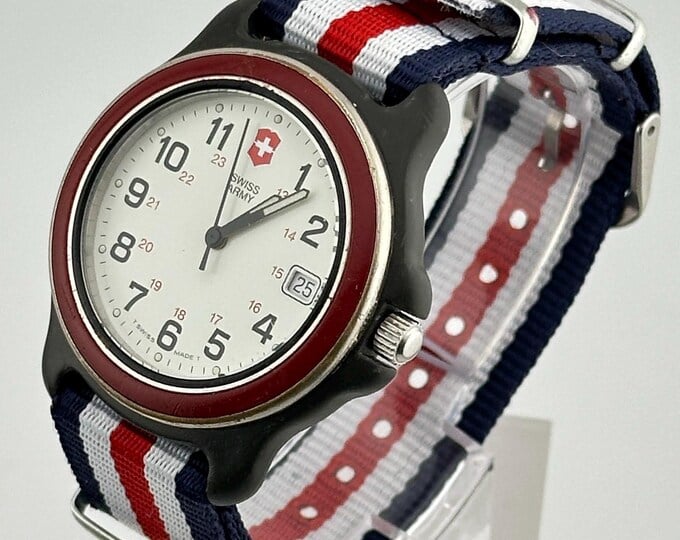
The Cavalry draws from the same visual well as the rest of Victorinox's field-oriented catalogue: legible Arabic numerals, a matte dial that does not throw reflections in daylight, a functional handset, and a small date aperture for the people who need one. Nothing here is decorative for its own sake. There is no guilloché, no applied logo in white gold, no exhibition caseback.
The case is stainless steel with a restrained bezel that keeps the dial the dominant element. The crystal is sapphire, which matters more than most buyers realise at this price — sapphire resists the everyday scratching that turns a mineral crystal into a haze within eighteen months, and it keeps a cheap watch looking new for years. The strap is leather on a pin buckle, a combination that suits the field-watch brief and, crucially, is cheap and easy to swap.
One honest caveat: Victorinox never published the kind of exhaustive specification sheet for this reference that modern collectors have come to expect. Case dimensions, water resistance ratings, and the precise variant map were not consistently documented across markets, which is a genuine frustration for anyone trying to authenticate or service an example today. If you are buying pre-owned, verify against the caseback and any accompanying paperwork rather than relying on forum memory.
The movement: quartz, and why that is the point
The 24531 runs a Swiss-sourced quartz movement. There is no in-house caliber to celebrate, no finishing to admire through a caseback, no escapement to argue about. What there is, is accuracy that costs nothing to maintain.
In practical terms, a Swiss quartz of this generation will hold to roughly fifteen seconds a month. That means you set it twice a year and otherwise forget it exists. There is no positional variation to learn, no five-position timing ritual, no real magnetisation anxiety in normal use. For anyone running a multi-watch rotation, the Cavalry quietly performs one of the most useful functions a watch can: it tells you the actual time, so you know how far off your mechanical pieces have drifted.
This is the point in a review where enthusiasts usually pivot to apologising for quartz. We will not. At this price band, quartz is the correct engineering decision and the alternative — a cheap mechanical movement — would produce a watch that is less accurate, more expensive to service, and less reliable. The trade-off you accept is romance. There is none, and pretending otherwise would be dishonest.
Ownership costs are close to zero. Battery replacement is inexpensive and any competent local watchmaker can do it, though we would advise having the caseback gasket checked and the watch pressure-tested at the same time. The real long-term risk is not the movement — it is parts availability for the case and crystal a decade from now, since Victorinox's support for older references is not as deep as that of the major Swiss groups.
On the wrist
The Cavalry wears the way a field watch should: close, quiet, and out of the way. It does not announce itself and it does not fight a shirt cuff. The case sits flat rather than domed, which is the single most underrated comfort variable in this category and one that plenty of far more expensive watches get wrong.
Balance is the other strength. On the leather strap, the package is light enough that you forget you are wearing it by mid-morning. If you are used to steel sports watches, the Cavalry will feel almost insubstantial — some collectors read that as cheapness, others as liberation. We lean toward the latter for daily wear, though it does mean the watch lacks the wrist presence many younger buyers now expect from a piece they have saved for. This is not a watch that photographs dramatically. It is a watch that disappears into your day, which is a different and arguably more useful quality.
The lume is Super-LumiNova and performs adequately rather than spectacularly — enough to read the time in a dark room, not enough to navigate by at 3am in a tent. Legibility in daylight is excellent, which is the metric that actually matters for a field watch.
What the market says
Here is where the analysis gets uncomfortable for anyone hoping to be told this is a future classic. It is not.
The Cavalry has no meaningful auction history. It does not appear at Phillips, Christie's, or Antiquorum with any regularity, and that absence is informative rather than accidental — auction houses follow demand, and there is none here. On the secondary market, examples trade in a narrow band roughly between $120 and $350 depending on condition, completeness, and strap. That band has been broadly flat for years.
Why? Three reasons. First, production volume: Victorinox made a great many watches and the Cavalry is not rare in any configuration. Second, brand positioning: Victorinox is respected but it is not a status brand, and watch collecting still runs substantially on status. Third, and most importantly, quartz: the collector market has largely, if unfairly, written off quartz pieces from non-luxury brands, which caps their ceiling permanently.
The consequence is that the Cavalry has effectively finished depreciating. It fell from retail to its current band years ago and now sits there. That is bad news if you bought at full retail hoping for upside. It is good news if you are buying today, because the downside risk from here is minimal — you are buying a tool at tool prices.
The competition
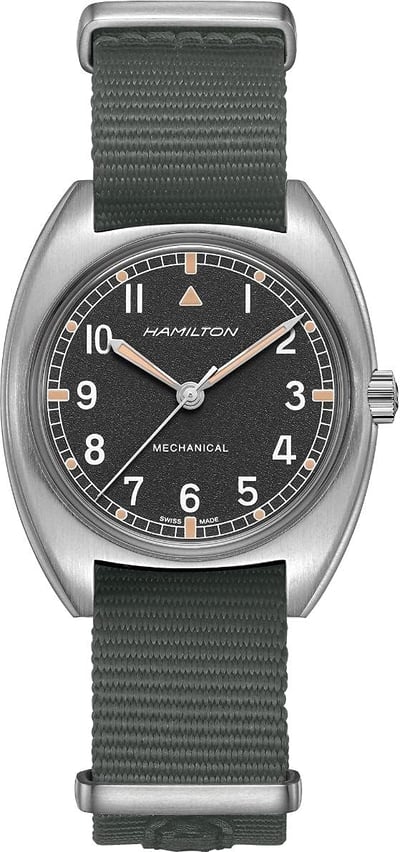
The Hamilton Khaki Field Quartz is the obvious rival and the one most buyers should compare directly. It carries more brand cachet in enthusiast circles, has better documented specifications, and holds resale slightly better. It also costs more, and the gap is not always justified by the product.
The Tissot PR 100 Quartz offers Swiss quartz with a stronger service network and better liquidity, though it lacks the Cavalry's field-watch honesty.
The Seiko 5 Sports SRPG series is the most interesting alternative because it changes the question entirely: for roughly the same money you can buy a mechanical field watch with a display caseback and a real movement story. It is less accurate and more expensive to service, but for a collector building an emotional attachment to a watch, mechanical often wins.
Below the Cavalry, the Timex Expedition Scout and various Casio analogs deliver the same visual grammar for under $60. They are not as well made and they will not last as long, but they make the case that the Cavalry's price is being paid for Swiss assembly and sapphire, not for design originality.
Hold, flip, or forget about it
Our recommendation is straightforward: hold it as a wearer, never as an asset.
There is no financial reason to sell a Cavalry. It has already done its depreciating, it trades flat, and the transaction costs of selling a $200 watch — shipping, fees, time — eat a meaningful percentage of the proceeds. Selling is only rational if the watch is not getting wrist time and the capital is needed elsewhere, and at this price the capital is not the issue.
Equally, there is no scenario in which it appreciates. It has no scarcity, no cultural moment, no discontinuation narrative strong enough to generate a squeeze. Anyone telling you otherwise is selling you something. If the goal is capital preservation, the same money in a used Seiko diver or a Hamilton Khaki Mechanical has a better long-term floor, because those categories have genuine enthusiast demand behind them.
Treat the Cavalry the way you treat a good pair of boots. Buy it, wear it hard, replace the battery, and do not check the resale value, because there isn't one worth checking.
The verdict
The Victorinox Cavalry ref. 24531 is a very good watch and a very bad investment, and the mistake most buyers make is confusing those two things. Judged as a tool — legible, accurate, comfortable, cheap to own, resistant to everyday damage — it beats watches costing three times as much. Judged as an asset, it is a dead end.
That is not a criticism. It is a clarification. There is room in a serious collection for a watch that simply works, and the Cavalry fills that role with unusual competence and honesty. Buy one to wear, and put the money you would have spent on a status piece into something with actual scarcity.