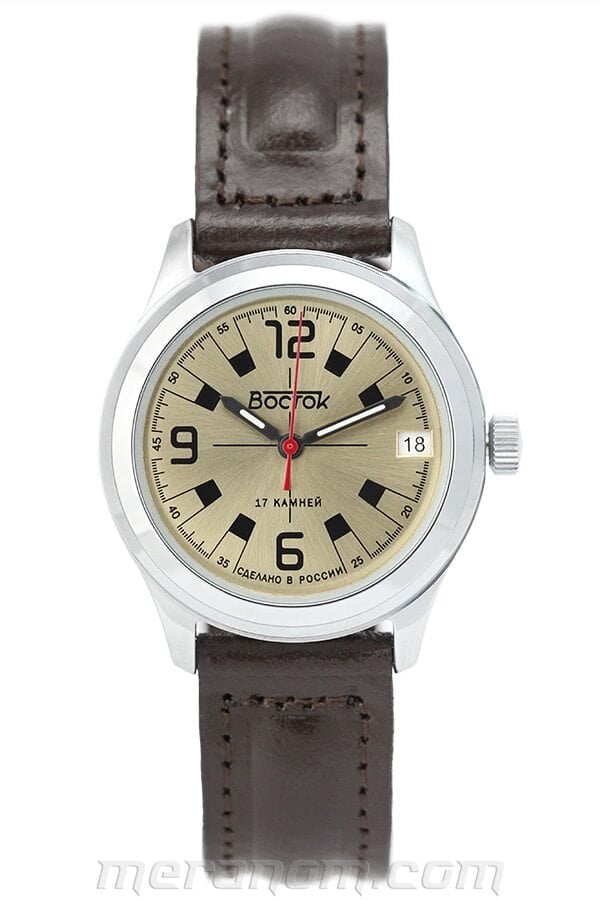
What the Kama Actually Is
The Kama sits in Vostok's current lineup as a stainless steel everyday watch built around the brand's familiar case geometry: a broad, grippy bezel, a slab-sided midcase, a dial that prioritises legibility over decoration and a movement you wind, set and forget. Vostok's catalogue is famously under-documented outside Russia — spec sheets arrive as PDFs that look like they were last edited in 2011, and specialist dealers frequently know more than the manufacturer's own website — so treat any published figure as a starting point rather than a promise. That is not a knock. It is simply what buying from a state-adjacent factory in Tatarstan looks like in practice.
Practically, the ref. 2602 is a watch you buy for the ratio. Vostok's finishing is honest rather than refined: brushed surfaces, a stamped caseback, an acrylic crystal that behaves like a consumable rather than a selling point. Where a Swiss entry-level piece buries cost in marketing and a global service network, Vostok hides nothing. You get a mechanical watch, a low price and eighty years of institutional stubbornness, roughly in that order.
There's also the matter of the crystal. Acrylic is a deliberate choice in 2025, not an oversight. It scratches if you look at it wrong, it also polishes out in ninety seconds with a bit of paste, and it gives the dial a warmth that sapphire simply cannot reproduce. Owners who complain about acrylic are usually the same people who complain that their Land Cruiser doesn't have ventilated seats. Different brief entirely.
Chistopol, 1942: The Factory That Kept Running
The Kama is not an abstract name. Chistopol — a town of roughly sixty thousand people in Tatarstan, a full day's drive east of Moscow — sits directly on the Kama River, which feeds the Volga and has been the region's commercial spine for centuries. When the Second Moscow Watch Factory was evacuated east in 1942 as the Wehrmacht closed on the capital, it was Chistopol that took the machinery. The plant never left.
What followed is one of the more remarkable runs in horology. The factory supplied the Red Army during the war, launched the Komandirskie for officers in 1965, introduced the Amphibia for divers in 1967 and adopted the Vostok name — 'East' — in the 1960s. When the Soviet Union dissolved, Vostok kept producing. When the ruble collapsed, Vostok kept producing. When every other mid-century watchmaker either died or was absorbed into a luxury group, Vostok kept producing, in the same town, with its own movements.
That context matters when you look at the Kama. It is not a heritage reissue or a nostalgia play. It is a current-production watch from a factory that has simply never stopped, and the reference number on the caseback connects to something considerably longer than a marketing deck.
The Movement: 2416B and the Case for Low-Tech
Inside the Kama is Vostok's 2416B, the workhorse automatic that has powered the overwhelming majority of the brand's output for decades. The spec sheet reads like a museum piece: 31 jewels, 19,800 vibrations per hour, a power reserve in the region of thirty-one hours, a date at three, and a rotor that winds in a single direction. There is no hacking seconds. There is no hand-winding — the crown sets the time and the date and nothing more, which means the watch lives or dies on how much you move your wrist.
For a certain kind of enthusiast, those omissions are disqualifying. For another kind, they are the entire point. The 2416B is a movement designed by people who expected it to be repaired rather than replaced, in a country where replacement was not an option. Bridges are stamped, finishing is industrial, and the whole assembly has the visual charm of a tractor engine. It is also remarkably tough, endlessly rebuildable, and supported by a global parts supply that costs almost nothing.
Set expectations correctly and the 2416B delivers exactly what it promises. It is not smooth. It is not quiet. But it is genuinely in-house at a price point where virtually every competitor is fitting a catalog movement from a third party, and there is something quietly satisfying about that transaction.
On the Wrist
Vostok has never been interested in the tall, domed cases that make a watch feel like a hockey puck on the wrist, and the Kama follows house form: a slab-sided case that sits close to the arm, with the bezel doing most of the visual work and framing a dial that reads instantly from across a room. On the rubber strap the whole thing disappears into the wrist. It doesn't shift when you type, it doesn't catch on a shirt cuff, and by the end of a fourteen-hour day you have forgotten it is there — which is the highest compliment you can pay an everyday watch.
The crown is the one thing you will notice. Vostok's crowns are functional to a fault, and the absence of hacking means setting the time is a small ritual rather than an instant. Some owners find that endearing. Others sell the watch within a month. Both reactions are legitimate, and neither has anything to do with whether the Kama is good.
Weight is modest and the balance is neutral — no top-heaviness on the rubber, no desire to spin around the wrist. Straps are where the Kama becomes genuinely versatile: the factory rubber suits it, a single-pass nylon makes it read as a field watch, and a plain leather band turns it into something you can wear to a client meeting without anyone raising an eyebrow. At this price, buying three straps and rotating them is a rational ownership strategy rather than an affectation.
Accuracy: Set the Bar Where It Belongs
Vostok does not chase chronometer certification and the 2416B is not COSC anything. Out of the box, expect something in the region of -10 to +30 seconds a day, with noticeable variation by position — dial up versus crown down will read differently, and the low beat rate makes the seconds hand sweep in visible, almost mechanical steps.
A competent watchmaker can regulate one into a much tighter window for very little money, and most long-term owners do exactly that once. Treat the number on the timing machine as a starting point, not a verdict. This is a watch you set in the morning and check against your phone at lunch, not one you obsess over. If that sentence made you wince, the Kama is not for you, and no amount of value argument will change that.
What it will do is keep running. There is a reason Vostok movements turn up in working condition after a decade in a drawer, and it isn't precision — it's robustness. The Kama is not accurate in the abstract, but it is accurate in the morning-after-a-flight sense, which is the only accuracy most people actually use.
Owning It: Service, Straps and the Value Question
The paradox of the Kama is that it is cheap to buy and slightly awkward to own. Vostok's factory service network is thin outside Russia and Eastern Europe, and for obvious reasons the logistics have become more complicated in recent years. But the movement is simple, well understood, and supported by inexpensive parts, and any independent watchmaker with a bench and a parts catalogue can strip, clean and regulate one. Find that watchmaker before you buy the watch. That single step removes ninety percent of the ownership friction.
On money, be blunt with yourself. Vostok pricing shifts with import routes, exchange rates and dealer margins rather than collector demand, and there is effectively no secondary market premium. Pre-owned examples trade below retail and always will. Vostok has no auction history worth discussing — you will not see a Kama at Phillips, and the brand's most collectible pieces are Soviet-era military references, not current production. Buy the Kama as an expense, not an asset, and it will overdeliver for years.
What It's Up Against
The obvious rival is the Seiko 5 Sports, which offers better case finishing, hacking and hand-winding, and a service network on every high street. The Orient Kamasu — a near-homophone, no less — gives you an in-house automatic with genuinely impressive dial work for a little more money. Citizen's Promaster automatics are more clinical but more rugged in the field.
None of them are from a factory that has been running continuously since 1942, and none of them carry this amount of story for this little cash. That is the whole argument. The Kama loses the spreadsheet comparison and wins the conversation, every time, usually around the second drink.
Verdict
The Vostok Kama ref. 2602 is not trying to win a comparison test, and that is exactly why it wins a certain argument. It is a mechanical watch made by a factory that has survived war, collapse and three decades of quartz with its tooling and its attitude intact, and it asks for less money than a service on most Swiss pieces.
Buy it as a second or third watch. Wear it in the sea, on a run, through an airport. Scratch the acrylic, polish it out, repeat. And stop pretending that every purchase needs to be an investment — some watches are worth owning simply because they exist, and the Kama has been existing, stubbornly, for longer than most of us have been collecting.