Vostok Kirovskie Ref. 550872: The Cheapest Honest Watch in the Hobby
The Kirovskie is the rare watch that forces a collector to separate 'interesting' from 'investable.' Reference 550872 arrives as a hand-wound, conservatively sized throwback to the post-war Soviet dress watch, priced in the same bracket as a decent pair of shoes. That price is the whole story — and depending on what you want from this hobby, it is either the entire point or the entire problem.
For readers who came to watches through resale charts and allocation lists, the Kirovskie is a useful corrective. There is no waitlist. There is no grey-market premium. There is no meaningful secondary market at all: no auction comparables, no dealer spread, no liquidity ladder. What exists instead is an honest mechanical object at a price that makes the word 'collecting' look slightly absurd. That is worth owning at least once, if only to recalibrate your sense of value.
The Name, the Factory, the Lineage
The Kirovskie name belongs to the First Moscow Watch Factory, which was renamed for the Soviet politician Sergey Kirov in the mid-1930s and sold watches under the Kirovskie label. When the German advance threatened Moscow in 1941, a substantial part of that factory's machinery and workforce was moved east to Chistopol on the Kama river. That evacuation is the origin story of the plant that became Vostok — the Chistopol Watch Factory, trading as Vostok from the early 1960s and still building its own movements today.
Vostok has since carried the Kirovskie name forward on retro-styled hand-wound pieces, and that is the form most buyers encounter. This matters for two reasons. First, it means the watch in front of you is not a costume piece cooked up by a marketing department in Geneva — it descends from a factory that has been making its own escapements continuously through war, shortages and decades of state planning. Second, it means reference stamps on Kirovskie-cased watches vary by batch, and buyers should verify the individual piece rather than assume a catalogue entry. Reference 550872 should be treated as a starting point for a conversation with the seller, not a guarantee.
That ambiguity is not a defect unique to this model. It is the defining characteristic of the entire Russian watch category. You are buying provenance and engineering philosophy, not documentation and boxed completeness.
The Movement: Simplicity as a Feature
Inside the Kirovskie sits Vostok's long-serving hand-wound architecture, generally reported as the 2409 family. The published figures are unglamorous: roughly 18,000 vibrations per hour, approximately 38 hours of power reserve, no hacking seconds, and minimal decoration. A modern Swiss calibre at ten times the price will beat every one of those numbers.
But look at what those numbers buy you. An 18,000 vph escapement is a low-wear design running at a lazy pace, built from robust components in a factory that has refined the same basic layout for generations. There is no rotor to wobble, no date mechanism to break, no module stacked on top of the base. Servicing is straightforward for any competent independent watchmaker, and if a movement ever proves terminal, a replacement costs less than a Swiss service estimate. That changes the ownership equation entirely. Most collectors baby their watches because a service bill runs into four figures. Here, you simply wear the thing.
One caveat worth heeding: Kirovskie-cased watches have circulated with more than one calibre over the years, and aftermarket assembly is not unknown. Ask for a clear photograph of the movement, confirm the calibre stamped under the balance, and if the seller cannot supply that image, walk. At this price point the risk is financial small change, but the hassle of discovering a mismatch is not.
On the Wrist
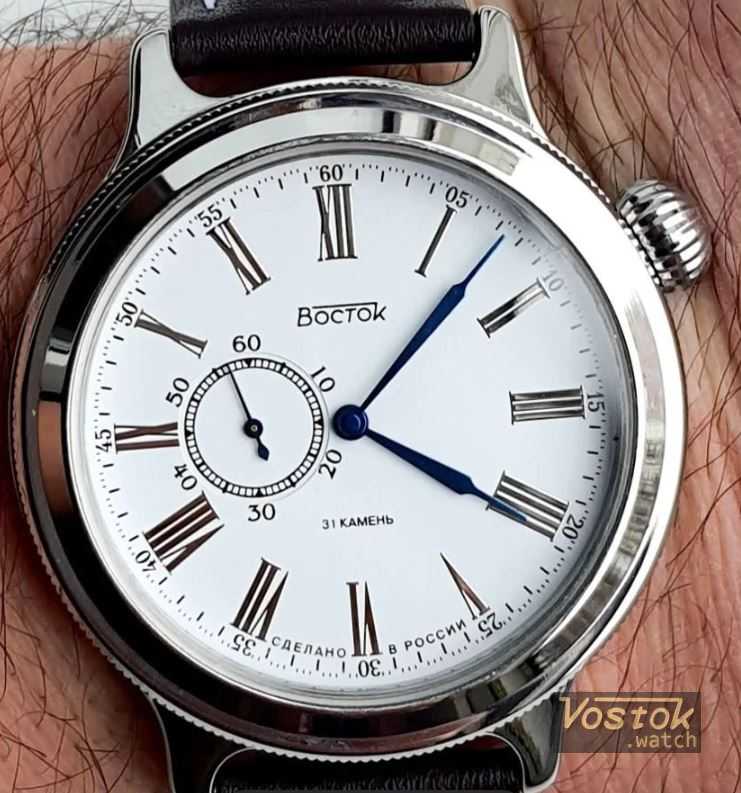
This is a watch that disappears. The case is deliberately modest by modern standards — if you spend most of your time in a chunky sports watch, the Kirovskie will feel like a dress watch from another era, because that is exactly what it is. It slides under a shirt cuff without negotiation and never snags a jacket lining. On a larger wrist it can read as undersized, and the thin strap fitted as standard does it no favours at all.
Balance is the pleasant surprise. Without a rotor, there is no top-heavy wobble, and the whole package sits flat and quiet. Swap the factory strap for a decent slim leather or a fine-mesh aftermarket band and the perceived quality jumps well past the asking price. Treat it as a small, light, unapologetically vintage-feeling object rather than a modern daily driver and it wears beautifully.
Do not, however, mistake it for a utility watch. There is no lume, water resistance is best described as unambitious, and the crystal is the period-correct acrylic type that picks up hairlines if you look at it too hard. This is a fair-weather, dry-hands, office-and-dinner piece. A little care costs nothing; a swimming pool would be an expensive lesson.
Accuracy: Set Your Expectations Before You Set the Time
A healthy 18,000 vph Vostok hand-wound will typically run somewhere in the region of minus twenty to plus forty seconds a day. A well-regulated example can do considerably better; a tired or poorly assembled one will do worse. There is no hacking seconds, so precise setting is a small ritual rather than a button press — hold a little backward pressure on the crown as you set and you can fudge a rough sync.
Positional variation is real and consistent. Leaving the watch dial-up overnight versus crown-down will produce noticeably different rates, which is part of the charm for some owners and an irritant for others. Spend a fortnight logging it and you can effectively regulate the watch by choosing how it rests. If you need sub-ten-second consistency from a mechanical watch, this is the wrong purchase and you already know it.
What It Costs and What It Is Worth
Here is where the market reality bites, and where Vivir readers should pay closest attention. The Kirovskie trades in the low hundreds when available new and typically under one hundred and thirty dollars secondhand. The pre-owned band is wide — roughly forty to one hundred and thirty dollars — because condition, dial variant and seller location drive almost everything. A clean example with a crisp dial and a running movement sits at the top; a scuffed one from an unclear source sits at the bottom.
There is no auction history to speak of, no collector index tracking these watches, and no dealer network making a market in them. That means no liquidity. If you buy at one hundred dollars and later want out, expect a private sale at fifty to seventy and a fair amount of patience. The spread between purchase and exit is, in percentage terms, worse than almost anything else in horology — and in absolute terms, trivial.
That contradiction is the entire investment case. Percentage-wise, this is a terrible asset. Dollar-wise, the downside is a round of drinks. Compare that to a mid-five-figure steel sports watch where a ten percent markdown costs more than a decade of Kirovskie purchases, and the risk profile starts to look almost conservative.
The Buying Checklist
Three things matter more than anything else. First, the movement: ask for a photograph, confirm the calibre, and ask when it was last serviced — 'never, but it runs' is acceptable at this price if it is honest. Second, the dial: redials and reprinted dials exist, and a suspiciously pristine face on a decades-old design deserves scrutiny. Third, the case: polishing softens the mid-century lines that make the watch worth owning, so an unpolished example beats a shiny one every time.
Buy from a seller with a return policy, even at this money. Photographs of the actual watch, not stock images, are non-negotiable. And do not pay a premium for 'rare' — the market is thin enough that rarity has no bid behind it.
Alternatives Worth Considering
If you want a hand-wound dress watch at this money with better finishing, look at the Orient Bambino for in-house automatic engineering, or the Timex Marlin Hand-Wound for a similarly nostalgic reissue with stronger domestic service support. If heritage matters more than price, the Sturmanskie Gagarin delivers genuine space-race provenance at two to three times the outlay. If you simply want maximum mechanical credibility per dollar and don't care about the story, the Seiko 5 line is more robust and more water-resistant, if entirely more boring. And if you cannot stomach the Russian supply chain or the aftermarket ambiguity, the Parnis and Sugess homages scratch the same aesthetic itch without the lineage — which is precisely the trade you are making.
Hold or Sell
Neither, in any conventional sense. This is a wear-it-until-it-stops watch. Hold-versus-sell logic assumes a functioning market with a bid, and there isn't one here. The correct framing is consumption: you are spending a modest sum on an object that will deliver mechanical pleasure, a piece of industrial history and a conversation starter, and will then be worth a fraction of that on the private market. Judge it the way you would judge a good meal or a decent bottle — on whether the experience justified the outlay. It usually does.
The only scenario where buying turns into a mistake is if you convince yourself you are investing. Collectors who buy Kirovskie examples expecting Soviet-era watches to re-rate the way certain Japanese or Swiss vintage references have will wait a very long time for a very small return.
The Verdict
Ref. 550872 is not a portfolio line item and should never be presented as one. It is the cheapest credible entry into hand-wound mechanical watchmaking, built by a genuine manufacturer with a wartime origin story most Swiss brands would pay a fortune to invent. Buy it as a second or third watch, wear it hard, and judge it on how a Tuesday morning feels when you wind it rather than on any resale chart. As a first taste of mechanical ownership it is close to unbeatable value. As an asset, it is a non-starter — and those two facts can both be true.