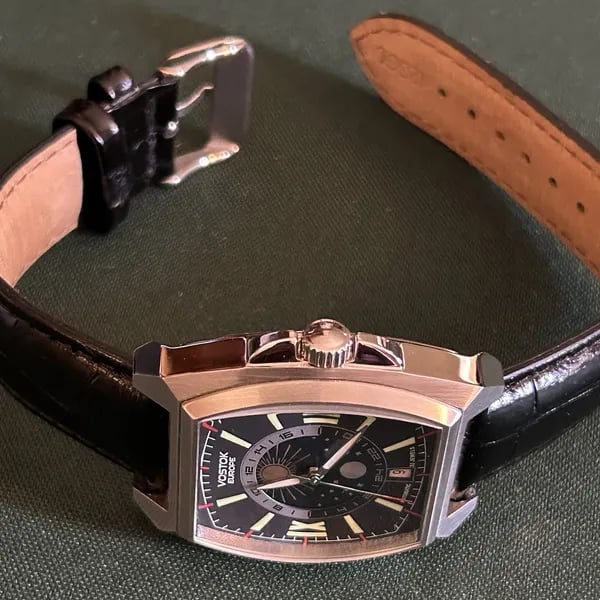
The Vostok Metro 2415.01 / 710ЯА2 is the sort of reference that only makes sense once you have spent time in the shallow end of the collector pool. It is a Chistopol-built, hand-wound, stainless-steel watch in Vostok's cushion-shaped 710 case, fitted with an acrylic crystal and shipped on a leather strap. Nothing about it is expensive. Almost everything about it is interesting.
That gap — between cost and character — is the entire investment case, and it is also the reason to be careful. Vostok does not publish a tidy, variant-by-variant specification sheet the way a Swiss maison does, and Western dealer listings for Russian-market references routinely disagree on the fine print. Treat this review the way you would treat a broker's note on a thinly traded small cap: the thesis is about scarcity, story and exit liquidity, not the headline data.
Here is the market read up front. The Metro is a wearer, not a hold. It earns its place as the hand-wound palate cleanser in a box full of automatics — the watch you take on a trip where losing it would be annoying rather than ruinous. Buy it because you want to wear it. Anyone underwriting this reference as an appreciating asset is underwriting the wrong watch.
Chistopol, 1942: the brand behind the caseback
Vostok's history is one of the more genuinely dramatic in watchmaking, and it explains almost everything about how this watch is built. The Chistopol Watch Factory was established in 1942, when the First Moscow Watch Factory was evacuated east ahead of the German advance and re-established in Tatarstan. The plant that made precision instruments for the front line never really stopped being a plant — it became the Soviet Union's volume watchmaker, and after 1991 it kept making movements in-house while much of the industry outsourced.
That vertical integration matters at this price. Vostok still stamps its own cases, makes its own dials and assembles its own movements in the same town. It is one of the very few houses at any price point that can honestly claim an in-house calibre — a fact trotted out constantly in forum arguments and almost never contextualised. Yes, it is in-house. It is also industrial, mass-produced, and built to a standard of “will run forever if you do not drop it,” not “will impress a watchmaker under a loupe.”
The Amphibia lineage is the other half of the context. Introduced in 1967, the Amphibia's party trick was a case engineered so that water pressure pushes the caseback tighter and the crystal deforms into its seat rather than away from it. The 710 case used here descends from that design language: a wide, cushion-profiled midcase with a domed crystal that looks slightly incongruous on a dress-adjacent watch, which is precisely the charm.
Decoding 2415.01 / 710ЯА2
Vostok's reference system is functional rather than elegant, and once you learn to read it the catalogue opens up. The string breaks into three parts. The first block, 2415.01, is the calibre designation. The second, 710, is the case number — the cushion “Ministry” profile that has been in near-continuous production for decades. The third, ЯА2, is a Cyrillic variant code covering dial, hands and sometimes bezel finish.
What that means practically: the reference does not identify one immutable watch, it identifies a build recipe. Vostok rotates dial codes constantly, and retailers frequently list the same physical watch under slightly different suffixes. If you are hunting one of these, search by case and calibre first and dial appearance second. Do not fall in love with a code — fall in love with a photograph.
It also means the documentation is thin. Where a Swiss reference number unlocks a factory spec sheet, a Vostok suffix often unlocks a forum thread. Expect to confirm details from the caseback, the dial printing and the seller's photographs rather than from any official PDF.
The calibre: a hand-wound workhorse
The 2415.01 is a manual-wind member of Vostok's long-running 24xx family — the same architectural lineage that has powered Komandirskies and Amphibias for generations. It is a conventional, low-beat design running at 19,800 vph, which gives it a slightly lazy, wide-sweeping seconds hand rather than the glide of a modern high-frequency movement. Power reserve runs to roughly a day and a half of autonomy, so the morning wind becomes a ritual rather than an afterthought.
Finishing is industrial. You will not find Geneva stripes, black-polished screws or anglage under a display back — and there is no display back here anyway, which is arguably the honest choice. What you do get is a movement that is simple, robust and cheap to keep alive. Parts are available, the design is well understood, and any competent independent watchmaker can strip and rebuild one without needing a factory parts account.
There is no chronometer certification and no pretence of one. Vostok does not publish a jewel count on the consumer-facing material for every variant, and frankly the number is irrelevant at this price — what matters is that the movement is serviceable, that replacement parts cost less than a restaurant dinner, and that the whole assembly can be swapped if it ever fails catastrophically. That is an unusual kind of security, and worth more than a specification sheet.
Case, crystal, and what the spec sheet does not tell you
Vostok does not publish a single consolidated dimension set for every variant, and dealer listings for Russian-market references are inconsistent enough that quoting a figure would be irresponsible. Measure the actual watch, or ask the seller for calipers in the wrist shot. What can be said with confidence is qualitative: the 710 case is a cushion-profiled design with short, strongly downturned lugs, which means it sits closer to the wrist bone and wears considerably smaller than its nominal footprint suggests.
The case is stainless steel, plainly finished with a brushed top and a light polish on the flanks. The crystal is acrylic, and that is not a cost-cutting failure — it is a design decision with real consequences. Acrylic is soft, so it picks up hairline scratches; it is also cheap, easy to polish with a dab of paste, and, in the Amphibia lineage, part of how the case handles pressure. A sapphire swap is possible and some owners do it, but it changes the character of the watch and is, in my view, the wrong call.
Water resistance figures are marked on the watch itself and vary by variant; confirm the dial and caseback markings on the specific example rather than assuming a number from the family. The watch ships on a leather strap with a pin buckle — an unremarkable strap on an unremarkable buckle, and the first thing most owners change.
On the wrist
This is a light watch, and it wears like one. The 710 case's short lugs mean it tucks in rather than perching on top of the wrist, and the domed acrylic gives it a low, rounded profile that slides under a cuff without complaint. There is no heft to speak of, no caseback edge digging in and no crown bite — the crown sits at four o'clock on this case family and stays clear of the back of the hand. On leather it disappears in the best sense.
The trade-off is presence. This is not a watch that announces itself across a table. The dial is legible, the case is handsome in a slightly retro, toolish way, and the whole thing reads as vintage-influenced everyday watch rather than luxury object. For some collectors that is a feature. For a young collector building a box alongside a Datejust or a Speedmaster, it functions as the low-stakes counterweight — the piece you wear when the nice stuff stays in the safe.
Balance is good, mostly because there is so little mass to balance. The one ergonomic caveat is the strap: the factory leather is stiff and the pin buckle is basic, and the watch only really comes alive on a decent NATO or a soft suede. Budget for that on day one.
Accuracy, honestly
Out of the box, expect a low-beat hand-wound Vostok to run somewhere between -20 and +40 seconds a day, and expect it to be inconsistent about it. That is not a defect; it is the nature of an unregulated, mass-produced, low-frequency movement. Positional variation is real — the watch will gain or lose differently dial-up versus crown-down — and temperature swings move the needle more than they would on a modern chronometer.
The good news is that regulation is cheap and effective. A competent watchmaker can bring a 24xx calibre into a stable ±10 to ±15 seconds a day for very little money, and once there it tends to stay there for years. If you are the kind of collector who checks a timing app weekly, this watch will drive you mad. If you set it once a week and do not think about it, it is entirely fine. The hand-winding ritual also means you are interacting with it daily, which tends to blunt the appeal of micro-accuracy.
Where it fits in a rotation
Daily wear is the obvious answer: it is cheap, it is robust, it is easy to read, and it does not require a second thought. It is a perfectly good casual watch with a t-shirt, and a genuinely good travel watch precisely because the loss would be annoying rather than catastrophic — though note there is no GMT or second time zone here, so travelling with it means doing the arithmetic yourself.
Sport is fine at the level of hiking, swimming and knocking about, subject to whatever water resistance your specific example is marked for. Dress is a stretch but not absurd — on a slim black leather strap the cushion case reads as a mid-century piece and will pass under a blazer, especially with the domed crystal doing its vintage impression. What it is not is a formal watch, and it is not a status signal. Wear it where you would wear a field watch.
Wrist presence: 2.5/5. Charming and legible, but quiet. Nobody will notice it unless they know what they are looking at, and the people who do know will be the right people.
The variant map
Because the reference encodes a build recipe rather than a fixed product, the Metro family spreads wide. The same 710 case has been paired with the hand-wound calibre and, in sibling references, with Vostok's self-winding 2416B — the same architecture with a rotor bolted on. Dial codes rotate through black, blue, gilt and printed variants, and bezel treatments range from plain polished to the Amphibia-style elapsed-time inserts.
The practical implication for a buyer is liberating: there is no “correct” variant to chase, and no rarity premium worth paying for dial codes. Buy the one whose photograph you like, at the price the market says it is worth, and do not get talked into a rare suffix. In Vostok land, rare usually means the seller has one.
Cross-shopping
The obvious rivals are Japanese. Seiko's 5 Sports range occupies the same psychological territory — mechanical, inexpensive, endlessly modified — with noticeably better finishing and vastly easier service access in the West. Orient's Bambino is the dressier alternative if you want a more conventional case. And Hamilton's Khaki Field Mechanical is the step up: roughly three to four times the money, but a genuinely better movement, better case finishing and a real service network.
What none of them have is the Vostok story. There is no other watch at this price where the case geometry descends from a 1967 Soviet dive watch, where the movement was made by the same factory that has been making it since the Cold War, and where the reference number is written in Cyrillic. That is the premium — not materials, not finishing, not accuracy. Story.
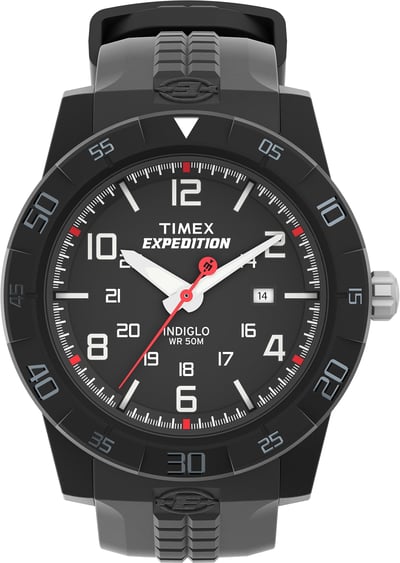
At the very bottom of the market, the usual suspects offer the aesthetic for less: a Seiko SNK-series or a Timex Expedition Scout scratches a similar itch, and a basic Komandirskie gets you the same factory and the same hand-wound philosophy for even less money. None of them are homages in any strict sense, but they are where a budget buyer ends up if the Metro is out of reach.
The money question
Let us be blunt about resale. Vostok is a depreciating asset with a thin secondary market. New examples sell in the low hundreds of dollars depending on variant and channel; used examples trade for less, and the spread between what you pay and what you can get back is wide in percentage terms even if it is trivial in absolute terms. There is no auction history of note — no major-house lot, no Geneva result, no bidding war.
Liquidity is the real constraint. Selling a Vostok means selling to an enthusiast, on a forum or a marketplace, and waiting. That is fine if you are moving a cheap watch. It is a reminder that this is not a piece you build a position in.
There is one market dynamic worth flagging. Since 2022, payment rails and logistics between Russia and Western buyers have become awkward, which has thinned the flow of new stock into Europe and North America and firmed prices on clean used examples. That is a supply story, not a demand story, and it is unlikely to turn a three-figure watch into an appreciating asset. But it does mean the days of picking these up for pocket change are largely over, and condition now matters more than it used to.
Hold-versus-sell: hold if you wear it, sell if you do not. There is no scenario in which sitting on a Vostok Metro is the right capital allocation, and there is no scenario in which selling one is a meaningful financial decision. It is a wearer. Treat the resale value as zero and you will never be disappointed.
Servicing and running costs
This is where the Vostok quietly wins. There is no authorised service centre network to speak of in most Western markets, which sounds like a problem and mostly is not — any competent independent watchmaker can service a 24xx calibre, and the parts are inexpensive and available through specialist suppliers. You are not hostage to a factory service price list.
The practical advice is to service on condition rather than on a calendar. If it is running consistently and winding smoothly, leave it alone. If it starts losing time dramatically, feeling gritty on the wind or stopping overnight, take it in. The economics are simple: a full service on this movement typically costs a meaningful fraction of the watch's value, which means that at some point the rational move is a movement swap rather than a rebuild. That is not a criticism — it is the same logic that governs any entry-level mechanical watch, and it is honest.
Pros and cons
Pros. A genuine in-house movement from a factory that has been making it for decades. Distinctive case architecture with real engineering history behind it. Hand-wound operation that gives you a daily ritual for the price of a dinner. Absurdly low cost of ownership, easy servicing and cheap parts. And a design that photographs better than its price tag has any right to.
Cons. Accuracy is mediocre and inconsistent. The acrylic crystal scratches and you will be polishing it. There is no meaningful low-light hardware, so this is a daylight watch. The factory strap and buckle are throwaways. Documentation is thin, variant codes are confusing and dealer listings disagree. And there is essentially no resale market to speak of.
Verdict
The Vostok Metro 2415.01 / 710ЯА2 is not a watch you buy with a spreadsheet. It is a watch you buy because the idea of a hand-wound, in-house, Soviet-descended cushion case for the price of a decent pair of shoes appeals to you — and because the pleasure of wearing something with genuine history at zero financial risk is a rare thing in this hobby.
Buy it used, in good condition, on a strap you like, and budget for a regulation. Wear it hard. Do not insure it, do not flip it, and do not let anyone tell you it is an investment. It is better than that: it is a watch.