Manufacture History
Kari Voutilainen founded his workshop in Môtiers, Switzerland, in 2002. His path to independence ran through formal watchmaking training in Finland and years of restoration work, experiences that shaped a deeply traditional approach to finishing and movement construction. The atelier is small even by independent standards, and its output reflects that scale: carefully made watches, often in limited numbers, with a strong emphasis on hand work.
Voutilainen is not a brand that chases trends. The watches tend to be classical in form, with guilloché dials, elegant cases, and movements that are meant to be viewed through the back. The 28-series is central to that identity. It is a family of manually wound watches with a restrained aesthetic and a level of finishing that places them among the upper reaches of contemporary independent watchmaking.
The 28SD10 sits within this context as a rare variant. It is not the model most often encountered in dealer windows, and that is part of its character. It represents the atelier's core values without compromise: a hand-finished movement, a classical dial, and a case designed to disappear under a cuff rather than dominate a room.
Movement and Finishing
The 28SD10 is powered by an in-house, manually wound Voutilainen caliber from the 28-series. The movement is the heart of the watch and the reason many collectors will seek it out. It uses a classical architecture with exposed ratchet and crown wheels, bridges that are shaped rather than merely machined, and a level of hand finishing that is increasingly difficult to find in modern watchmaking.
Look closely at the movement and you see the hallmarks of traditional finishing. Bridges are chamfered and polished by hand, with the kind of soft, consistent bevel that only comes from patient work. Steel components are black-polished, creating a dark, mirror-like contrast against the warmer tones of the movement. Surfaces show straight-grain and frosting, and the screw heads are polished and aligned with care. None of this is decorative excess. It is the visible evidence of a philosophy that treats the movement as the primary object of beauty.
The movement runs at 18,000 vph, a frequency that suits the classical character of the watch. The power reserve for this exact reference is not publicly specified, but the manually wound format means the owner participates in the ritual of winding. That interaction is part of the appeal. A watch like this is not meant to be forgotten on a winder; it is meant to be handled, wound, and observed.
The 28SD10 is not COSC certified, and that is not a criticism. Voutilainen regulates and finishes to independent high-horology standards, and the emphasis is on craftsmanship rather than certification. The small seconds display keeps the dial balanced and gives the movement a visible sign of life. It is a time-only expression in the best sense: no date, no unnecessary complication, just the hours, minutes, and seconds presented with clarity.
Case, Dial, and Strap
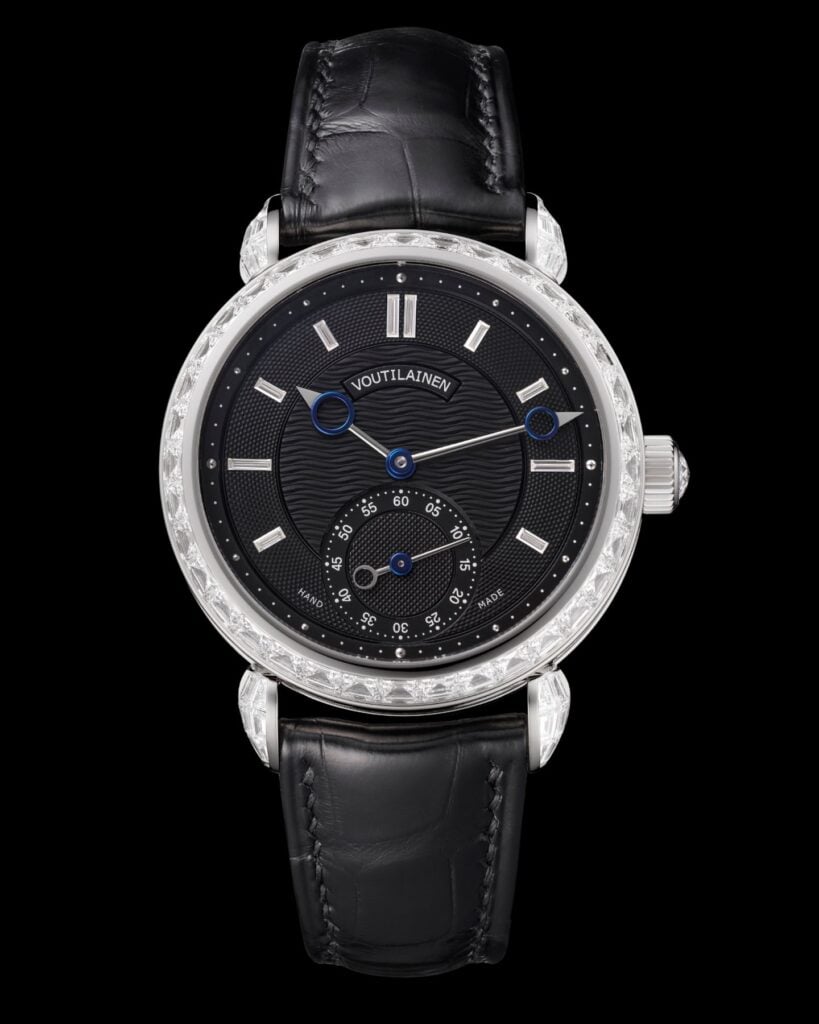
The case is platinum, a material that gives the watch a dense, cool presence on the wrist. Platinum is not chosen for flash. It is a quiet metal, and in Voutilainen's hands it is finished with restraint. The crystal is sapphire, and the watch has no lume, which is entirely appropriate for a dress watch of this kind. The strap is leather, and the clasp is a pin buckle, both choices that keep the watch classical and comfortable.
The dial is where the 28SD10's restraint becomes most apparent. It is a hand-guilloché silver dial, and the pattern is executed with the kind of precision that rewards a loupe but does not shout for attention across a table. The small seconds display is integrated into the design rather than added as an afterthought. The hands and markers are fine and legible, and the overall impression is one of balance.
Voutilainen's dials are often celebrated for their subtlety, and this one fits that reputation. It is not a maximalist dial. There is no unnecessary text, no aggressive color, and no attempt to turn the face into a billboard. Instead, the dial relies on proportion, finishing, and the way light moves across the guilloché surface. It is a face that changes with the angle of the wrist, but always within the bounds of good taste.
On the Wrist
The 28SD10 wears like a proper dress watch: close to the wrist, balanced, and unobtrusive under a cuff. Platinum gives the case a dense, reassuring weight, but the shape and lug geometry keep it from feeling clumsy. The supple leather strap and pin buckle complete the classical picture, and the watch sits comfortably for long periods without demanding attention.
What stands out is the sense of proportion. The dial is legible without being sparse, and the small seconds display gives the eye a natural point of rest. It is not a watch that feels fragile, but it is clearly a watch to be worn with care. The experience is less about wrist presence and more about the private pleasure of knowing what is happening inside the case.
This is not a watch that will appeal to someone looking for a statement piece. It is a watch for the collector who enjoys the feel of a well-made object, the slight weight of platinum, the softness of a good leather strap, and the knowledge that the movement beneath the dial is finished to a standard that few watches can match. It wears best with a shirt cuff, but it is not so delicate that it cannot be worn regularly with care.
Accuracy and Daily Use
The 28SD10 is hand-regulated and built to independent high-horology standards, though it is not COSC certified. Real-world accuracy should be excellent for a watch of this type, with stable rates and the kind of consistency that comes from careful adjustment. Owners should expect a mechanical watch that keeps time very well, but they should not treat it as a chronometer-certified tool. It is a precision object, not a timing instrument for sport.
Daily use requires a certain mindset. The watch has no lume, no date, and no published water resistance rating, so it is not the piece you wear for a swim or a hike. It is a dress watch in the traditional sense, and it is happiest under a cuff or on a desk. The manual-wind movement means a daily winding ritual, which some owners will find charming and others will find inconvenient. For the right collector, that ritual is part of the value.
The small seconds display is easy to read, and the dial is legible in most lighting conditions. The platinum case will show scratches over time, as all precious metals do, but platinum wears differently from gold: it develops a patina rather than losing material quickly. A watch like this is meant to be worn and enjoyed, not kept in a safe.
Occasions and Presence
The 28SD10 is at its best with formal and dress attire. It suits a suit, a jacket, and a quiet evening. It can be worn daily if the owner is careful, but it is not a sports watch and should not be treated as one. Its presence on the wrist is discreet. In a room full of modern luxury watches, it will not be the loudest object, but it may well be the most interesting one to the person who knows what they are looking at.
On a five-point scale, I would place wrist presence at 3/5. It is not invisible, but it does not seek attention. The platinum case has a cool gleam, and the guilloché dial catches light in a subtle way. The watch communicates quality through finishing and proportion rather than size or color. That is exactly the point.
Reference Variants and Family Context
The 28SD10 is a rare variant within the 28-series. The core sibling is the 28S, which shares the small-seconds format and the classical approach but is more commonly encountered. The 28E is another family reference, and the Vingt-8 is the best-known Voutilainen model for many collectors. These watches share a commitment to hand finishing and in-house movement design, but they differ in details of dial, case, and complication.
Within the brand, other notable models include the Vingt-8, the Observatoire, and the GMT-6. Each represents a different facet of Voutilainen's work, from classical time-only watches to more complicated pieces. The 28SD10 sits at the restrained end of that spectrum. It is not the most complicated watch the atelier makes, but it is one of the purest expressions of its values.
Comparisons and Alternatives
The obvious comparison is Philippe Dufour's Simplicity, the benchmark for hand-finished, time-only independent watchmaking. Both watches are about movement finishing, classical proportions, and the refusal to add unnecessary complications. The Dufour is more famous and more expensive, but the Voutilainen occupies the same philosophical territory. It is a watch for someone who values the inside of the case as much as the dial.
Another natural comparator is F.P. Journe's Chronomètre Souverain, which offers an in-house manual-wind movement and a strong independent identity. Roger Smith's Series 1 is also relevant: a hand-made, small-seconds watch in the same craftsmanship-first tradition. These are not alternatives in the sense of being cheaper substitutes. They are peers in a small field of independent watchmaking where hand work and design integrity matter more than marketing scale.
For readers looking for a more accessible entry into the aesthetic, there are affordable alternatives. The Orient Bambino Small Seconds captures the classical small-seconds dress-watch formula at a fraction of the price. The Seiko Presage Craftsmanship Series offers Japanese dial craft and a classical case. The Nomos Tangente 38 provides a minimalist in-house manual-wind design with a similar intellectual appeal. None of these watches is a Voutilainen, but they can satisfy the desire for a restrained dress watch while the real thing remains out of reach.
Investment and Ownership
Voutilainen does not publish a fixed retail price for every piece, and the 28SD10 is best described as price on request. The pre-owned market for such watches is thin and relationship-driven. This is not a watch with a deep auction record or a liquid secondary market. It is a collector's object, and its value is tied to the reputation of the atelier and the rarity of the reference.
The trend for Voutilainen watches has been stable to strong over the long term, but that is not a reason to buy. The 28SD10 should be acquired because the owner wants a hand-finished independent watch of the highest quality, not because it is expected to appreciate quickly. The hold recommendation is straightforward: buy for the craftsmanship and keep it for the long term. It is not a trading instrument.
There is no major auction history for this exact reference. That is not surprising for a rare independent watch. If a piece comes to market, it will likely be sold privately or through a specialist dealer. The lack of public auction data means buyers should rely on the reputation of the source and the condition of the watch rather than on a price chart.
Service and Long-Term Care
Service and restoration are handled directly by Voutilainen in Môtiers. The atelier recommends that the watch be serviced by its own watchmakers, and independent watchmakers should not be entrusted with the movement. The service interval and approximate cost for this exact reference are not publicly specified, so owners should contact the atelier directly for guidance. Long-term care is part of the ownership experience with a small independent brand, and it is worth factoring into the decision.
The watch should be kept away from water, shocks, and magnetic fields. The platinum case will develop a patina over time, which many owners consider part of its character. The leather strap will need replacement periodically. The sapphire crystal is resistant to scratches, but the case and dial should be treated with care. This is not a watch that demands special treatment, but it rewards thoughtful ownership.
Pros and Cons
The strengths of the 28SD10 are clear. The hand finishing is exceptional, the in-house manual-wind movement is architecturally beautiful, and the design is discreet and classical. It is rare, it is made by a respected independent, and it offers a level of craftsmanship that is increasingly difficult to find. These are the reasons to buy it.
The weaknesses are equally clear. Availability is very limited, the price is likely substantial, and the watch lacks the practical features many modern buyers expect, such as lume and a published water resistance rating. Service requires a return to the atelier, which can mean time and expense. These are not flaws in the watch so much as realities of the category.
Final Verdict
The Voutilainen 28SD10 is not a watch for every collection, but it is a complete statement of independent horology. Its movement is the main event, and the case and dial serve it with restraint. For the collector who values hand finishing over flash, it is close to essential.
It is a watch to be worn, wound, and studied. It will not appeal to someone who wants a single do-everything watch, but it will reward the owner who understands why a hand-finished bridge or a black-polished steel component matters. In a market full of loud objects, the 28SD10 is a quiet reminder of what watchmaking can be at its best.